What do you think about your large intestine? If your answer is “not much,” then you probably have pretty healthy digestion. If you have a strong opinion, it’s likely because you are in health care and know about anatomy and physiology, you are a big one for gut health, or–the least fun option–you have issues with the tail end of your digestive process.
How ever you answered, it’s still worth considering this important organ from both the Western and the Eastern perspectives. As with all of my comparison blog posts, I will start with the biomedical story before moving along to the Chinese medicine narrative. As always, I will also state that (a) I think that Chinese medicine has a more comprehensive and interesting tale to tell and (b) when I’m speaking about the organ, it’s “large intestine” and when I’m speaking about the umbrella category that includes channel, organ, and associated entities, it’s “Large Intestine.”
*****
*****
~~Your Western Intestine~~
Did you know that you have beneficial gut bacteria in your large intestine that help to make up your vitamin K and some of the B vitamins? A healthy large intestine moves things along and is tasked with releasing waste as its end product, but it’s still a pretty cool organ nonetheless. And as you may know already, your microbiome (all those lovely bacteria, viruses, and fungi living in your gut) resides mostly in the large intestine.
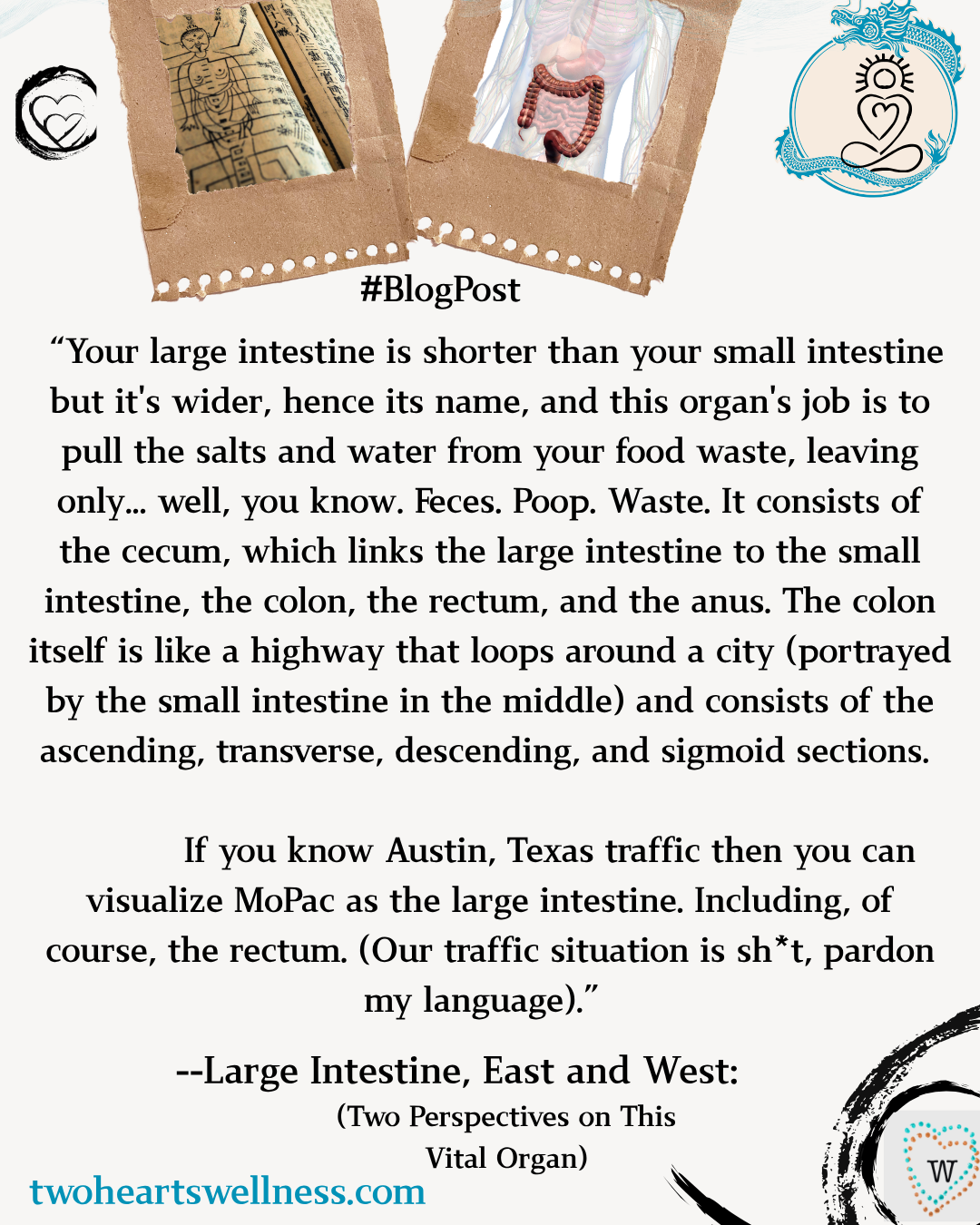
Your large intestine is shorter than your small intestine but it’s wider, hence its name, and this organ’s job is to pull the salts and water from your food waste, leaving only… well, you know. Feces. Poop. Waste. It consists of the cecum, which links the large intestine to the small intestine, the colon, the rectum, and the anus. The colon itself is like a highway that loops around a city (portrayed by the small intestine in the middle) and consists of the ascending, transverse, descending, and sigmoid sections.
If you know Austin, Texas traffic then you can visualize MoPac as the large intestine. Including, of course, the rectum. (Our traffic situation is sh*t, pardon my language).
Anyhow… back to business. The large intestine is about six feet long and three inches in diameter and when it’s working well, you may not think much about it at all. When it’s not, you end up with constipation or diarrhea, pelvic floor dysfunction, IBS, to name a few common ailments (I’ll avoid listing the even more unpleasant ones, from fistulas to cancer and so forth). Bowel problems can be devastating when they’re severe or long-lasting, so knowing about your large intestine and how to care for it is a good idea.
~~Your Chinese intestine~~
As per usual, I’m going to start by saying that the Chinese medicine large intestine is more interesting than the biomedical version. For one thing, our organs have pairs, and the Large Intestine (LI) is pair with the Lung (LU) in our narrative. This is evocative, if you ponder it, because we take in oxygen and release carbon dioxide on one end (LU) and take in the leftovers from the small intestine (SI) and release what is no longer needed (feces) on the other end. Both processes are mirror images of one another on many levels (though one is a little nicer and tidier than the other), don’t you agree?
Our LI has a job and a name, according the Nei Jing, or Yellow Emperor’s Internal Classic (this is the bible of Chinese medicine and it’s over 2000 years old). According to this venerable text, the LI is “The Official of Transmission and Transformation,” so even though the LI is a lower-level functionary, they’re still quite important with their title and their work. This organ is associated with the fall season and the element of metal, along with their pair, the Lung.
“Your lungs are your first interface between what’s inside you and what’s outside in the world around you. Without them, your blood wouldn’t have any oxygen to carry to your body as a whole. When they’re healthy, it’s easy to forget about them and–as the saying goes–just breathe. When they’re not, it’s a wake-up call to take care of this delicate and crucial organ.
–Your Lungs, East and West (Two Perspectives on This Vital Organ)
What are you going to do for your lungs today?”
The metal element is one of five (wood, fire, earth, metal, and water), and they interact with one another, ideally in a harmonious fashion. Each element represents something, and in the case of metal, the something in question consists of harvesting, collecting, letting go, and setting boundaries. If you think about the Lung and the Large Intestine’s functions, this makes sense, doesn’t it? Both organs when doing their jobs reflect a cycle of ingesting and releasing, and on either side, holding and clutching and clinging brings nothing but trouble, as does the opposite. For optimal wellbeing, there needs to be a measured intake and output, if you ponder it.
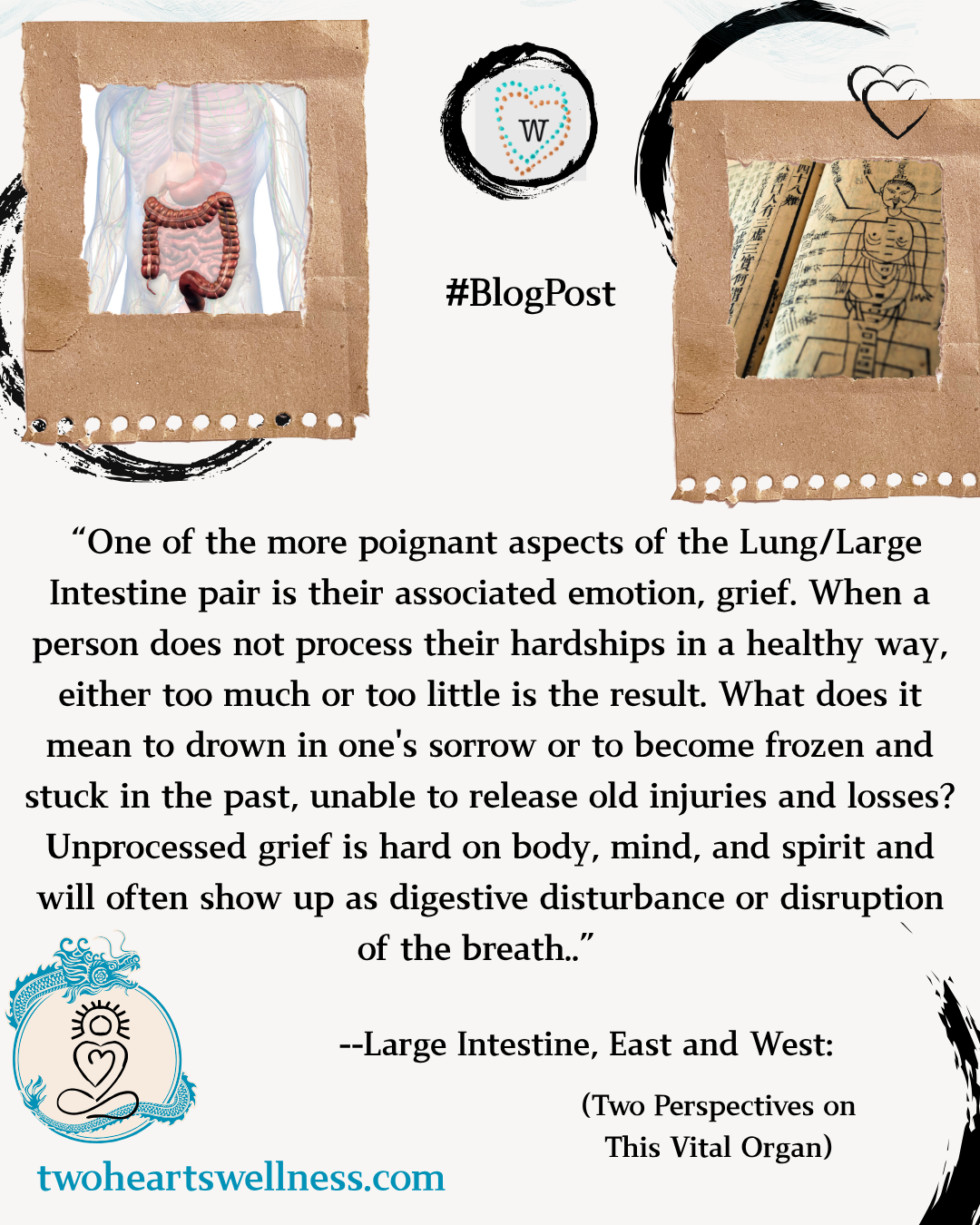
One of the more poignant aspects of the Lung/Large Intestine pair is their associated emotion, grief. When a person does not process their hardships in a healthy way, either too much or too little is the result. What does it mean to drown in one’s sorrow or to become frozen and stuck in the past, unable to release old injuries and losses? Unprocessed grief is hard on body, mind, and spirit and will often show up as digestive disturbance or disruption of the breath.
*****
*****
~~Chinese medicine’s way of supporting LI health~~
Have you ever been to an acupuncturist in the hopes of resolving digestive difficulty? If so, you already know what might happen. Your practitioner will, of course, ask you about your poop. Do not be embarrassed by this. We ask everyone about their poop and it’s just part of the info-gathering process. We’ll also look at your tongue for clues, and take your pulse at your wrists.
“Before I get to the Chinese medical attitude towards poop, though, let me ask you to think about your poop. How is it? How many times a day do you go? What does it look like? Do you feel happy and comfortable afterward, or do you feel like there’s more in there and you need to take a detour back to your bathroom and try again shortly after the first one? Do you suffer from gas or bloating? Does your stomach hurt during the day? Is there anything you eat that makes things worse? Anything that makes things feel better? If you try, can you teach yourself to view poop as though it were the tea leaves and you were telling your fortune each time you looked into the porcelain bowl?”
—How’s Your Digestion? Two Hearts Wellness Gives You The Straight Poop on … Well, You Know
We will probably get you right on the table and start placing needles (no, they do not hurt, and yes, they are single-use and sanitary) according to your presentation. We may, depending on our practices, give you an abdominal tui na treatment (pronounced “twee nah,” this is Chinese manual therapy and it’s heavenly1). We will, depending on your presentation, prescribe herbal formulas that have stood the test of time, like the Song dynasty-era formula Si Jun Zi Tang (“Four gentlemen formula”) or other similar. Many acupuncturists are expert in Chinese medicine’s nutritional precepts and we might discuss these with you as well. It all depends.
We are not psychotherapists (well, most are not) but your acupuncturist might help to soften the effects of grief by treating the Lung or Large Intestine categories. I have found, in my own practice both as an acupuncturist and as a health coach, that people whose digestion is injured by unprocessed grief know exactly what I’m referring to when I mention these organs and their connections with letting go and setting boundaries. By linking daily habits and emotional healing with digestive health or breathwork, both patients and health coaching clients find that one speaks to the other. When their voices act in harmony it is certainly possible to achieve a level of meaningful wellbeing that includes lasting resolution of grief or unhealthy holding patterns.
“When we become comfortable with the idea that grief is part of being alive, it can then be easier to step back and tend to our bodies which, in turn, nurtures the process of grief and the processing of it. Chinese medicine is pragmatic about this issue. When someone is grieving, we see this in connection with the Lung. They are the “most delicate organ,” as I was taught in my program, and excess grief damages them. If grief is overwhelming, we heal through the Lung.
—Grief and Mourning (Some Thoughts)
If you ponder it, this is not fanciful. When we are sad, we might breathe more shallowly. Gasping while choking out sobs involves the lungs (I capitalize Lung, singular, when referring to Chinese medicine’s umbrella category; for the actual organ, it’s lungs). Both activities are not beneficial to the nervous system and the body’s oxygen. Unresolved grief leads to cortisol disruption and inflammation, and this can also be unhealthy for the Lung organ.”
This, to me, is one of the beauties of Chinese medicine. Yes, we can approach any organ or system from its functional perspective and treat the weak digestion or the asthma or the histamine overload as such, full stop. And that’s a fine treatment and a worthy goal. But we can also branch out, and start drawing in the interconnected threads of spirit and environment and, yes, job duties, humble though they might be. It doesn’t have to be just your large intestine; we can also address this organ’s metaphoric and spiritual value as well.
Are you thinking about your large intestine now? And if so, what are you thinking? And what do you want to do in order to nurture it (and the Lung organ), especially during autumn or during times of holding onto to what, maybe, it is time to relinquish?
Questions, questions. But do not despair, because Chinese medicine might just have some good answers for you.
*****
*****

Dr. Paula Bruno, Ph.D., L.Ac., is a licensed acupuncturist and herbalist, an AOBTA-CP traditional Chinese bodywork therapist, a health coach, and an author. She maintains an active and growing practice at her Austin, TX office. Dr. Bruno is also available for distance appointments for wellness consultation or coaching.
In her first career, she was a Spanish professor.
Dr. Bruno’s specialties as a Chinese medicine practitioner include: • Musculoskeletal health (acute or chronic pain relief; Ehlers Danlos syndrome & hypermobility support) • Digestive support, gut health, and weight loss • Aesthetic treatment, including scar revision • Men’s health • General preventive care and wellness support for all persons.
She is the author of Chinese Medicine and the Management of Hypermobile Ehlers Danlos Syndrome: A Practitioner’s Guide. Dr. Bruno also maintains a second website, holistichealthandheds.com, with resources and information curated specifically for people with hEDS and HSD.
When you are ready to discover what traditional medicine plus a vibrant and engaged approach to holistic health can do for you, either contact Dr. Bruno or book an appointment online.
*****
*****
Two Hearts Wellness does not accept paid advertising on this website & only uses strictly necessary cookies. All our copy is generated by human effort (there is no AI slop here!)
Note: Material on this web site site is not intended to diagnose, prevent, treat, or cure any disease, illness, or ailment. A Chinese medicine practitioner in Texas identifies syndrome patterns but does not diagnose illness. Material on this web site does not purport to identify syndrome patterns.
*****
- If you’ve never experienced the wonder of tui na, you are missing out on one of life’s greatest treasure. See “Push and Grasp: The Magic of Tui Na (Chinese Medical Massage)” for more information. ↩︎

