Tui na (pronounced “twee nah”) means “push” and “grasp” and it’s one of those very literal Chinese terms that seems simple but encompasses an entire universe. I love the bare-bones simplicity of this term. Pushing and grasping sounds like something you do when you’re kneading raw material for dumplings, doesn’t it? Chinese language has many, many terms that are fancy or poetic (Di Long, or “earth dragon” for earthworm, for instance), but the act of using one’s hands to–yes–push and grasp in order to move qi and nurture health is straightforward and plain.
Beautiful, don’t you think?
*****
*****
It’s not the same as acupuncture or other modalities of Chinese medicine. With acupuncture, your practitioner inserts needles (push); when you get cupping, this involved pulling. Gua sha pushes. Qigong and tai chi rely on inner movement. Only with tui na do you get both the pulling and the pushing from an external agent (the practitioner).
It seems unreal, but I shared my first blog post on the subject, “What is Tui Na?” in 2015. Yowzers, time flies! I reread the essay before writing this one and am confident that it stood the test of time. It was a good post then and it’s good now. (See below graphic with link to this post).
And yet…there is always something new to say. I’ve learned a lot in the twelve years that I’ve been practicing tui na. I will learn a lot more over the next decade. But what, you might be wondering, does any of this have to do with you, a potential patient?
*****
*****
It’s not a massage, per se
You probably have experienced one or more of the common massage styles. Swedish style is for relaxation and is usually what you get at a spa or for a treat. Deep tissue is more commonly used to release tight muscles (as is myofascial release). Sports massage is for injuries and to recover from strenuous exercise. A chair massage is great for neck and shoulders and even better when one doesn’t have time to get on a table for a full-body treatment.
None of the above relate much to a tui na treatment. We can provide any of the above (relaxation, loosening tight tissues, injury recovery, and/or spot treatment) at your appointment but there is a different approach, a vastly different philosophy of practice, and a wide range of techniques, pressure levels, and locations on the body where we might work that differs from a Western massage.
CCM and TCM
There is a reason I say that I practice Chinese medicine (CM). In my earlier blog posts, I’d refer to it as traditional Chinese medicine (TCM), which is a shorthand that people who don’t know the history of CM usually recognize. But there is another manifestation of this healing practice, and that would be Classical Chinese medicine (CCM). They are not the same.
TCM is a standardized system of Chinese medicine developed in the 1950s. It’s an integrative medicine that combines Western biomedical knowledge and Chinese medical wisdom and approaches. Your TCM practitioner will use specific point prescriptions and probably avoid talking to you about shifting your lifestyle practices from the perspective of Daoist philosophy. CCM, on the other hand, is the ancient and original Chinese medicine. A practitioner will look to thousands of years old texts like the Huang Di Nei Jing (Yellow Emperor’s Internal Classic) and the Shang Han Lun (a venerable resource for herbal knowledge) for guidance. Daoist philosophy also plays a role in how your practitioner will assess and treat you.
In my practice, I rely on both schools of thought and to me, that’s Chinese medicine, or CM: the mixture of ancient and contemporary and pragmatic yet deeply philosophical. As you can see from the following link to a blog post on abdominal tui na, there is a difference between a treatment centered on the midsection vs. chi nei tsang, which is abdominal treatment with a CCM philosophy. The actual treatment itself isn’t necessarily all that different between the one and the other, but the intention is certainly not the same.
*****

*****
Both the CCM and the TCM approaches to tui na treatment are excellent. You do not need to get philosophical in order to experience the benefits of tui na. And yet, I find that as I become a more seasoned practitioner, my own perspective on the role of CCM has changed. It is very clear to me now that some patients have a spiritual injury that is more damaging than the ache or pain that inspired them to set an appointment. Bringing my focus to a level that surpasses the tangible increases the benefit for the patient. Not always, and if so, it’s with the consent and understanding of the patient. But either way, the tangible body has multiple layers of meaning and experience. When I move qi or dredge channels or pacify the Liver (for example) I am always relying on a combination of the two philosophies of Chinese medicine.
What about style?
One of my dearest memories of being a new practitioner goes back to a visit with a senior practitioner, an American who had gone to China to study tui na. We had met up for lunch and he wasn’t feeling too good, so he asked me to give him a short treatment for his neck and shoulder pain. I was quite nervous! Here this guy had been practicing a long, long time AND he had gone to the mothership–China–to learn.
Within a minute he said to me, “Your teacher is from Beijing.” This was not a question. It was a statement. I asked him how he knew this and he replied, “Your technique. Anyone getting a treatment from you who knows the different regional styles will know that your teacher is from the North.” I was so happy! Especially when I was very junior, my primary goal in life was to be just like my teacher, Dr. Fan, so hearing this was validating.
Of course, now, time has gone by and I have adjusted my style and added to it. It took me a while, but the more subtle options like One-Finger Zen (Yi Zhi Chan) are now part of my repertoire in a way that they were not when I first started. I’m also much, much better at the rolling technique (gun fa) than I was at the start of my practice. My teacher made it look so easy but no, it’s not, and yes, I have practiced and practiced and practiced. Practice does make perfect, you know.
*****
*****
Who benefits from tui na?
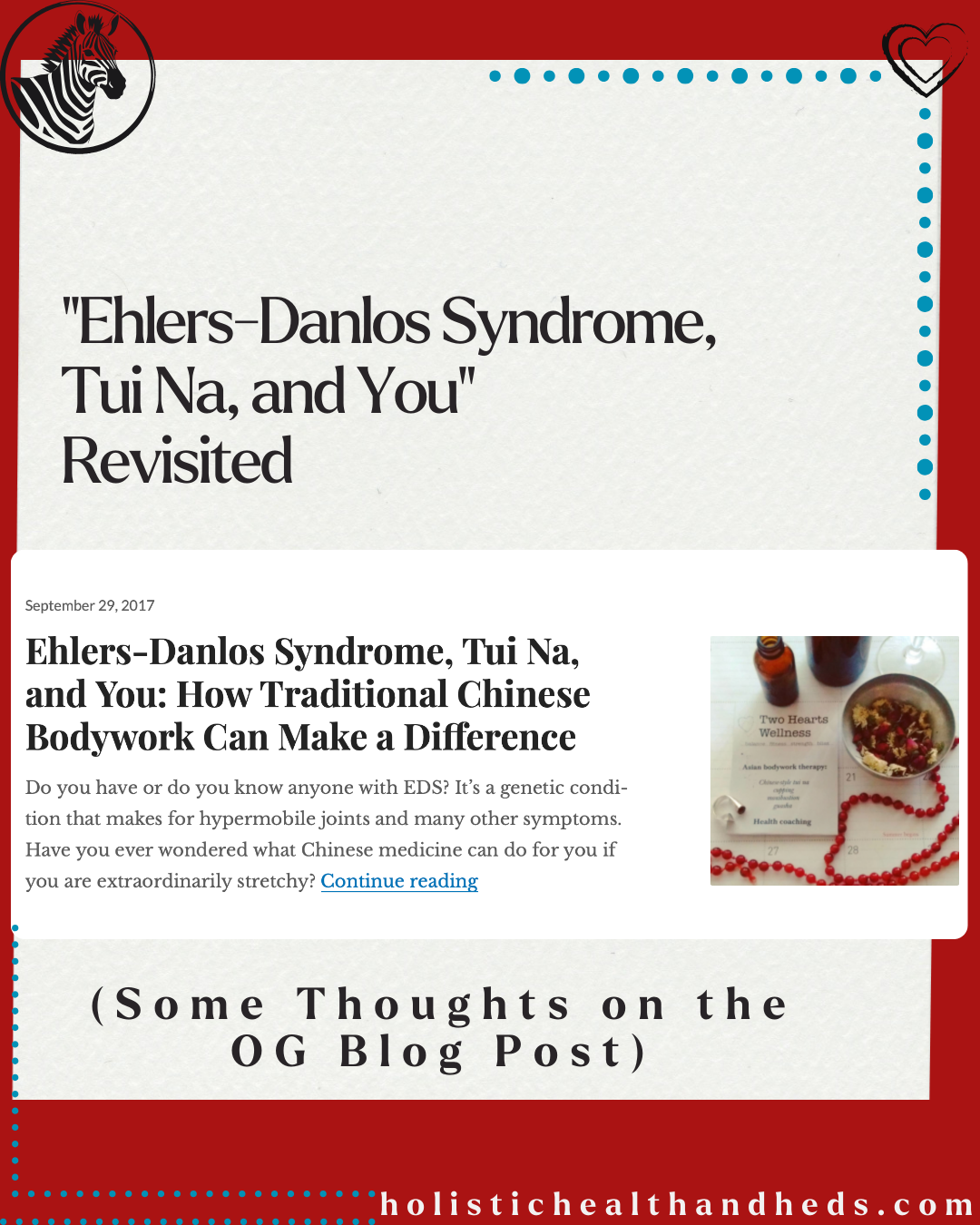
Tui na is useful for anything that can be treated by acupuncture and then some. I treat a lot of chronic pain, whether it be from old injuries or misuse or due to hypermobility spectrum disorders or hypermobile Ehlers Danlos syndrome (HSD/hEDS). I also treat a good amount of acute injury. It’s not within an American’s scope of practice to do bone setting, but if a patient has gone to their surgeon and has been given a boot or a sling and a week to see whether they heal or they need surgery? I have a marvelous track record of patients who end up not needing surgery and being told that their injury healed so much better and faster than expected because they came for tui na treatment. No bone setting–I can’t do that here–but, instead, gentle work on the surrounding soft tissue is what I do. I also do a lot of scar work, which I love, and for that I rely on tui na first and foremost.
*****
*****
Gut health, digestion, sleep, anxiety…any and all of these things can be improved or resolved via tui na. If you have ever thought to try Chinese medicine but were put off by the idea of acupuncture needles, you could actually start with a tui na treatment instead.
Keep in mind though: this is not the same as a massage like you would get at a spa (unless you actually go to a spa that offers Asian bodywork therapy, but that’s still not the same as going to an acupuncturist who practices tui na). You remain clothed during treatment and the practitioner will work directly on the area of interest only. In other words, if you go because your back aches, the practitioner will work on your back, not your whole body. If you have pelvic floor problems, your practitioner will probably work on your feet, your sacrum, and/or your abdomen. If your headaches are getting in the way of enjoying your life…we understand, and will work on the scalp and maybe the neck and shoulders too. But it’s not a full-body treatment the way a massage usually is.
I remember the first time I heard the term “tui na.” I remember thinking that it sounded weird, and being a little confused between what a massage is and how this Chinese manual therapy compared. In my program, we had to take either medical qigong or tui na, and I decided that the latter sounded much more interesting.
And so it was, and so it continues to be (although, to be fair, as time goes by I am increasingly interested in medical qigong and may eventually get further training in this modality). I love tui na, though. I do. It is truly a natural form of healing, relying only on hands and one’s knowledge of qi, and pathways in the body, and the call to harmony and balance that a person must achieve in order to create and nurture lasting wellbeing.
Are you ready to try tui na?
*****
*****
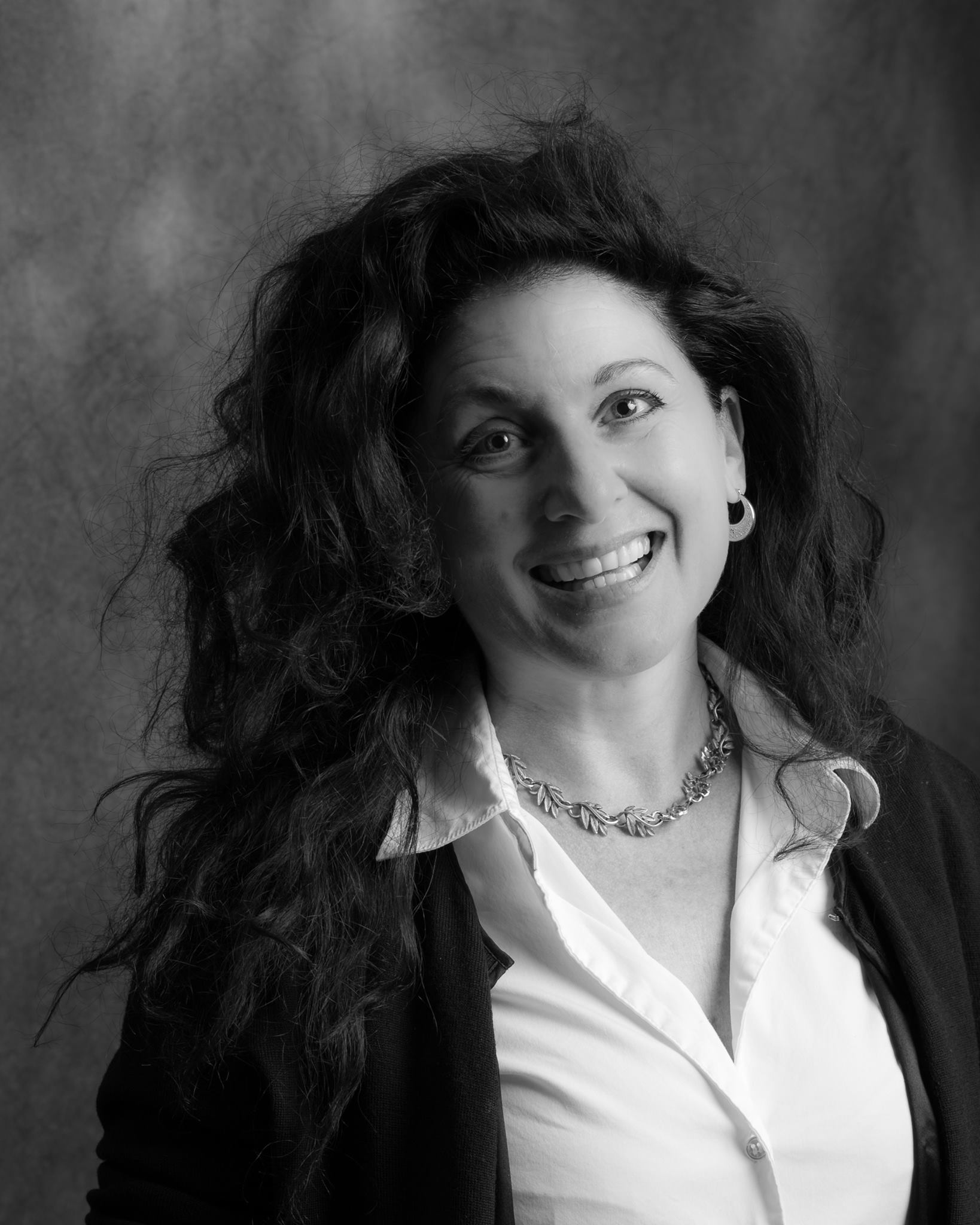
Dr. Paula Bruno, Ph.D., L.Ac., is a licensed acupuncturist and herbalist, an AOBTA-CP traditional Chinese bodywork therapist, a health coach, and an author. She maintains an active and growing practice at her Austin, TX office. Dr. Bruno is also available for distance appointments for wellness consultation or coaching.
In her first career, she was a Spanish professor.
Dr. Bruno’s specialties as a Chinese medicine practitioner include: • Musculoskeletal health (acute or chronic pain relief; Ehlers Danlos syndrome & hypermobility support) • Digestive support, gut health, and weight loss • Aesthetic treatment, including scar revision • Men’s health • General preventive care and wellness support for all persons.
She is the author of Chinese Medicine and the Management of Hypermobile Ehlers Danlos Syndrome: A Practitioner’s Guide. Dr. Bruno also maintains a second website, holistichealthandheds.com, with resources and information curated specifically for people with hEDS and HSD.
When you are ready to discover what traditional medicine plus a vibrant and engaged approach to holistic health can do for you, either contact Dr. Bruno or book an appointment online.
*****
*****
Two Hearts Wellness does not accept paid advertising on this website & only uses strictly necessary cookies.
Note: Material on this web site site is not intended to diagnose, prevent, treat, or cure any disease, illness, or ailment. A Chinese medicine practitioner in Texas identifies syndrome patterns but does not diagnose illness. Material on this web site does not purport to identify syndrome patterns.
*****

