“Breathe in… and breathe out… at your own comfortable breath pace. Allow your shoulders to soften and feel your rib cage rise and fall. [Pause] Breathing in and breathing out at your own comfortable breath pace, notice the sensation of your body against the mat. Feel your lungs expand. Follow the sensation of your exhale. Relax your body. [Pause] Breathing in and breathing out at your own comfortable breath pace, wiggle your toes and notice the sensation of movement in your feet. Rest, and feel your legs against the mat. [Pause] Breathe in and breathe out at your own comfortable breath pace…”
One of the first things I did after leaving academia was to get certified to teach yoga. The above is part of a guided meditation that I developed while teaching at a local veterans’ clinic. It’s a resource I still use in my work with patients who see me for Chinese medicine and clients who work with me in my capacity as a health coach. Breath work is healing, especially when a person is challenged by anxiety, chronic pain, and/or any sort of impediment to easy breathing.
Our lungs and our breath are treasures to be cultivated. Though Western biomedicine is a little less flowery than Chinese medicine or yoga on the topic, we all know that breath is life and that healthy lungs are key to this endeavor.
*****
*****
~~The biomedical perspective~~
As with my other essays regarding internal organs, I will begin with the biomedical description of the lungs. I do this not to privilege allopathic approaches but, instead, because I think that most of us tend to understand things better if we begin with a point of reference that we already are familiar with or at least know somewhat. (And when I capitalize Lung and reference to it in the singular, that’s the Chinese umbrella term that covers not just organ but also channel and other associated entities).
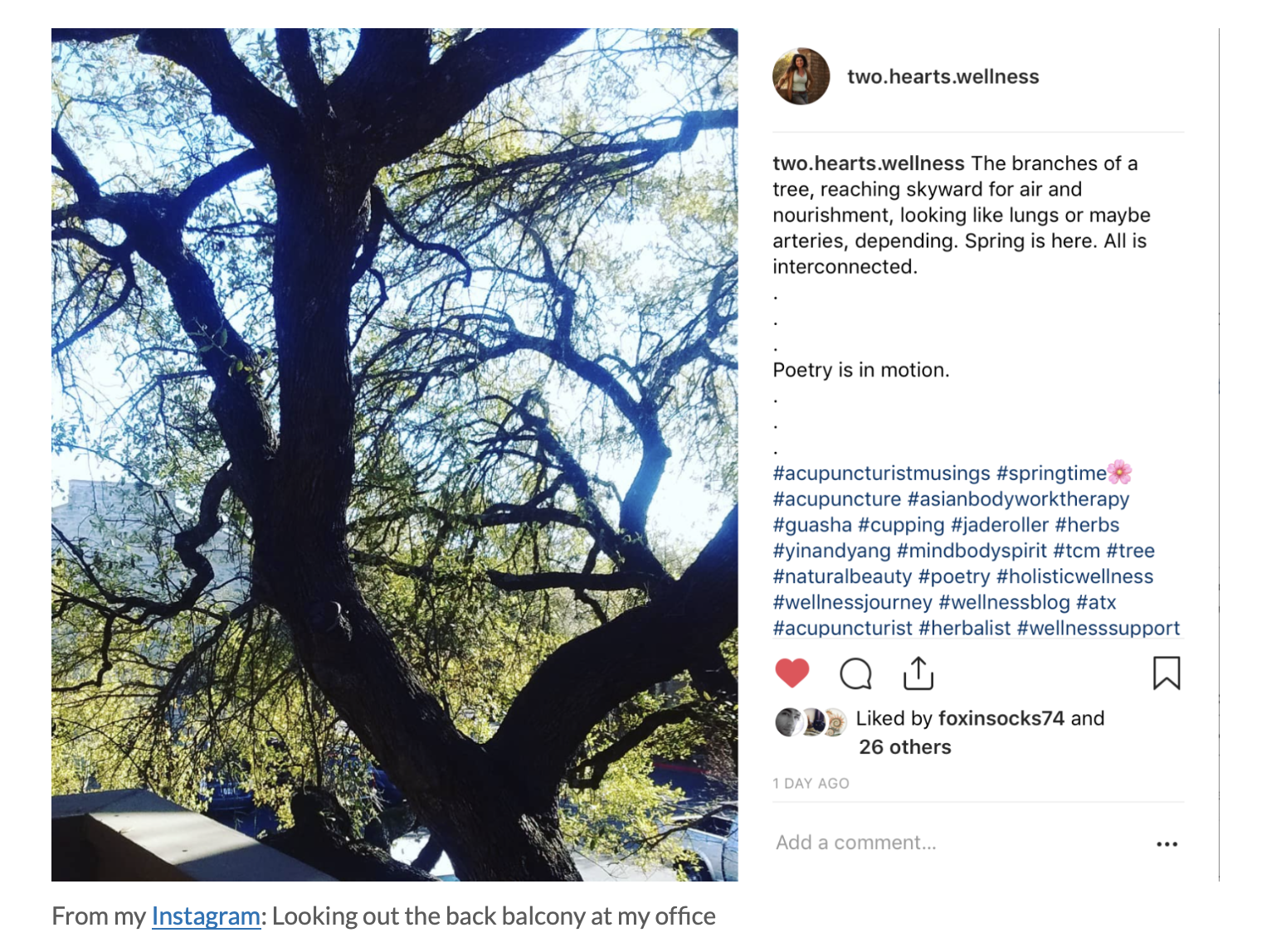
Your lungs have a big job: they bring oxygen into your body and let out carbon dioxide. They are a pair (hence: lungs) that consist of two sides: on the right, you have three lobes and on the left, two. The extra space left by the absence of the third lobe is taken by your heart. If you look at a picture of the lungs, you’ll see the trachea (your windpipe) that delivers air from your nose and mouth to the lobes and the bronchi and bronchioles, which branch off the trachea and give it that characteristic tree-like appearance. Tiny air sacs where gas trades occur are called alveoli. On the bottom, you have a large muscle, your diaphragm, that moves the lungs up and down. At the top, you have scalene muscles that originate in your cervical vertebrae and attach at your ribs. Like the diaphragm, these muscles also help with breathing by raising and lowering the ribs.
On the in-breath, your diaphragm descends and helps to pull air through the trachea and into the lungs. Once the air arrives at the alveoli and fills them, oxygen is taken into the blood and the blood in exchange gives back the waste product, carbon dioxide, which is released with the outbreath.
Interest in and the growing popularity of yoga (in the United States, at least) brought attention to the lungs and their function. In my estimation, though, I think it is the COVID pandemic and the post-COVID syndromes that made people aware of how crucial our lungs really are on a broad scale. One thing is to be a life-long smoker who develops COPD or cancer; this, fairly or unfairly, may be dismissed by blaming the sick person for their life choices. Quite another is to have a COVID infection and then spend years, if not the rest of your life, trying to recover from the damage. This, I think, seems much more random and thus unfair. Your lungs are your life, and understanding them and protecting them is just as important nurturing your gut health (which, if you follow my socials is one of my favorite topics). And either way, I do think that folks are more aware of their lungs now than, perhaps, we all were five or six years ago.
*****
*****
~~The Chinese medicine perspective~~
The Lung in Chinese medicine has its own story, some of it similar to what you know from biomedicine and much of it framed it terms that expand well beyond in-breath and out-breath.
First of all, we refer to the lungs as “the delicate organ.” They are in direct contact with the external environment and they are vulnerable to pathogens and whatever climate factors are present (cold, wind, dampness, and/or dryness), not to mention other things like pollution, mold, or chemical irritants. The lungs are also a canopy, given that it is the highest organ in the torso, where it sits, almost like an umbrella, over the organs beneath it. The lungs prefer moderate dampness (too much dampness would lead to phlegm), and heat and other extremes of dryness will damage this delicate organ.
This makes sense, doesn’t it? For instance, if you do smoke or vape, you are scorching your lungs with heat (and will eventually have to deal with the consequences of this activity… BTW, did you know that acupuncture can help you to quit smoking? It can!). If you live with immune system volatility (allergies, MCAS, chemical sensitivities) and you smell perfume or Febreze or [fill in the blank] you know what that feels like: sudden rushes of mucus, coughing, maybe hives, etc.
*****
*****
~~The soul of the Lung organ~~
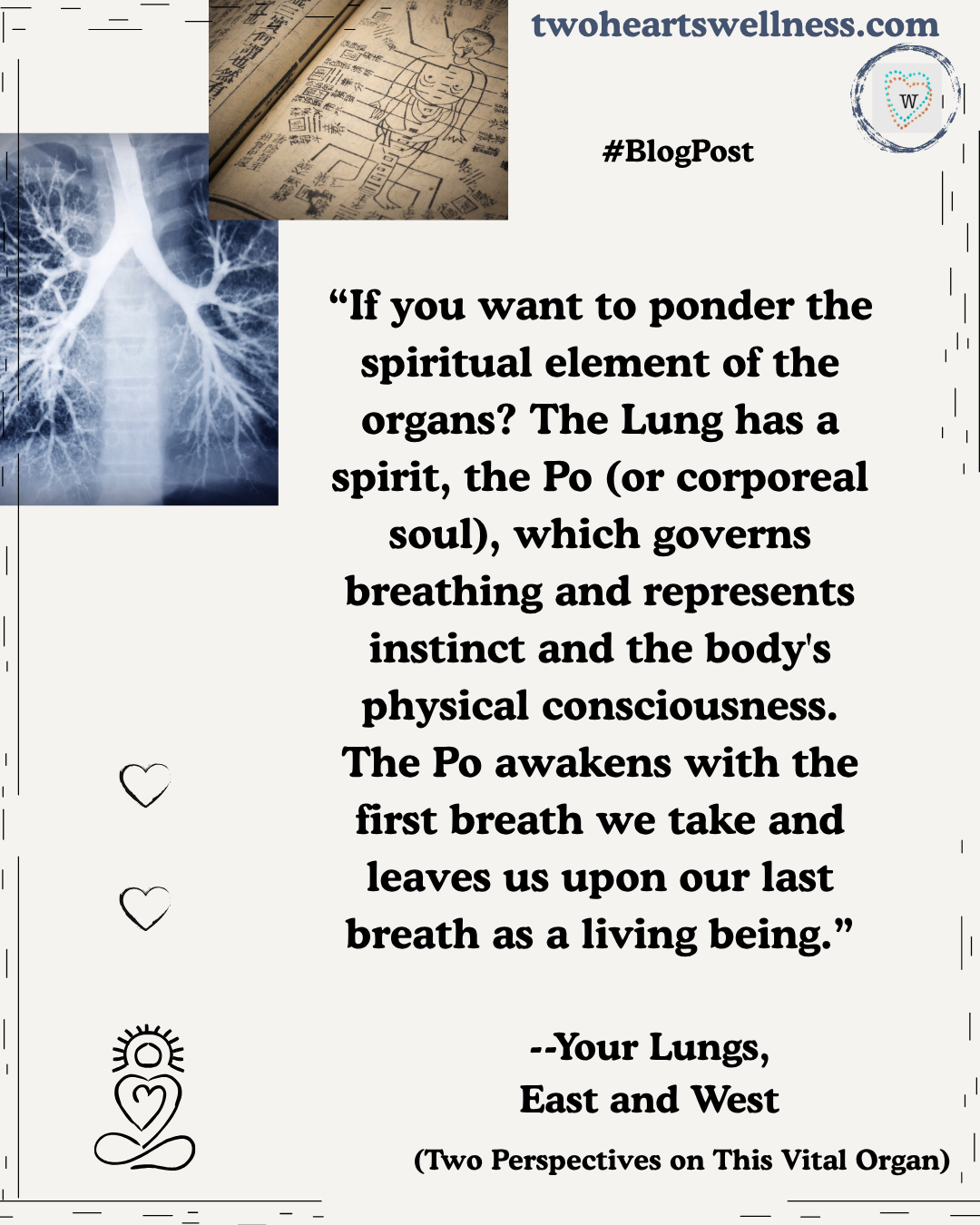
If you want to ponder the spiritual element of the organs? The Lung has a spirit, the Po (or corporeal soul), which governs breathing and represents instinct and the body’s physical consciousness. The Po awakens with the first breath we take and leaves us upon our last breath as a living being. When our Po is unbalanced, we might experience shallow breathing, breathlessness, anxiety, skin problems, and/or problems with the immune system.
The Lung is also associated with a time period (fall) and an emotion: grief. Healthy grieving is healing to our lungs; unresolved grief can manifest in Lung issues or, on the other end, via the Lung’s paired organ, the Large Intestine. Yes, each organ has its pair, and while the Lung is a yin organ, the Large Intestine is yang, and together, both are associated with not just fall season but also the element of metal.
*****
*****
Yes, once you get into all the associations of the organs it does become a bit of a rabbit hole… what is important is to understand the most basic message of the Lung/Large Intestine pair. To wit: one is the upper organ, which takes in oxygen and releases waste (carbon dioxide) and the other is the lower, and it takes in nutrients and releases the waste product related to digested food. Just as with unresolved grief causing trouble to the Lung, undigested food (on the functional level) and unprocessed emotion (on the spiritual plane) are issues related to the Large Intestine. Either coming or going, your mind and body need the healthy process of taking in what is needed and releasing what is not.
~~Caring for the Lung~~
So how do we care for the Lung in Chinese medicine? Between remedies to restore health and practices to maintain wellbeing, your acupuncturist will have options for you. These include acupuncture treatments, herbal medicine, bodywork therapy, breathwork via qigong, and nutritional guidance. We have a lot to say about Lung health in Chinese medicine!
Aside from not smoking or vaping, there is a lot you can do at home for Lung health. Nutrition, unsurprisingly, is key. Since your lungs are delicate and in need of a certain level of dampness you can expect that your practitioner will suggest white, cooling, and moistening food. My nickname in my nutrition class was “Asian Pear” because my answer to every question, practically, was that. I love Asian pears and your lungs will too. Another good option is daikon radish, which is especially good for resolving phlegm and cooling the lungs. Almonds are also good for lungs because they moisten the throat and contain healthy fats. If heat is an issue, cooling items like celery, peppermint, chrysanthemum tea, or watercress can be options. With phlegm, we might suggest ginger, garlic, white pepper, or barley.
*****

*****
I personally tend to avoid telling patients what not to eat. I’m definitely on the side of intuitive and mindful eating rather than restrictive. But if a person has a lot of coldness and phlegm, I will (as will just about any acupuncturist) counsel to avoid greasy food and overdoing it with dairy. If my patient has a dry cough and sore throat, I’d suggest that they avoid bitter or fried foods for the interim. In the case of phlegm and heat, it’s a good idea to not eat spicy food or to drink coffee or alcohol. A lot of common sense and wisdom goes into Chinese medicine dietetics, as you can imagine.
Of course, you do not smoke (or if you do, you can go to an acupuncturist and get help with that). You practice mindful breathing (don’t you?). And when you have any sort of respiratory concern, like asthma or a cold or even COVID, you have an acupuncturist to support you along with whichever form of allopathic care you might choose to follow. Right? Your lungs are a treasure, so guard them well. Chinese medicine is a resource, so definitely keep us in mind if you want to bolster your health in this or any other realms.1
~~In conclusion~~
Your lungs are your first interface between what’s inside you and what’s outside in the world around you. Without them, your blood wouldn’t have any oxygen to carry to your body as a whole. When they’re healthy, it’s easy to forget about them and–as the saying goes–just breathe. When they’re not, it’s a wake-up call to take care of this delicate and crucial organ.
What are you going to do for your lungs today?
*****
*****

Dr. Paula Bruno, Ph.D., L.Ac., is a licensed acupuncturist and herbalist, an AOBTA-CP traditional Chinese bodywork therapist, a health coach, and an author. She maintains an active and growing practice at her Austin, TX office. Dr. Bruno is also available for distance appointments for wellness consultation or coaching.
In her first career, she was a Spanish professor.
Dr. Bruno’s specialties as a Chinese medicine practitioner include: • Musculoskeletal health (acute or chronic pain relief; Ehlers Danlos syndrome & hypermobility support) • Digestive support, gut health, and weight loss • Aesthetic treatment, including scar revision • Men’s health • General preventive care and wellness support for all persons.
She is the author of Chinese Medicine and the Management of Hypermobile Ehlers Danlos Syndrome: A Practitioner’s Guide. Dr. Bruno also maintains a second website, holistichealthandheds.com, with resources and information curated specifically for people with hEDS and HSD.
When you are ready to discover what traditional medicine plus a vibrant and engaged approach to holistic health can do for you, either contact Dr. Bruno or book an appointment online.
*****
*****
Two Hearts Wellness does not accept paid advertising on this website & only uses strictly necessary cookies.
Note: Material on this web site site is not intended to diagnose, prevent, treat, or cure any disease, illness, or ailment. A Chinese medicine practitioner in Texas identifies syndrome patterns but does not diagnose illness. Material on this web site does not purport to identify syndrome patterns.
*****
- One of my older blog post, “Find An Acupuncturist: How To Find The Best Chinese Medicine Practitioner For What You Want To Accomplish,” is useful if you’ve never tried Chinese medicine and don’t know how to find a good practitioner for you and your goals. If you live with chronic or complex illness, my post from my EDS-dedicated website, “Acupuncture & EDS: How to Find a Practitioner of Chinese Medicine When You’re a Zebra” is the one to read. ↩︎

