Chinese medicine landed on American soil in the 1970s and a language to narrate it, in response, developed and took root. Fifty, going on sixty, years later, though, things are not the same and the words that once made one kind of sense either no longer do so, or they communicate something that may not necessarily be accurate today.
For that reason, I think it’s time to revisit some common terminology. This is a very short list, but the key words I’m discussing here are: TCM/CCM; qi; acupuncture; meridians; and balance (of yin and yang). Each short definition will be followed by a longer discussion. From my perspective as a multilingual scholar, I think this is a fascinating topic. By the time you finish reading this blog post, I think you will see these terms and their shifts as fascinating too.
I hope so, anyway! And so without further ado…
*****
*****
TCM vs. CCM: “What is the difference between TCM (traditional Chinese medicine) and CCM (classical Chinese medicine)?”
Definition: TCM is the modern iteration of CCM and both have their pluses and minuses. But no, they are not the same.
Discussion:
It’s been interesting to watch the evolution of the use of the term “traditional Chinese medicine.” When I discovered Chinese medicine (CM), I viewed partaking of it in terms of: “I am going to get acupuncture.” For the longest time, I do have the sense that for most people, “Chinese medicine” and “getting acupuncture” were the same thing. I also think that this started to shift once dry needling and trigger point therapy started to become popular. Suddenly, if you want to indicate that you are experiencing Chinese medicine, this needed to be clarified. “TCM” is pretty clear, or so it seems.
Actually, it’s not.
TCM was developed in China the 1950s and it does incorporate some principals of biomedicine into its precepts. CCM relies, even today, on the guidelines set forth by the ancient texts (The Yellow Emperor’s Classic, or Su Wen, and On Cold Damage, or the Shang Han Lun). Both types of practice are valuable and it really depends on what you’re looking for if you have the option of choosing one over the other. Do you want herbs with a side of Daoism (CCM) or do you want a point prescription that is standardized (TCM)?
Even within both traditions, you will find variation. In my practice, I lean towards CCM but I specialize in conditions that require a lot of anatomy knowledge specific to pain. My primary teacher (my capital-T Teacher) in my program is a renowned soft tissue and traumatic injury specialist and that knowledge and skillset requires something a little different than the prescriptive TCM; he’s also a brilliant herbalist and that’s a CCM trait. Based on what I’ve seen, most of us draw on both TCM and CCM to inform our knowledge and skillsets. What tends to separate one from the other is the degree to which philosophy (Daoism) informs the practice.
*****
*****
Qi: “Is qi really some kind of fairy substance that exemplifies exotic Chinese wisdom or is it a logical depiction of energy that can be applied to many contexts?”
Definition: Qi is an energy that can be applied to an endless range of concepts. In essence, it’s the driving force (whether that’s hormones or photosynthesis or nerve conduction or the biological impetus that makes a duck’s egg hatch) behind movement and healthy development.
Discussion:
No, qi is not a fairy substance that exotic Chinese people made up out of thin air. If you ever read anything that speaks of qi and helpfully explains that it’s “pronounced chee” then you know it’s pitched by someone who lacks cultural awareness to people who lack cultural awareness. By 2026, though, I think that most people know how to pronounce qi.
Also: Chinese medicine (CM) came to the United States in the 1970s and there are a few navel-gazing Boomers who wrote turgid prose about qi being some sort of ethereal energy in a way that not ONE of my Chinese instructors EVER described it while I was in my second graduate program. Qi can have a metaphysical tone to it, sure (especially if your practitioner is primarily CCM and much less so TCM), but it is not the ooey-gooey exotic Chinese whatever that you might think it is by reading some of the solipsistic odes written by Boomers in the late seventies through the mid to late eighties.
Just saying.
Qi is energy, and that can mean a lot of things, health-related or not. Its literal translation is air, vapor, or gas and the Chinese written word is a visual representation of steam coming up from rice. People who follow my blog know that I was a Spanish professor in my first career and I spent the entirety of the first half of my adult life bridging Spanish (and Italian, in some instances) to English and back again. I think this way: if I’m speaking English and framing things in terms of Western biomedicine, I’d talk about hormones and neurotransmitters and the work of the autonomic nervous system (stuff that moves and has an energy). When I’m thinking in CM, I’d call it qi. A person whose digestion is humming along nicely has good stomach qi. Someone who does not, who maybe has gastroparesis, is lacking in same.
*****
*****
Acupuncture: “What is acupuncture and is it still acupuncture if you get it from your chiropractor?”
Definition: Acupuncture is what you get from your licensed practitioner of CM.
Discussion:
Acupuncture as a term was coined in the 17th century by Dutch physician, Willem ten Rhijne, to describe what he observed in Asia. The word combines two Latin words: acus (“needle”) and puncturus (“pricking” or “piercing”). Common parlance over time made this word representative of what happens when you go get poked at your licensed practitioner of Chinese medicine’s office.
And yes, this has begun to change recently. It started with “medical acupuncture,” blossomed via “drying needling,” and really got some legs with “trigger point therapy.” Language does change with the times, and so did the word acupuncture.
For a while there, allopathic practitioners really tried to make dry needling into something exciting, something scientific, something other than what you get at your alternative medicine (aka CM) practitioner’s office. The only problem is that it’s pretty unexciting once you realize that dry needling means only that there is nothing being injected. The needle is dry. That’s an objective description. It doesn’t confer some kind of scientific superiority to what people were starting to get at the chiropractor’s or the physical therapist’s or the doctor’s office. Trigger point therapy, which is anatomy-based and does require an understanding of nerves and referred pain, is a little more in line with what they try to accomplish (aka: making a distinction between CM, an “alternative” medicine, and what they do, which would be real live evidence-based practice). *cough*
Medical acupuncture is a term that was coined by doctors at UCLA in 1987. It’s an unfortunate term, because by calling what they do “medical acupuncture,” the implication is that what we do (CM) is not really medicine. Basically, by giving it this name, allopathic physicians took all authority for biomedicine and left us with… energy healing, I guess.
To be fair: I can see how that made sense back when the term was coined. Acupuncture came to the United States in the 70s and was embraced by counter-culture sorts like Tupac Shakur’s stepfather. Dr. Mutulu Shakur himself was an acupuncturist who founded the first acu-detox clinic in the United States. Also, hippies were into acupuncture. Yoga, acupuncture, turn on, tune out, drop out…yeah, baby! To doctors at UCLA in the 1980s, it probably made perfect sense to call what they did the more sober and trustworthy “medical acupuncture.”
But herbal medicine used to be called “Oriental medicine,” and in fact my third MA degree (the one I earned in my second graduate program) is an MAcOm (Master of Acupuncture and Oriental Medicine) reflects this. Recently (and by this, I mean less than a year ago), that term changed. Herbal medicine is herbal medicine. It is no longer “Oriental.”
When I was earning my first two MA degrees and the PhD, there was a shift in language as well. What used to be called “the discovery” of the Americas changed, and now the only place you ever find that term is if you read something published in the 70s and maybe into the early 80s. By the time I got to graduate school, it was called el encuentro, or the encounter, which reflected the reality: there were people already living in what eventually became what we now know as the Americas and the Caribbean and it was an encounter, a meeting, between two cultures. The Spanish explorers did not discover anybody.
Maybe one day “medical acupuncture” as a term will go the way of “Oriental medicine” (now herbal medicine) and “the discovery.” I hope so.
Anyway, when we say acupuncture, I view this as CM’s version of needling, and if we’re talking trigger point therapy, we can keep in mind that even the ancient texts referred to needling places that hurt (“ashi” or “Oh, yes, this spot!”) points. These are needle-worthy spots on your body that do not correspond with acupuncture points but which, instead, are painful or reactive. However, if you do equate the term “acupuncture” with CM, then no, you’re not getting at the chiro’s, the PT’s, or the doctor’s office(s). Over there, you’re getting dry needling or, perhaps, trigger point therapy.
*****
*****
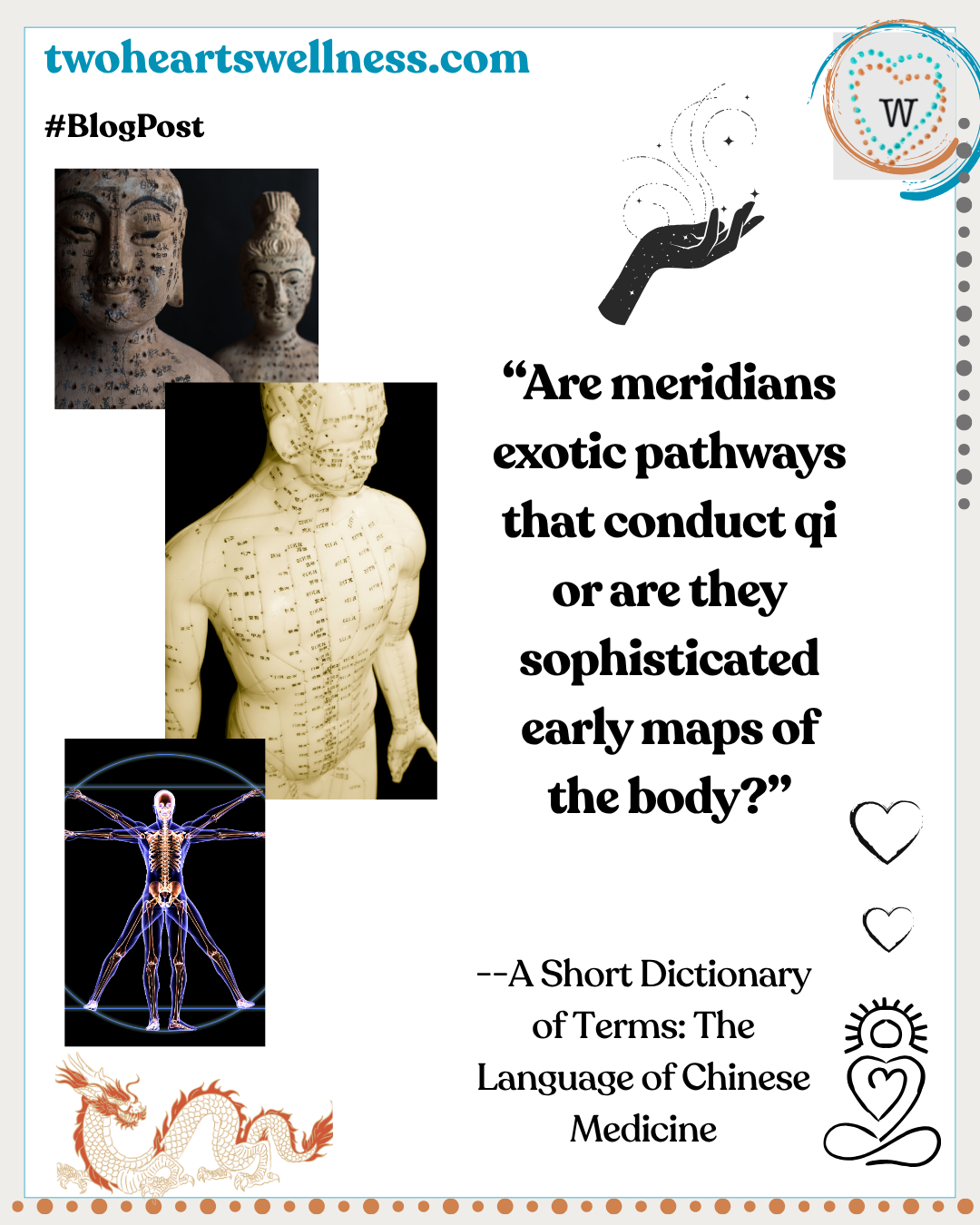
Meridians: “Are meridians exotic pathways that conduct qi or are they sophisticated early maps of the body?
Definition: Meridians are pathways within the body that provide a map, somewhat akin to how fascial planes, dermatomes, and myotomes work according to Western medicine.
Discussion:
You really have to hand it to the chiropractors–they do think that they know everything and some of them, bless their hearts, even think they know more about CM than actual licensed practitioners do.
I got into it with one on Instagram once, I forget precisely why because it was a good while ago, but what I remember about the exchange was that she very earnestly informed me that I was wrong in my commentary because–she wrote–Chinese medicine focuses on meridians, not biomedical anatomy. OMG. I was fairly new to the profession at the time. If someone said that to me now (or wrote it) they would get the patented Dr. Bruno Death Ray Glare of Doom (or the online equivalent). The full force of Profesora Bruno would make them feel dumb and embarrassed. If it were a civilian (someone without a medical license), that’s different. They get some grace and patience.
But a licensed medical care provider? No mercy.
When you look at the ancient CM model of the figure with lines, those are meridians. Pathways. A map. When you look at an anatomy textbook or google “dermatome” or “mytome” you will see an outline of a human body with colored zones in line form. What you are looking at is a map of either dermatomes (where nerve conduction goes to the skin) or myotomes (where nerve conduction goes to muscles). And if you ponder it, they are remarkably similar to the earlier depictions by CM originators. Huh. I know, right?
You might also hear talk of fascial planes, and if you ever take a look at the dissection pictures in any of Luigi Stecco’s books, you will see that this wonderful Italian physiotherapist compares meridians to the contours of fascial planes. Luigi Stecco developed a signature fascial manipulation method in the 1980s. I love the guy because he gives credit where credit is due to Chinese medicine and his books show dissections of human bodies that compare fascial planes to meridians. Stecco’s daughter, Carla Stecco, is an orthopedic surgeon in Italy and his son, Antonio Stecco, is a researcher and faculty member at NYU. Much of what is not popular understanding about fascia comes from the Stecco family and the roots of this knowledge is, in part, from Chinese medicine.
TL/DR: No, they are not exotic fantasy pathways in exotic Chinese bodies. They are remarkably accurate maps that guide the places where your practitioner will work to move, enhance, or subdue (depending on what’s going on with you) your qi.
*****
*****
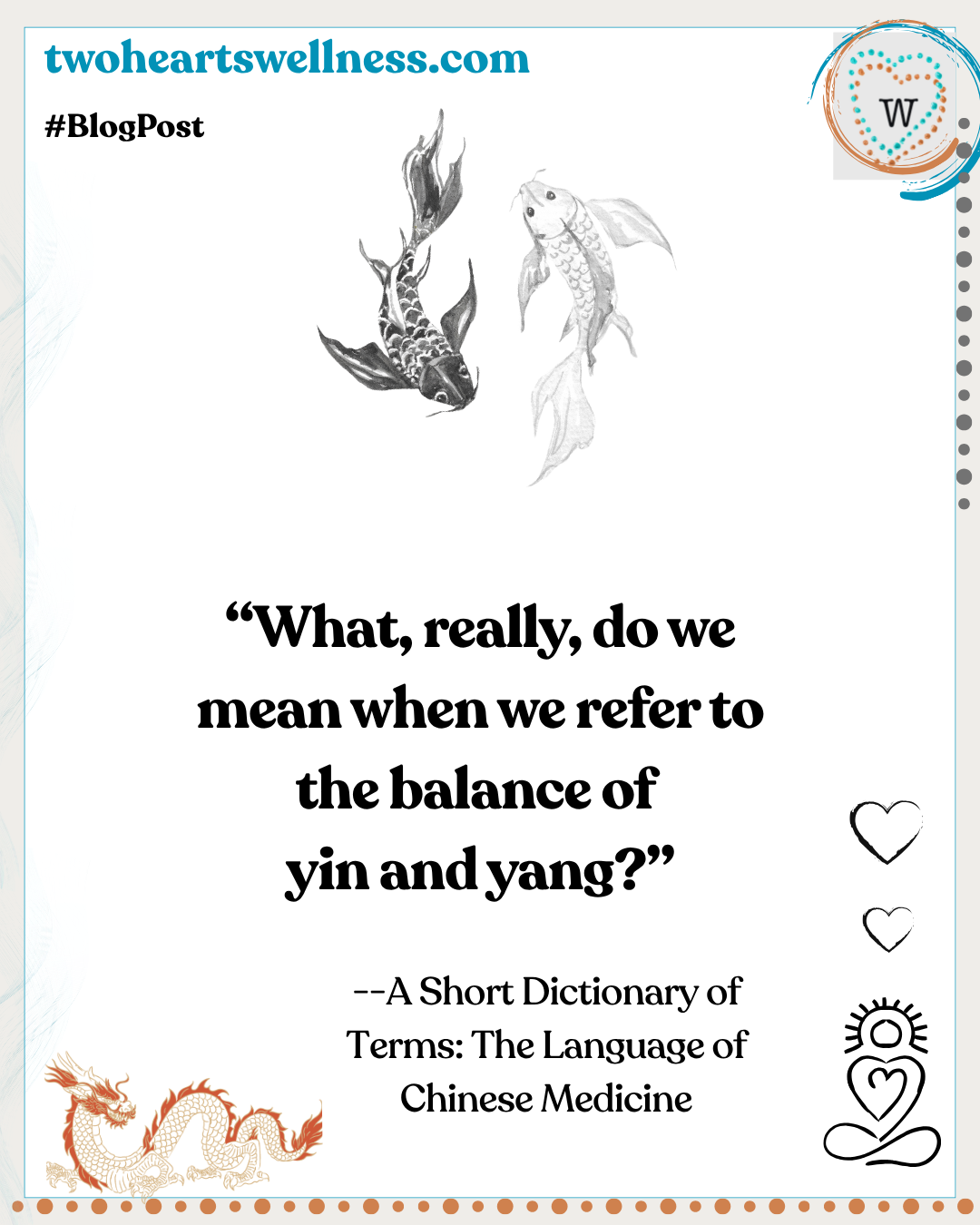
Balance (yin and yang): “What, really, do we mean when we refer to the balance of yin and yang?”
Definition: All of Chinese medicine rests upon balance between complementary opposites. Yin is a quality (dark, feminine, inert, etc.) and so is yang (bright, masculine, active, etc.) and the goal is to have not too much of one and too little of the other but, instead, a right balance.
Yin and yang are concepts that would require way more than a blog post to explain. It’s enough to say here that approaches to yin and yang can be pretty straightforward and relatively simple or they can be extremely complex, either medically or philosophically. What matters in this context is that the balance of yin and yang that we abide by in CM has an equivalent in the biomedical concept of homeostasis.
Homeostasis in essence means “not too much and not too little; just right for the task at hand.” It’s not that complicated. If you are a man, for instance, and you have low testosterone, you are (A) yang deficient and (B) suffering from not having enough testosterone. And so forth. Both in Eastern and Western medicine, we want you to have not too much and not too little of the substances you need in order to stay alive and remain healthy. It’s not complicated.
In CM, though, there is a philosophical nuance to balance that does not exist in Western medicine. You will see a form of it in Ayurvedic practice, and more and more, functional medicine and other less-hidebound approaches value the idea of balance more openly. But it is a bedrock of the philosophy and the practice in CM that does rely on the classical roots.
Even so, if you agree with the precepts of homeostasis (and why would you not?) then you agree with Chinese medicine too.
It’s not so tough.
Language is a living creature. It changes and shifts and accommodates its contexts. Same with how we narrate medicine, be it bio or Chinese. The root of it may stay the same, but the nuances shift. I wonder, as I write this in 2026, how things will change in twenty or thirty years. For now, though, I do think we are in a moment of transition. The language that spoke for the 1970s and 80s is no longer that which communicates today, is it? And don’t get me started on the notion of “alternative” medicine. That is a whole different blog post, and one worth writing.
What do you think?
*****
*****
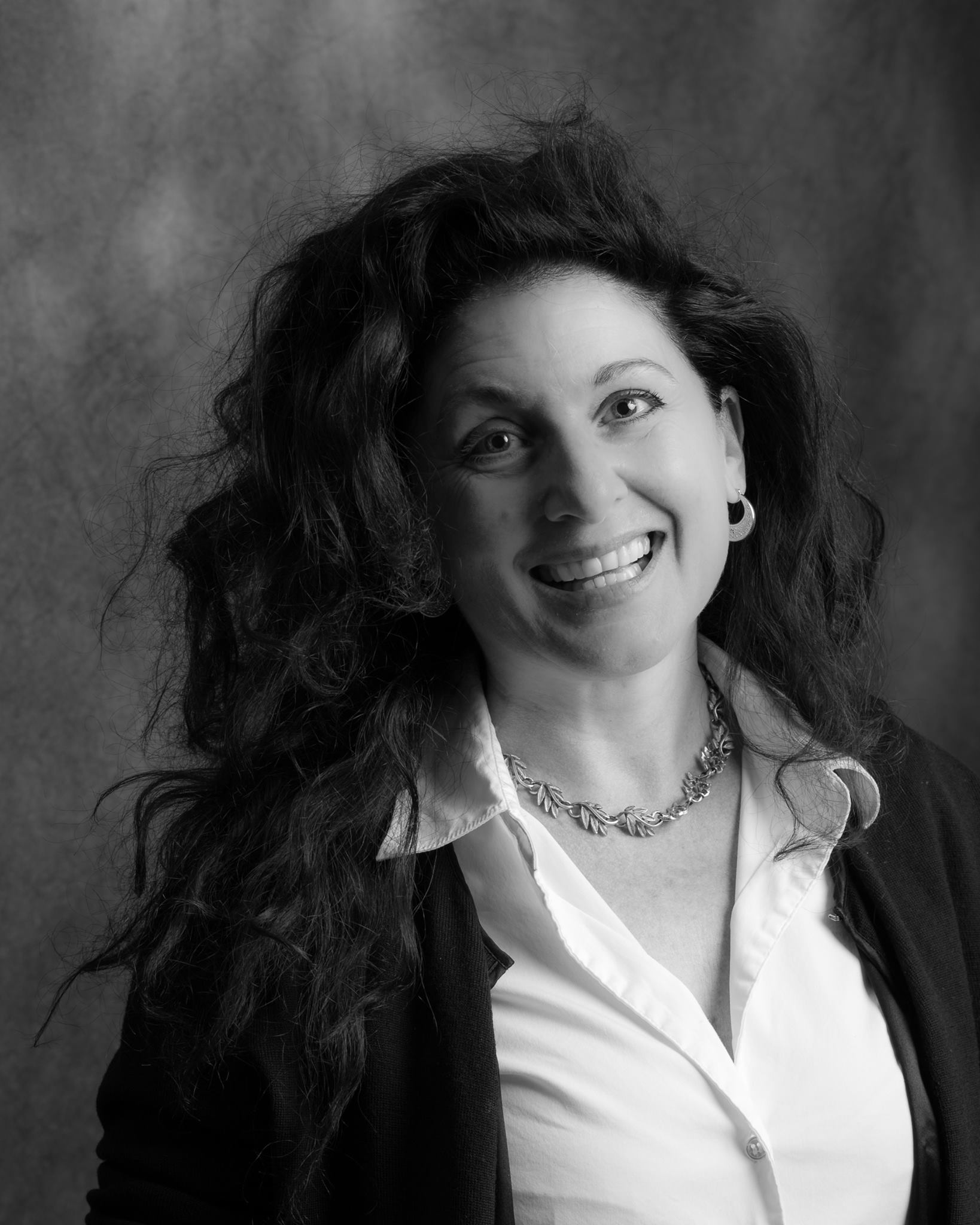
Dr. Paula Bruno, Ph.D., L.Ac., is a licensed acupuncturist and herbalist, an AOBTA-CP traditional Chinese bodywork therapist, a health coach, and an author. She maintains an active and growing practice at her Austin, TX office. Dr. Bruno is also available for distance appointments for wellness consultation or coaching.
In her first career, she was a Spanish professor.
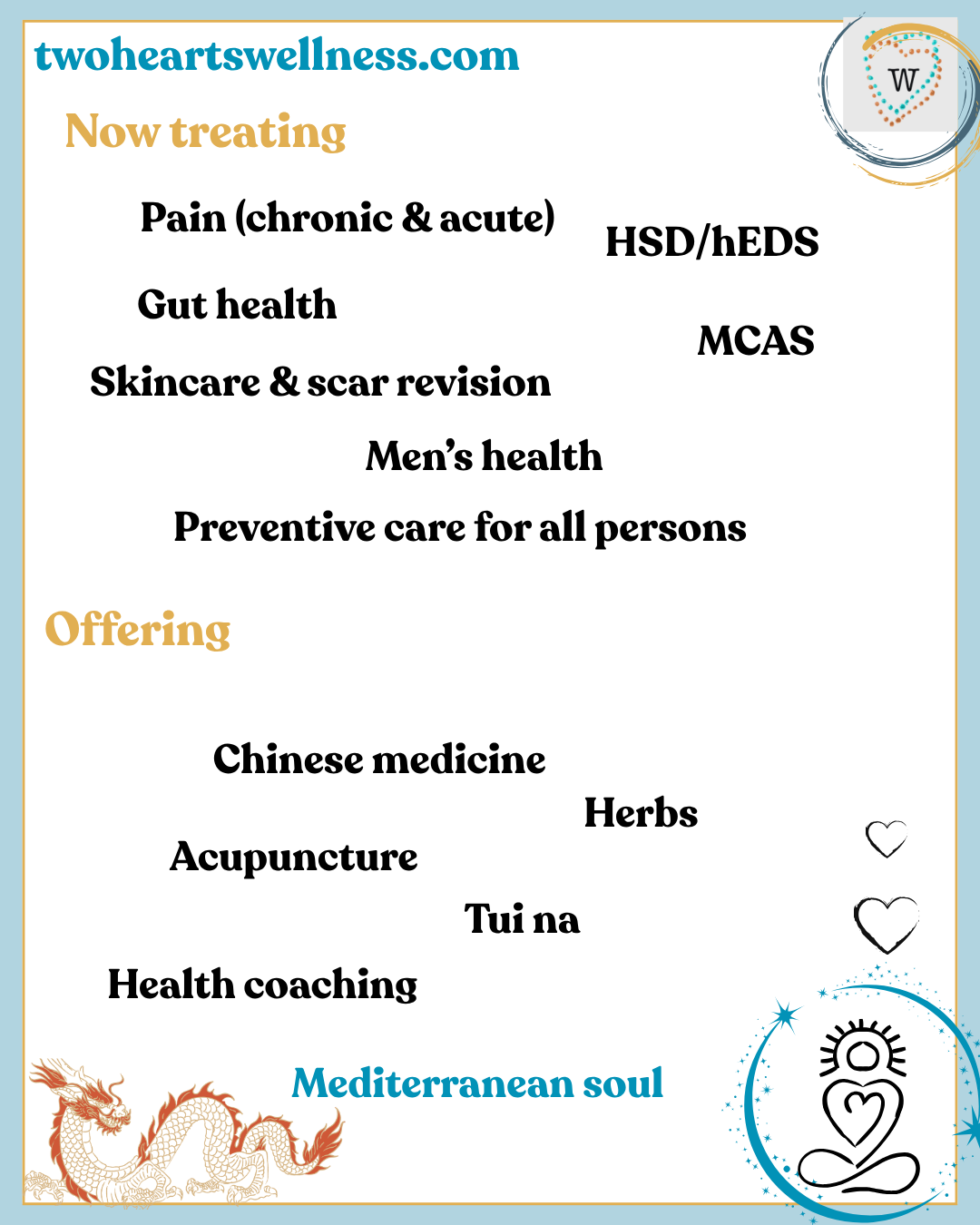
Dr. Bruno’s specialties as a Chinese medicine practitioner include: • Musculoskeletal health (acute or chronic pain relief; Ehlers Danlos syndrome & hypermobility support) • Digestive support, gut health, and weight loss • Aesthetic treatment, including scar revision • Men’s health • General preventive care and wellness support for all persons.
She is the author of Chinese Medicine and the Management of Hypermobile Ehlers Danlos Syndrome: A Practitioner’s Guide. Dr. Bruno also maintains a second website, holistichealthandheds.com, with resources and information curated specifically for people with hEDS and HSD.
When you are ready to discover what traditional medicine plus a vibrant and engaged approach to holistic health can do for you, either contact Dr. Bruno or book an appointment online.
*****
*****
Two Hearts Wellness does not accept paid advertising on this website & only uses strictly necessary cookies. All our copy is generated by human effort (there is no AI slop here!)
Note: Material on this web site site is not intended to diagnose, prevent, treat, or cure any disease, illness, or ailment. A Chinese medicine practitioner in Texas identifies syndrome patterns but does not diagnose illness. Material on this web site does not purport to identify syndrome patterns.
*****

