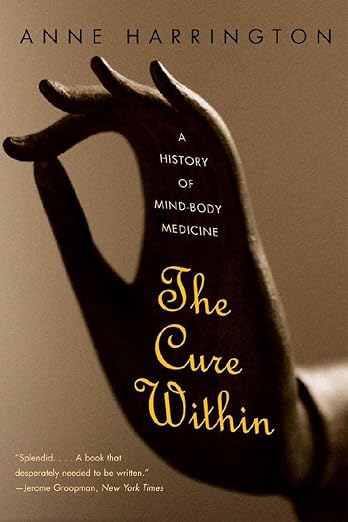
Back when I was writing my book, Chinese Medicine and the Management of Hypermobile Ehlers-Danlos Syndrome (Singing Dragon, 2023), I read voraciously… Well, even more voraciously than usual. One area included the review of mind-body wellness narratives from a range of sources, including historical reviews and investigations produced by anthropologists. Medicine, whether allopathic or other, has a lot of ingredients that create it, and these range from the scientific to the financial to the cultural and more. I left no stone unturned.
Initially, my plan for this blog post was to write a review of a book I read then that I found both problematic and emblematic of the thought processes of a certain sector. As I sat down to write here, though, I started to go in a different direction. And so…there will be some book review and some wandering thoughts as I write. Not all journeys are linear, and neither are my approaches to health and wellbeing.
Where does health come from?
We all want to be healthy and pain-free. That, at least, is a topic that enjoys consensus. But where does health come from and who dispenses it? Biomedicine really does want to center itself as the one and only reliable source but human beings are not so easily corralled. If a person does not want to give their agency and control over to an MD, there are ample choices otherwise. And that’s where the book review part of this blog post becomes relevant. Over the course of history, the way social groups create narratives surrounding mind-body wellness and how to achieve it is most certainly a topic to investigate.
Where does health come from, and how do we create a sense of possibility, a sense of control and agency? Who, ultimately, holds the power to cure?
*****
*****
The history as per a Harvard historian
One of the books I read while writing, The Cure Within: A History of Mind-Body Medicine (Harrington 2008), was worth perusing mainly because its author is a tenured professor of History of Science at Harvard and thus is accorded a certain level of respect by virtue of same (whether or not it is warranted). This book was met with great enthusiasm by reviewers from multiple sectors, both professional and popular. And yes, it was published almost twenty years ago but books like this one articulate a cornerstone of beliefs that flourish even today.
I’ll say it up front: I think that The Cure Within is awful. It centers Western history and places Asian (East and Southeastern) in the realm of the exotic. If you aren’t paying attention, you could come away from reading it believing that mind-body medicine originates in the West. Harrington achieves this by via the following chapters that make up her book:
–The power of suggestion: This chapter outlines medieval-era notions of illness as demonic possession that must be eradicated by a priest, a perspective that became secular over time and morphed into Mesmerism (a forerunner of hypnosis);
— The body that speaks: A stressed individual who ignores their body’s signs is one who will eventually break down. This perspective also had a religious origin, whereby confession of sin led to absolution and a return to health. It blossomed in the 1970s into the notion that the individual can and should trust their instincts even in the face of dismissive medical care providers;
–The power of positive thinking: This one too has a religious origin and relates to the words of Jesus (“you have been healed because of your faith”). Currently, this thread turned into notions regarding the power of placebo, among other things, and centers the patient and their attitude as the deciding factor in health (or lack thereof);
–Broken by modern life: Here we begin from a modern perspective. To wit: stress and a Type A personality, for example, lead to heart attacks (for example);
–Healing ties: This chapter also begins from a contemporary viewpoint. Here, the focus is on community and social support and how these create and maintain wellbeing;
–Eastward journeys: And now, I guess so that the book isn’t entirely focused on a white, Christian perspective, Harrington then goes on her “exotic journey” to the East. Here, “ancient wisdom” is the source for being able to find a cure within, and contemporary Western patients are–via meditation, qi gong, and perhaps a smattering of Buddhism–able to create their own health and wellbeing without the intervention of Western biomedicine.
*****
*****
Harrington privileges biomedicine. She’s condescending, I thought, about anything other than science-based medicine as a vector for health. At the time, given that I was writing a book about hypermobile Ehlers-Danlos syndrome and Chinese medicine, I also thought to myself that she must not have a lot of personal experience with complex chronic illness because she did not appear to have a lot of respect or appreciation for people’s attempts to become healthy outside the allopathic fold. She further seems to argue that mind-body narratives come from Judeo-Christianity without much regard for Asian medicine.
You can only imagine, dear reader, how that landed for me. I mean… Ayurvedic tradition, Chinese medicine, Arabic medicine, and even classical Greek healing arts all are pretty clear about the connection between mind, body, and environment. Medieval priests didn’t get that ball rolling. And why, if she is so Anglo-centric, does the cover of her book show a Buddha?1 I actually purchased the book because of the cover, which implied much better discussion of Eastern medicine that which she delivered. (Yes, I know: never judge a book by its cover).
Even so, it is an interesting book. (People who know me know that when I say a book is “interesting” I mean something otherwise. It’s the equivalent of saying “bless your heart” with a Southern accent, really). But, seriously? It may make a reader contemplate where they acquired their notions of health and whether or not they think a cure can actually come from within or if, instead, the only recourse for cures is by way of Western biomedical precepts and an allopathic physician. So maybe it’s worth reading but it definitely requires a large grain of (organic pink Himalayan) salt to make it more palatable.
I’m not convinced that reasonably healthy people give the topic much thought (trust me when I say that chronically ill people do) and, for this reason, it is also worth reading. Where does health come from, in essence: the doctor’s office or via something that you, yourself, can control? And by what means is that control effected?
*****
*****
What did you learn growing up?
What have you learned about your ability to control your own health and make your own choices as far as healing is concerned? Do you believe that you have some agency, or do you think that the only chance you have to ever fix anything is via your MD’s office?
Anyone who follows either of my blogs, either this one or my EDS-dedicated one knows that (A) I am not here to kowtow to the biomedical industrial complex and (B) even so, I do “believe in” science. Yes, the notion of a cure tends to reside within the purview of biomedicine. And yes, healing–for its part–remains relegated to “alternative medicine.”
Life takes us on unexpected paths, though, doesn’t it? I started my adult life as a Spanish professor but here I am, a practitioner of Chinese medicine. For me, this is not “alternative medicine.” It’s the only kind I want for myself and, for a number of my complex condition patients, it’s not the booby prize “alternative” that they accept in lieu of real medicine (aka biomedicine). People who do not respond well to Pharma drugs or who are reluctant to get surgeries that may or may not work may well find the cure they are yearning for in Chinese medicine; if not cured, the healing journey they experience is equally valid and certainly treasured.
“I think that we are, a lot of the time, sold the idea that a cure is the only truly worthy outcome. Whenever there’s a new genetic finding I notice on social media how some will say, “Maybe they’ll find a cure!” Honestly, I don’t think that EDS will ever be curable. Instead, I believe that healing can be an equally worthy goal that takes into consideration both scientific advances and the power of the individual to chart their path and find ways to coax out their strengths.”
—Healed vs. Cured: A Not-So-Simple Life
Chinese medicine is more than acupuncture
When I underwent yoga teacher training, I observed yoga culture up close and personal. One thing that stood out was how many ways there are to love and practice yoga. Some people went all the way and learned the sutras, lived by the precepts, and pretty much made yoga the center of their world. I met several American Kundalini practitioners who wore all white clothing and who changed their names to Southeast Asian Indian ones. Other people loved yoga in its manifestation as a once-a-week practice. There are a lot of ways to practice and many degrees of folding a practice into one’s daily life and philosophy.
Chinese medicine is the same, really. I think that it’s not necessarily clear to most, but there is more to it than acupuncture and TCM. Traditional Chinese medicine (TCM) is a construct developed in the 1950s that combines ancient acupuncture knowledge with biomedical precepts. There are specific point prescriptions and not a lot of philosophical musings in TCM. Classical Chinese medicine (CCM), on the other hand, relies on the ancient texts like Huangdi Neijing, (The Yellow Emperor’s Inner Classic) and Shanghan Lun (Treatise on Cold Damage Disorders by Zhang Zhongjing), and yes, there is more of a philosophical tone to it.
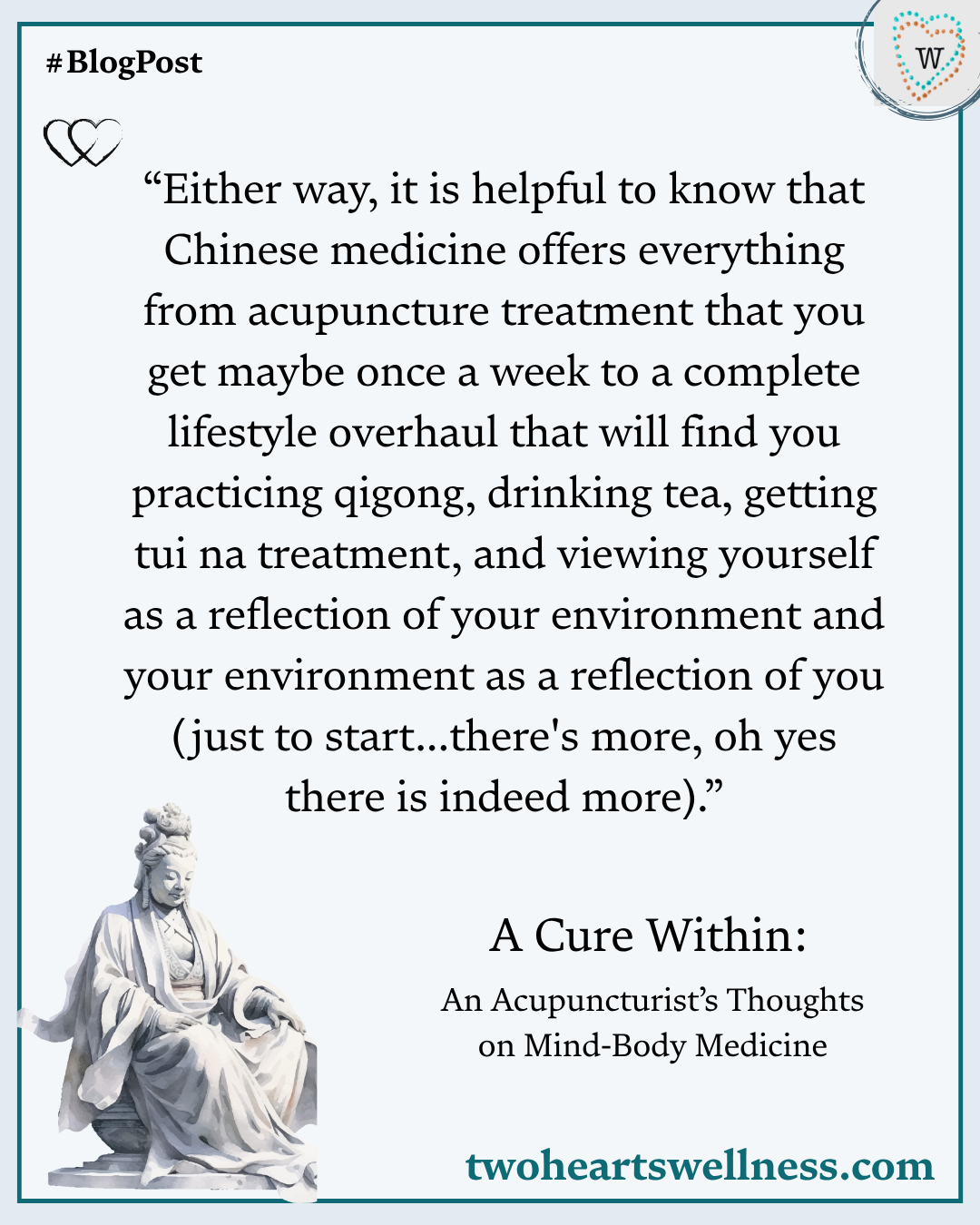
Either way, it is helpful to know that Chinese medicine offers everything from acupuncture treatment that you get maybe once a week to a complete lifestyle overhaul that will find you practicing qigong, drinking tea, getting tui na treatment, and viewing yourself as a reflection of your environment and your environment as a reflection of you (just to start…there’s more, oh yes there is indeed more). The TL/DR on that is: it can be possible to be cured by Chinese medicine and it is always going to offer you a healing journey that includes not just your body but also your mind and your spirit.
*****
*****
Knowledge is power
I bang on about this constantly because it is true: knowledge is power. You do have options. Yes, there are some things that absolutely require biomedicine (type I diabetes, for instance, or a burst appendix, to name two). But there are a lot of things that can be changed by lifestyle and dietary shifts. It’s getting harder and harder to discern, given the onslaught of AI slop and influencer culture, true, but if you find the right resources to build your knowledge base? Yes, you do have options.
So what do you think?
And where, if you ponder it, does the power over your own health and wellbeing reside?
*****
*****
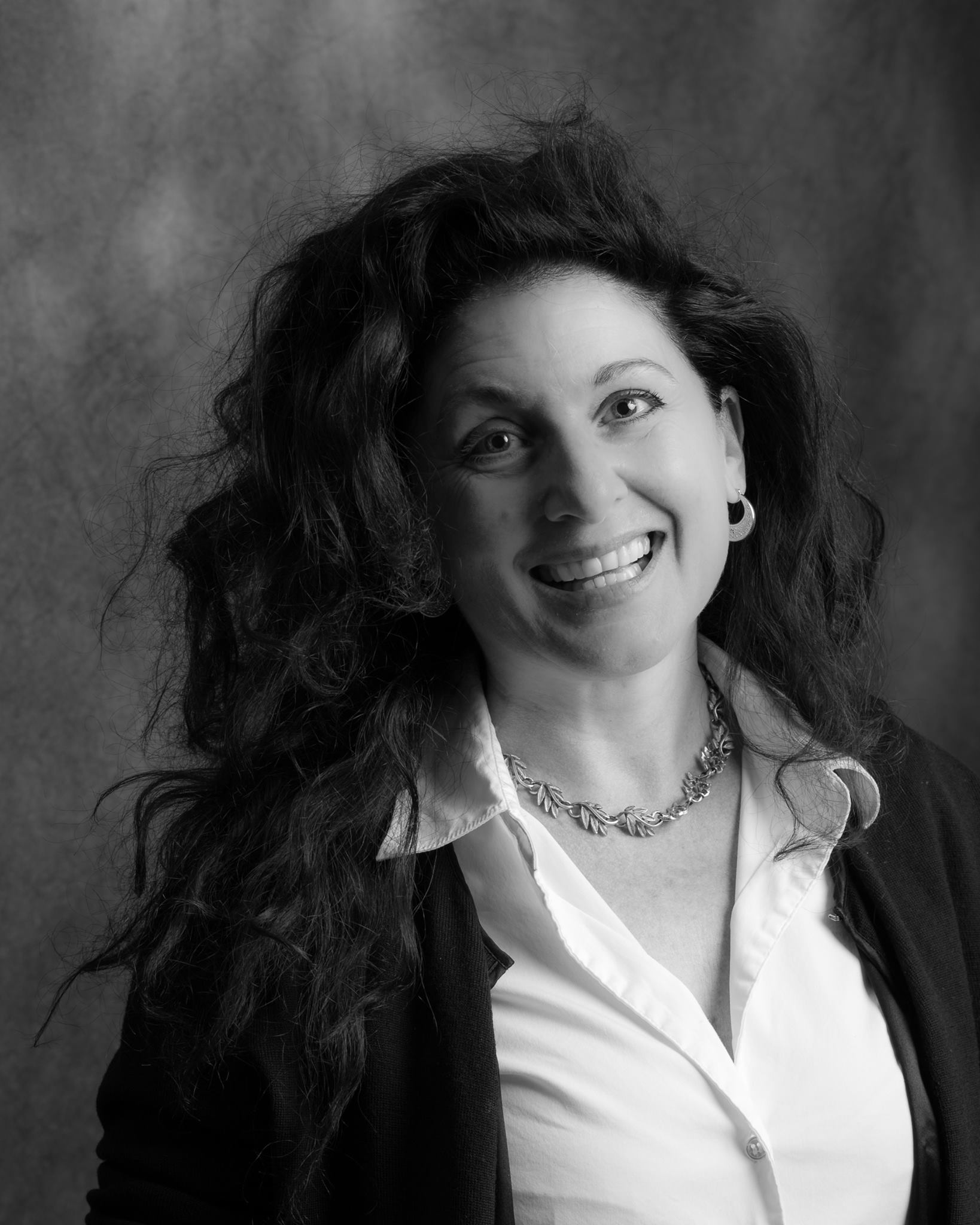
Dr. Paula Bruno, Ph.D., L.Ac., is a licensed acupuncturist and herbalist, an AOBTA-CP traditional Chinese bodywork therapist, a health coach, and an author. She maintains an active and growing practice at her Austin, TX office. Dr. Bruno is also available for distance appointments for wellness consultation or coaching.
In her first career, she was a Spanish professor.
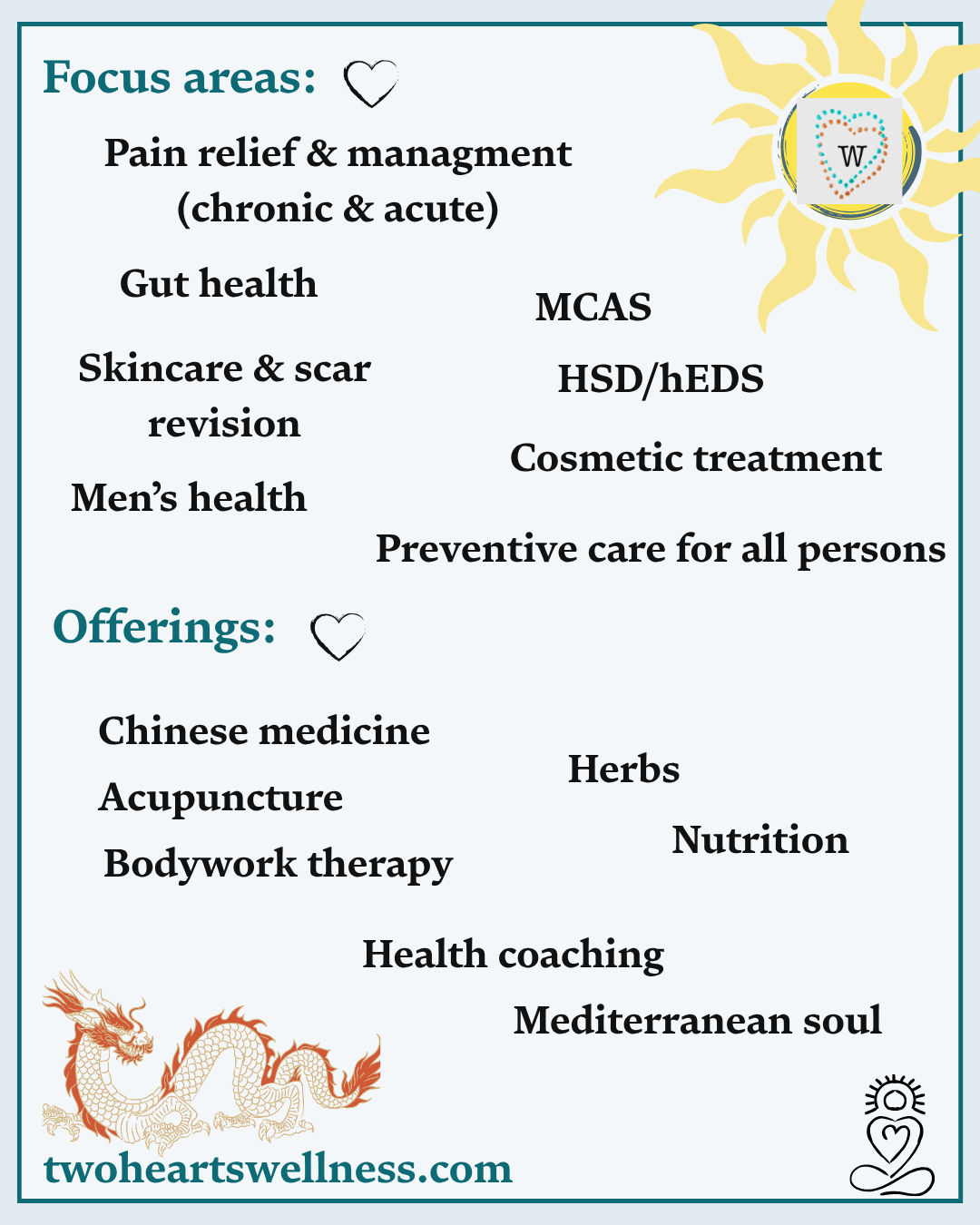
Dr. Bruno’s specialties as a Chinese medicine practitioner include: • Musculoskeletal health (acute or chronic pain relief; Ehlers Danlos syndrome & hypermobility support) • Digestive support, gut health, and weight loss • Aesthetic treatment, including scar revision • Men’s health • General preventive care and wellness support for all persons.
She is the author of Chinese Medicine and the Management of Hypermobile Ehlers Danlos Syndrome: A Practitioner’s Guide. Dr. Bruno also maintains a second website, holistichealthandheds.com, with resources and information curated specifically for people with hEDS and HSD.
When you are ready to discover what traditional medicine plus a vibrant and engaged approach to holistic health can do for you, either contact Dr. Bruno or book an appointment online.
*****
*****
Two Hearts Wellness does not accept paid advertising on this website & only uses strictly necessary cookies. All our copy is generated by human effort (there is no AI slop here!)
Note: Material on this web site site is not intended to diagnose, prevent, treat, or cure any disease, illness, or ailment. A Chinese medicine practitioner in Texas identifies syndrome patterns but does not diagnose illness. Material on this web site does not purport to identify syndrome patterns.
*****
- This is the cover of the copy I purchased. It’s interesting, because in a book of six chapters (plus intro and concluding remarks), only one of them relates to Asian topics. A more realistic cover would have had someone with a distinctly Anglo visage being hypnotized, I think, if not a priest performing an exorcism. ↩︎