Autumn is upon us and the longer I practice Chinese medicine, the more the wisdom of our venerable medical ancestors resonates. Do you pay attention to the seasons and shift your lifestyle in a mindful way along with their rhythms? Most people do, to a certain extent, but it’s more an instinct than a choice. And now, especially with extreme weather events occurring more and more frequently, people are becoming amenable to the need to be seasonally aware. Either way, this blog post is an invitation to consider how you transition into a new season and it shares ways to nurture your wellbeing in so doing.
Here, as with my other blog posts on the subject of seasonal living, I touch upon four key elements of this topic according to the philosophy of Chinese medicine. These are: environment, organs, food, and mood.
Living seasonally according to Chinese medicine’s values has become a favorite topic of mine and there are other posts on the subject if you are equally charmed. Refer to Living With The Seasons According To Chinese Medicine: Spring Tips For Health And Happiness and its companion pieces, Living With The Seasons According To Chinese Medicine: Summer Tips For Health And Happiness and Late Summer: Health, Happiness, & Strategies for further exploration of this theme. An essay for winter will be forthcoming, so stay tuned…
Environment:
Entities and ideas don’t stand alone in Chinese thought. To some degree, your Chinese medicine practitioner values the inter-relation more than the thing. In other words, we’re looking at what happens to an object, idea, or action once it’s placed in relation to something else and we also truly value the interspace created by the interaction. Ideally, the this and the that in any given context are in balance and engage harmoniously. We also take note of their qualities and deem them either yin or yang or in-between.
*****
*****
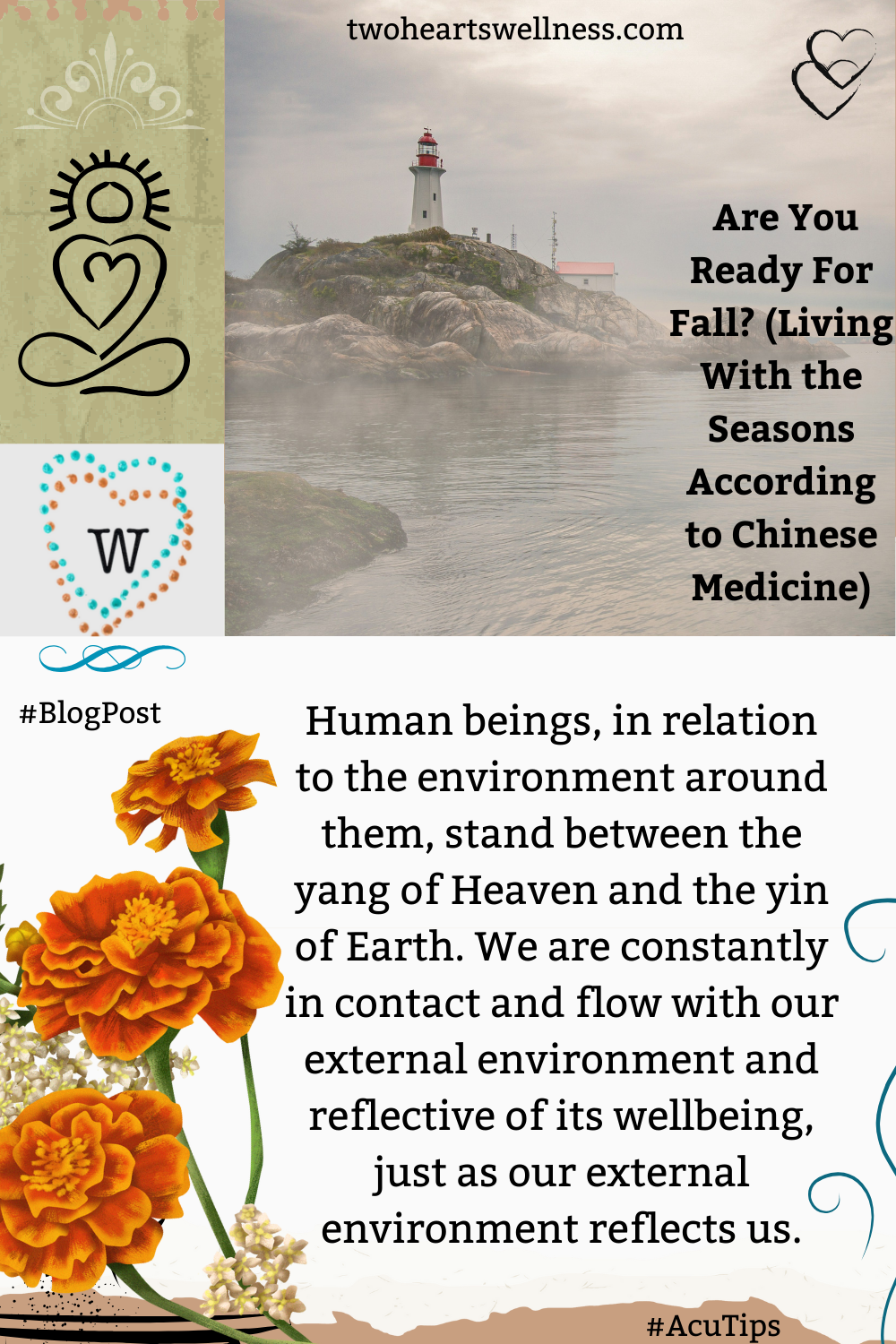
Human beings, in relation to the environment around them, stand between the yang of Heaven and the yin of Earth. We are constantly in contact and flow with our external environment and reflective of its wellbeing, just as our external environment reflects us.
Fall is a yin period, and winter even more so. Winter is the most yin of the seasons, as one can easily imagine. Spring is when yin decreases and yang increases; the highest point of yang (relative to the other seasons) is, of course, summer. Yang is movement, heat, and energy, among other qualities that provide contrast to its opposite, the relatively colder, quieter, and more unmoving yin. Fall’s essential element is metal, and its organ association is the Lung and its pair, the Large Intestine.1
But what, especially if you are new to Chinese medicine, does this mean for you?
Organs:
If we ponder this within the context of Lung and Large Intestine, we might notice that these are the organs of inspiration and elimination, respectively. During the fall season, we are smart to nurture balance in our Lungs and Large Intestine. Otherwise, we find that colds, cough, allergies, asthma, and skin problems like rashes and eczema are a problem. If our Large Intestine is not in balance, the result can be diarrhea or constipation.
Gut health is, without question, one of my favorite issues as far as health and wellness goes. Your gut is your everything. If you’d like to follow up on some of Chinese medicine’s thoughts on gut health, refer to “Gut & Digestive Health: Three Reasons Why It Matters & How Chinese Medicine Can Improve Yours.” For more information on what Chinese medicine can do for you if you suffer from seasonal allergies, take a look at “Seasonal Allergies (And Ways To Resolve Them).”
This makes sense, doesn’t it? Fall is when rates of colds and flu increase. From a strictly biological perspective, respiratory and digestive problems are a logical response to changes in temperature. Cold, especially if you live in a region with truly snappy fall weather, truly does affect our health.
If you do want to look at it in biomedical terms, it’s this: the temperature drops, our body’s defense mechanisms kick in to protect us. This usually means constricting blood vessels and increasing internal pressure within the digestive system. This increased pressure can cause stomach discomfort, even pain. In addition, digestive enzymes tend to work less efficiently when temperatures are low, leading to indigestion and bloating.2. Digestive problems, in response to cold, can either manifest or, if already present, worsen. Cold can also affect the immune system and the way our noses protect us from viruses.3
It makes sense, if you think about it. And just because Chinese physicians of two thousand years ago didn’t have the scientific knowledge prevalent today, that doesn’t mean that their assessment of cold in relation to the respiratory and digestive systems was faulty. They knew.
How ever you narrate it, colder temperatures affect your lungs and your gut. The season attributed to Lung and Large Intestine suddenly makes perfect sense, doesn’t it?
*****
*****
Food:
Fall is the moment to eat a mixture of warming and cooling foods with the intent to create balance and to open the Lungs. Fall, as we remember, is a dryer period of time and one that Chinese medicine associates with the element of Wind. It can be smart to eat more substantive food (proteins, meat, fish, nuts, beans, and seeds) now. It is also a good idea also to leave summer’s cold salads behind for the interim.
Seasonal vegetables, especially stewed or steamed or folded into soups, are a great resource. Sharp vegetables, like the pungent ginger, horseradish, onions, garlic, and turnip are also excellent at this time. If you like fermented vegetables, now can be a great moment to indulge.
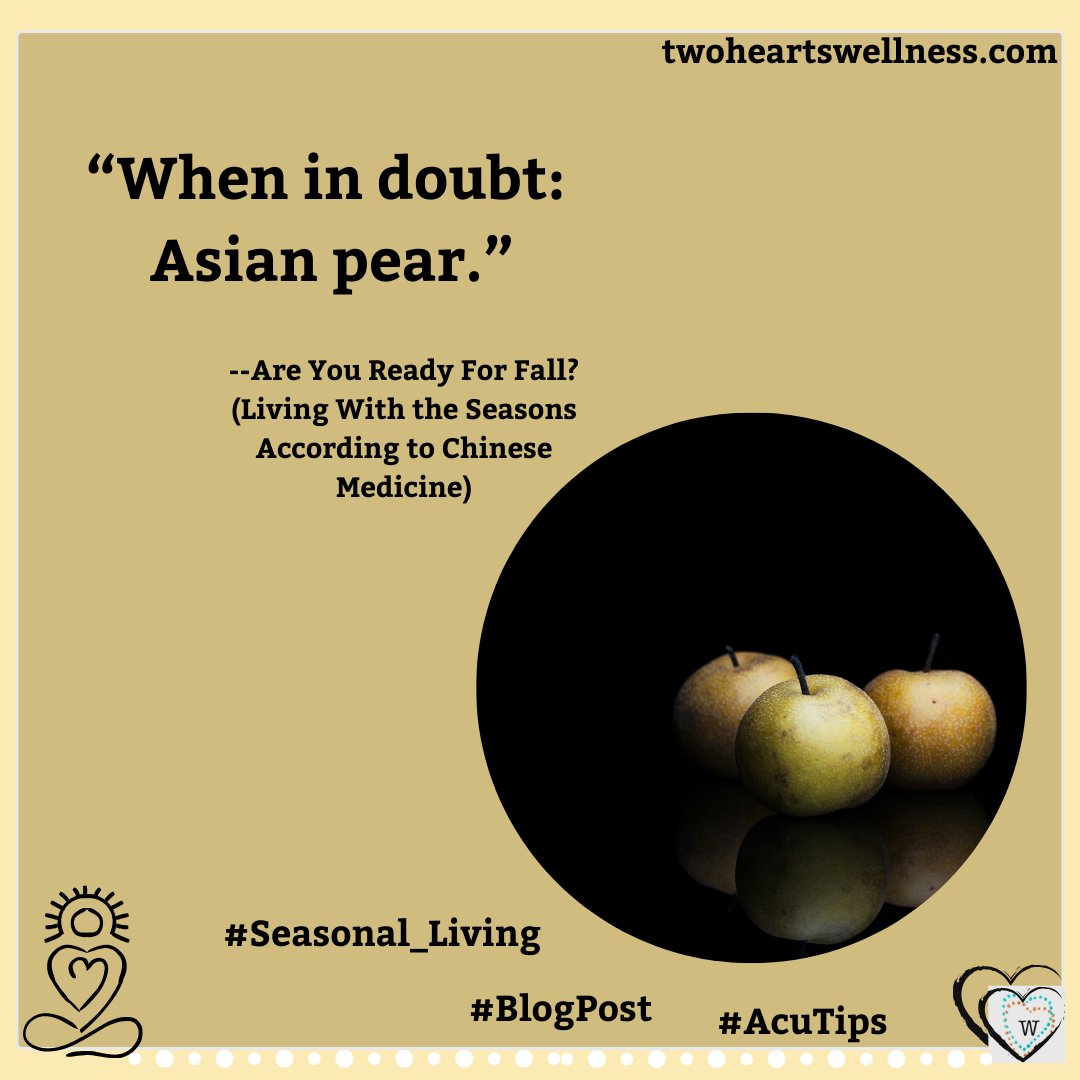
In-season fruit, like pumpkin, squash, apples, grapefruit, and lemon are healthy options for the time period. Another excellent option? Asian pears. (When I was studying nutrition during my second graduate program–that would be the Chinese medicine; the first grad studies were in Spanish–I earned myself the nickname “Asian pear” because every time the instructor asked “What would be a good fruit for [fill in the blank] condition?” my answer was “Asian pear.” But the fact is…Asian pears are delicious and they’re really good for just about everything. My motto? When in doubt: Asian pear.)
As to spices…some of the good ones for this season are cloves, cinnamon, ginger, oregano, rosemary, thyme, cardamom, and fennel. Ginger tea is also a good choice for fall.
Mood:
Do you notice that you feel melancholy when the weather starts to turn? From the biomedical perspective, this can be due to less sunlight leading to shifts in vitamin D levels and serotonin (the so-called “feel-good hormone”). Being sad or blue during fall can be a precursor to seasonal affective disorder in winter, or SAD, which is cyclical dips in mood that follow the seasons. In other words, a person is depressed and anxious every fall and/or winter, no matter the context of the rest of their lives. Things could be fabulous in every way, including mood, until autumn gets into gear and/or winter hits, and then it’s sleepy, depressed, carb-craving, and anxious. That is seasonal affective disorder, and it’s no kind of fun for anyone who experiences it.
*****
*****
Chinese medicine sees this in our own way, but we also are a little more philosophical about it. We view the moods of fall as being a logical outcome of Lung imbalance at the turn of the new season. We view this as something that can be ameliorated by acupuncture, by an herbal formula, via some nutritional strategy, and/or through a measure of lifestyle accommodation. We’re not here to urge pharma drugs or pathologize this development. Instead, we might nurture the Lung and its connection to grief, or consider the Large Intestine and its capacity for letting go, and support the organs accordingly.
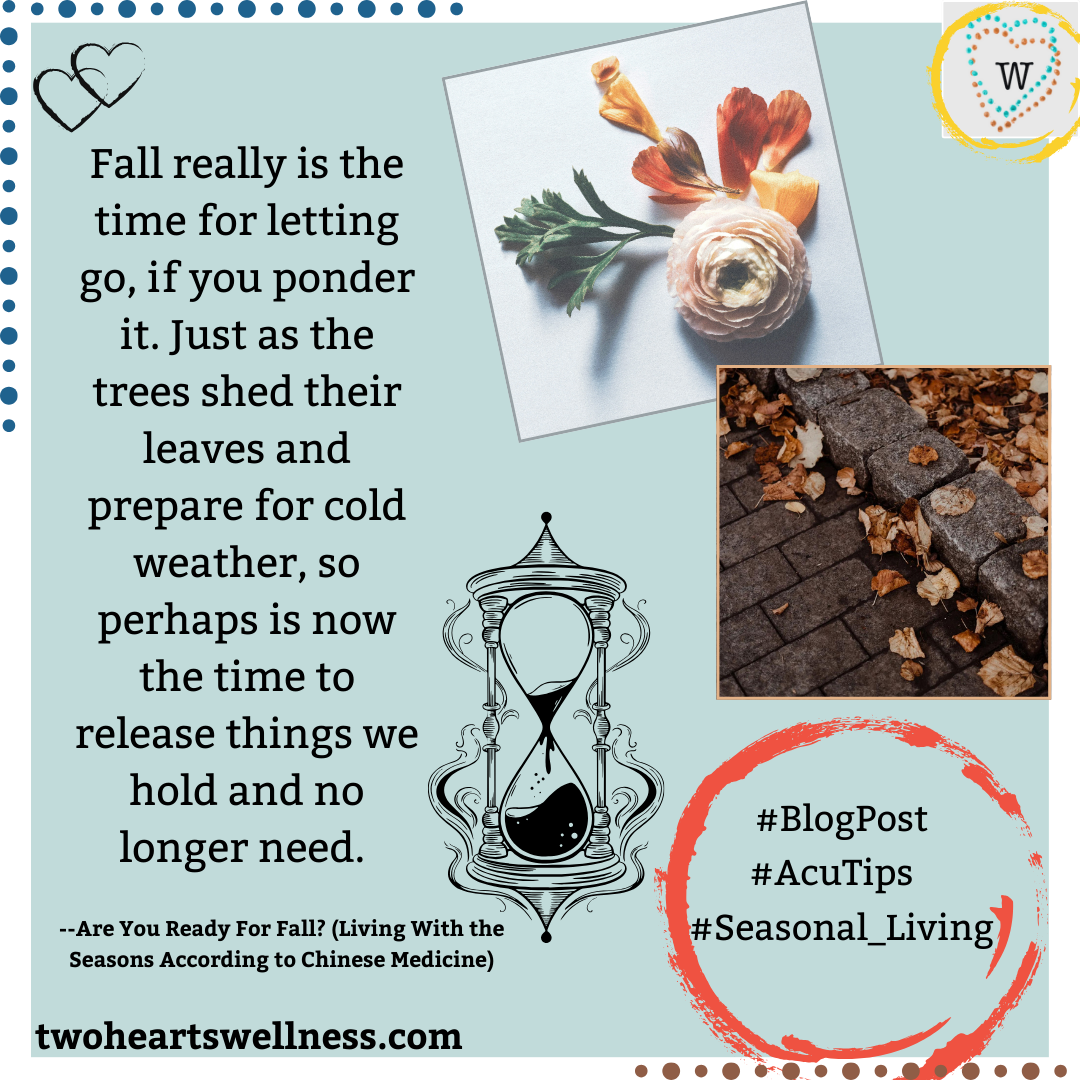
Fall really is the time for letting go, if you ponder it. Just as the trees shed their leaves and prepare for cold weather, so perhaps is now the time to release things we hold and no longer need. And with loss comes a measure of grief, no matter how subtle, and the awareness that life is fleeting and time moves quickly. As we slow down a bit for the season, it can be good to take stock of how we appreciate our lives and recognize that where we are right this moment will most certainly not last forever.
Fall is a beautiful time of year, and it is poignant. When we move gracefully with the changes of season and acknowledge that which they bring us, we cultivate a healthy and fruitful life.
Are you ready to enjoy a beautiful and healthy fall season?
***
***

Dr. Paula Bruno, Ph.D., L.Ac., is a licensed acupuncturist and herbalist, an AOBTA-CP traditional Chinese bodywork therapist, a health coach, and an author. She maintains an active and growing practice at her Austin, TX office. Dr. Bruno is also available for distance appointments for wellness consultation or coaching.
In her first career, she was a Spanish professor.
Dr. Bruno’s specialties as a Chinese medicine practitioner include: • Musculoskeletal health (acute or chronic pain relief; Ehlers Danlos syndrome & hypermobility support) • Digestive support, gut health, and weight loss • Aesthetic treatment, including scar revision • Men’s health • General preventative care and wellness support for all persons.
When you are ready to discover what traditional medicine plus a vibrant and engaged approach to holistic health can do for you, either contact Dr. Bruno or book an appointment online.
~~~~~



*****
Note: Material on this web site site is not intended to diagnose, prevent, treat, or cure any disease, illness, or ailment. A Chinese medicine practitioner in Texas identifies syndrome patterns but does not diagnose illness. Material on this web site does not purport to identify syndrome patterns.
Two Hearts Wellness does not accept paid advertising on this website
*****
- Note: when I capitalize an organ it means that I’m thinking about it in Chinese medicine’s terms; otherwise, lung or large intestine are terms related to the organs as they are conceptualized in biomedicine. The same goes for the use of Heaven vs. heaven, or Earth/earth. ↩︎
- Sometimes it can seem like Chinese medicine is a little esoteric (and sometimes it definitely is) but I will always challenge the idea that the ancients were fantasists. Western biomedicine has its narratives, just as Chinese medicine does. It is fascinating to look at contemporary research and notice how genuinely brilliant and insightful our medical ancestors were. See, for intance: “Blowing Hot and Cold: Body Temperature and the Microbiome,” “Alterations in intestinal microbiota and enzyme activities under cold-humid stress: implications for diarrhea in cold-dampness trapped spleen syndrome,” and “Cold exposure, gut microbiota, and hypertension: A mechanistic study” for current research into these topics. The first and third are more geared towards biomedicine and the middle one offers somewhat of a pivot between the two that leans towards Chinese medicine. ↩︎
- Take a look at “Cold exposure impairs extracellular vesicle swarm–mediated nasal antiviral immunity” for the biomedical narrative of this process. ↩︎
 Two Hearts Wellness