You are ready for change (or, after a lecture at your doctor’s office about pre-diabetes, you know that change is in your best interest whether you’re ready or not). It’s time to restructure the way you manage and nurture your wellbeing. For some people, it’s a chronic condition. For others, it’s a surprising one-off health happening. For still others, it’s looking ahead to a goal, whether it be near or far, in the future. Is it that you want to lose weight for a reunion or other special occasion?
Whatever your reasons for wanting to work with a health coach, here you are. If you’re at the “looking for a coach” stage, you’re in the right place and you’re smart to have questions. Health coaching is a relationship-based service. You want to get along well with your coach and establish a comfortable rapport. But it’s also your health. You need to find someone who is qualified to help you to get where you want to go. It seems like it would be easy to find a coach (a simple web search will bring up page after page of options) but working with a coach is an investment and you really do want to find your optimal wellness guide.
What, then, to do?
Note: I will reference it below (and link, as well) but this essay riffs on one I posted here at Two Hearts Wellness back in 2018, “Find A Health Coach: How To Find The Best Coach For What You Want To Accomplish.” It’s essentially an updated version that reflects my more robust knowledge of the profession at large and how it affects you, a potential new client of either my services or another coach’s. Coaching as a profession has grown but I still think it’s not always that easy for people to choose the right one, especially since there are now so many options.
Well, you see what you think…
*****
*****
~~ First, find your why ~~
If you’re trying to adjust to a medical diagnosis you might be more successful if you work with a coach assigned by your doctor’s office, for instance. If you have a rare or complicated condition like–just to cite something I work with a lot–Ehlers Danlos syndrome, you already know that you need someone who knows this condition.1. In the absence of pressing medical need, you may want someone who helps you to lose weight or change your ideas about your power over your own wellbeing and that may not be the health coach you get from your MD’s referral list.
When you look for a health coach, your why is an important point of departure.
The first step, consequently, is to sit with yourself and ask yourself, simply, why you want to work with a health coach and what you hope to accomplish. One benefit of working with a coach is the way you become a team, with the most important member and project being YOU. If you have a health concern is long-standing and you’ve tried and tried and tried and not been able to shift things, working with a health coach can be the deciding factor in your eventual success. If you have a goal that you want to achieve within a certain time frame, your health coach can be the one to guide you toward the winning strategy. Everyone has their story, so what is yours? From providing encouragement and inspiration to being a source for accountability, your health coach will be with you every step of the way.
Are you ready to start?
~~ Reading websites ~~
When you look around to see what the internet has to offer, there is one thing (besides credentials, which I’ll discuss next) that should give you a pause and that would be whether or not you feel a sense of authenticity as you peruse the offerings. Is the whole website one big AI fabrication? If there are pictures of the coach, are they filtered unto something nearly unreal? Do you honestly feel like you’ve gotten a sense of who this coach is from their website? If it’s so canned and clichéd that you wonder if you’ll be dealing with an actual human then this might not be the best option. Keep looking.
Speaking for myself, I really do not like AI one bit. My website content is obviously made by a human being (me). There’s nothing wrong with having a chatbot as your health coach, but if that’s not what you want and you do actually want a human being, then see what resonates when you look at their socials. Can you perceive a personality or a philosophy of practice that doesn’t rely on a script?
Once you’ve narrowed your search by taking note of who seems like a real person and who might actually be more chatbot/less actual person, then you want to circle back to the websites that made the cut and look at credentials.
*****
*****
~~ Credentials count ~~
Texas is a funny place for many reasons, some good and some less so. One of the odd things here in Texas is that you don’t need any credential at all to call yourself an herbalist. However, if you want to be a licensed acupuncturist you are required to have undergone a substantive herbal study program and you must pass a grueling board exam. I know people who decided to leave Texas because they couldn’t pass the board exam but they were determined to be acupuncturists. And yet: anyone can be an herbalist with no credential in Texas (as long as they’re not a licensed acupuncturist).
Being a health coach is kind of the same thing. There doesn’t seem to be a lot of regulation of health coaches and people can just set themselves up as coaches without substantive credentials. An ethical coach will have a clear explanation of their background and they really should (I think, anyway) have a specific health coaching certification. Depending on your goals, you might also look to see if they mention any training or specialty certification related to your interests and goals. (Here are my bona fides).
“There are several perfectly good ways to become credentialed and your potential coach should make it clear that they are certified and clarify by whom they are certified. If you want to know what characterizes their program, the coach should be able to speak readily about their preparation and how it compares to other certifications.” —Find A Health Coach: How To Find The Best Coach For What You Want To Accomplish.
*****
*****
~~ Conditions count, too ~~
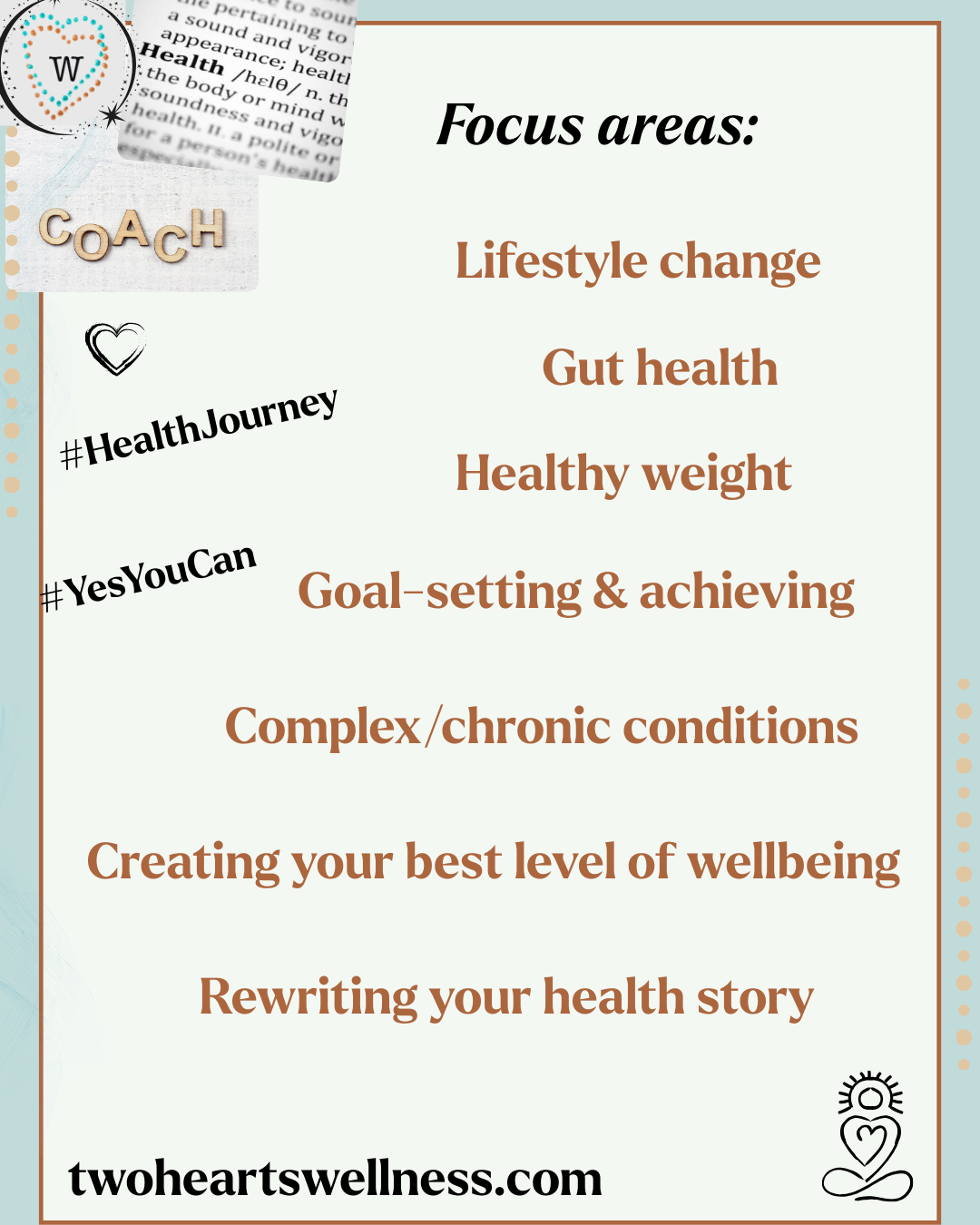
In my practice, my background as a Spanish professor informs my coaching style. Certainly, I have lots of training and experience with motivational interviewing and working with people over the course of the stages of change. But I love teaching and am passionate about learning and self-knowledge. As a coach, my goals for you are to inspire critical thinking, to bolster your confidence in your ability to create your optimal version of health, and to make it possible for you to learn about an extremely important person: you. Consequently, my style is Socratic and I tend to get on best with clients who enjoyed their college years. I also am obsessed with gut health, a super-specialist in Ehlers-Danlos syndrome, hypermobility, and MCAS, and a literature PhD. I’m the one you work with if any or all of the following describes you:
- You want to be challenged to think critically and to question your beliefs (especially if they’re limiting);
- You want gut health first (and are happy to see how healthy weight follows);
- You want to learn how to enjoy your food in a healthy, affirming way;
- You’re interested in slow living, calming down, and/or restoring tone to your vagus nerve;
- You live with a complex, chronic illness (EDS, MCAS, autoimmune disease, fibromyalgia) and you want to learn how to live your best life with your condition;
- You’re a college student (I’m still Professor Bruno at heart)2
- You are excited to learn and love thought-provoking questions (no matter your age)…
There are a lot of interesting and wonderful coaches out there. If you want to lose weight, would it make you happier to work with someone who is almost like working with a nurse, or would you rather have a health coach who is a foodie who inspires you to try new recipes and intercultural adventures? (I’m more aligned with the second, although I do have the healthcare provider credential and can provide an experience in alignment with the first). If you live with EDS or fibromyalgia, you’re probably better off with someone who knows these conditions, true, but are you more interested in learning gentle, at-home movement or do you want to shift your mindset? In the first instance, a coach who is also certified to teach yoga or who offer guided breath work might be your best bet, while in the second case you might want one who is keeps the focus on inspiring and challenging you in other ways.
What are you bringing to the interaction and what do you need for your potential health coach to bring in response?
*****
*****
~~ S’up? ~~
What’s up with supplements? Everywhere you turn, there are pushes to get you on the bandwagon of supplements. In my practice as a licensed acupuncturist, I do not sell any supplements and I send my Chinese medicine patients to a local herbal pharmacy for their prescriptions. This is because I do not feel okay about shilling supplements and I’m not even altogether that comfortable about selling herbs directly to my patients.
I’m not sure how this is with other certifications, but the study material for my health coach cert was pretty clear that it’s not a good idea for health coaches to push supplements. If you work with a health coach that wants you to buy supplements from them it might be a good idea to check their credentials one more time. What specifically qualifies the coach to decide which supplements are best for you?
~~ No goal, no soul ~~
What is your goal? And are you determined to achieve it or do you need some prodding to persuade you?
Some coaches are great at helping you to find your motivation. If you have no motivation, that’s just fine because they have enough for both of you. If they are an excellent coach, they’ll probably even teach you how to find your motivation. That’s not me. I’m baffled by people who are unmotivated. If you have even the slightest shred of competitive urge or intrinsic drive to succeed, I can take you places you never thought you could go. But you have to have at least some motivation to start.
This is an interesting distinction and I remember it being the case when I was an academic too. One of my dearest friends loved teaching the students to find their motivation. I was the one who could whip students into graduate school (or really good job) shape if the student was at least somewhat competitive, but I wasn’t anywhere as good as my buddy was when it came to the unmotivated. My buddy wasn’t the one to mold future grad school students with quite the ferocity with which I did, though, so it evened out.
Point being? Coaches have their talents and weaknesses and you should ask them any questions you like about either or both. There is no one perfect health coach but there surely is the perfect health coach for you. If you’re unmotivated, there is an excellent coach out there who can support changing that. If you are already motivated (even just a little bit) but you’re not sure where to start and you love to be challenged, then I (or someone like me) would be your better option. There is someone for everyone, trust.
*****
*****
~~ Cheerleader or Accountability Czar? ~~
On that note… you also want to consider what motivation style works for you. Do you want someone to be your Chief Encouragement Officer or your Accountability Czar? I think that a bit of each is best for clients but you might feel strongly that you want one or the other. Which one resonates more with you?
Think about what feels best for you and then if the coach doesn’t ask you about it (they should ask you about it), you can just tell the coach what you prefer. Speaking for myself, I do ask clients and potential clients what they think about each option and what has their experience been as far as which worked better. If a client mentions a specific preference, then that is what we follow. People learn better and do better when the support system responds to their communication and learning styles. There is no right or wrong here, only what works for you.
~~ Is coaching different from working with a therapist or personal trainer? ~~
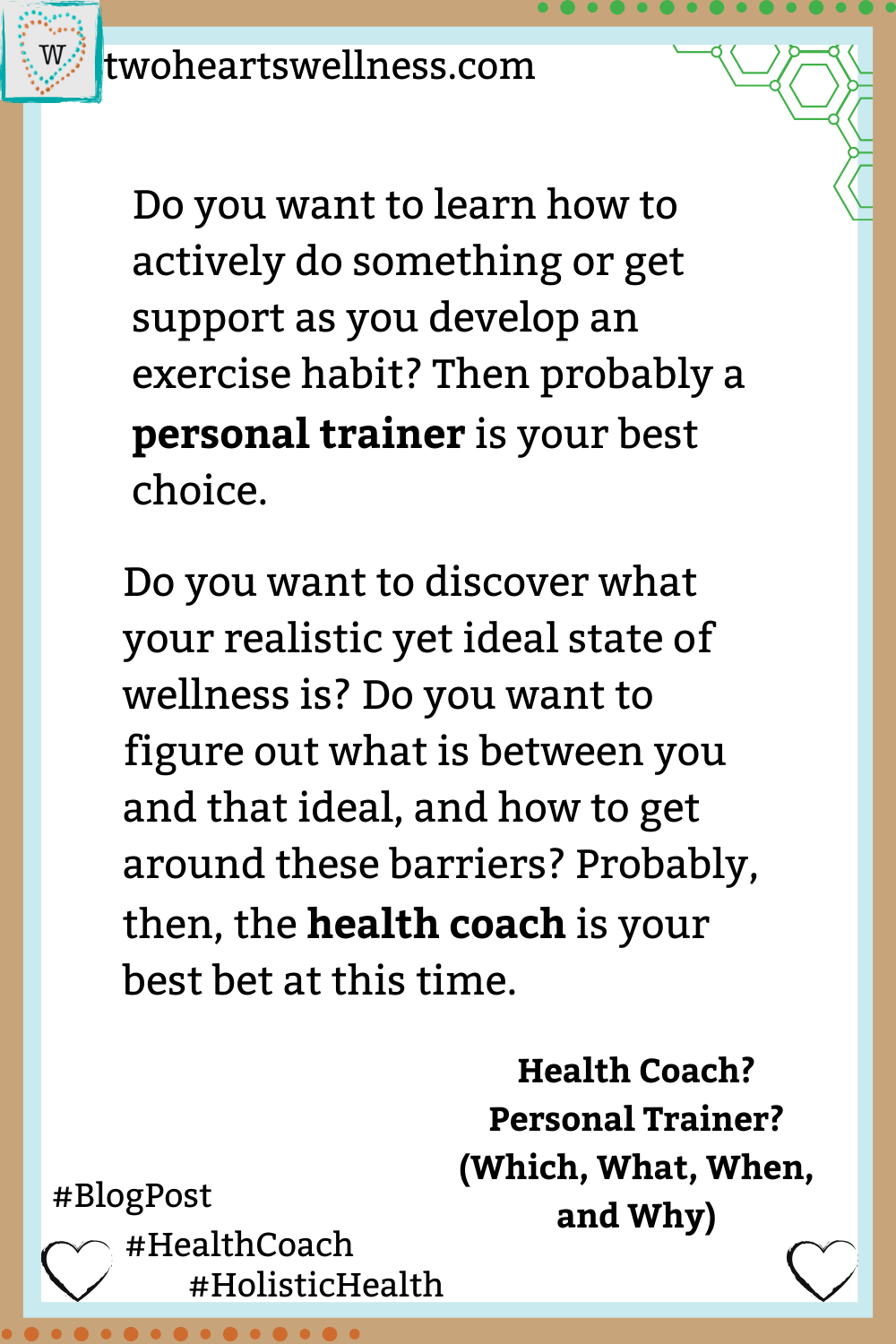
Here’s another (also older) blog post. This one’s about the difference between a personal trainer and a health coach and no need to read the whole thing unless you’re intrigued. The gist is as follows:
*****
*****
And no, a health coach is not a psychotherapist. In my practice as a licensed acupuncturist, I will tell patients that I can help them to find their trauma but that their therapist helps them to make meaning of it. I can ease the stress and distress caused by things like–for example–nightmares, brooding, anxiety via acupuncture, nutrition guidance, and herbal medicine. A good series of appointments can even potentially put a stop to the aforementioned nightmares, brooding, and anxiety. Digging into traumatic details surrounding the why of ongoing nightmares is not what a person should be doing at an acupuncture appointment, for instance. That is something to discuss with a therapist.
The same goes for health coaching. If you’re learning how to eat with joy and awareness of healthy portions, without shame and/or obsessiveness, then that is a wonderful reason for working with a health coach and getting to do the practical things that will help you to achieve your goals. It would also be safest for you, if you are in recent recovery from an eating disorder, to have a therapist also. The behavior change and daily self-talk and new healthy habits are aligned with your work with the coach; what the eating disorder means to you on a psychological level is for therapy.
Good healthy boundaries make for wonderful health coaching relationships.
*****
*****
~~ What’s your unicorn? ~~
The coach should be asking you questions too. What brought you to the table? Tell me your history regarding your goal. If you have failed in the past, what do you think are the reasons for not succeeding? What did you learn? When you have succeeded, what was the reason for your accomplishment? What are you most proud of in both the failure and the success scenarios?
The most important question, I think, is: what does your wellness unicorn look like? By that I mean: we all have our mythical vision of what we want out health to look like. And we all have our stories. What are your most heart-felt hopes for this endeavor? If you could describe your optimal outcome, what does it look like and feel like? Visualize it as though you were already there and share your thoughts. Doesn’t it feel great to have a goal and a confident vision? Well, if you can describe it to me then you are halfway there and that is a great beginning and point of departure.
And finally, one last question here:
Are you ready to begin?
*****
*****
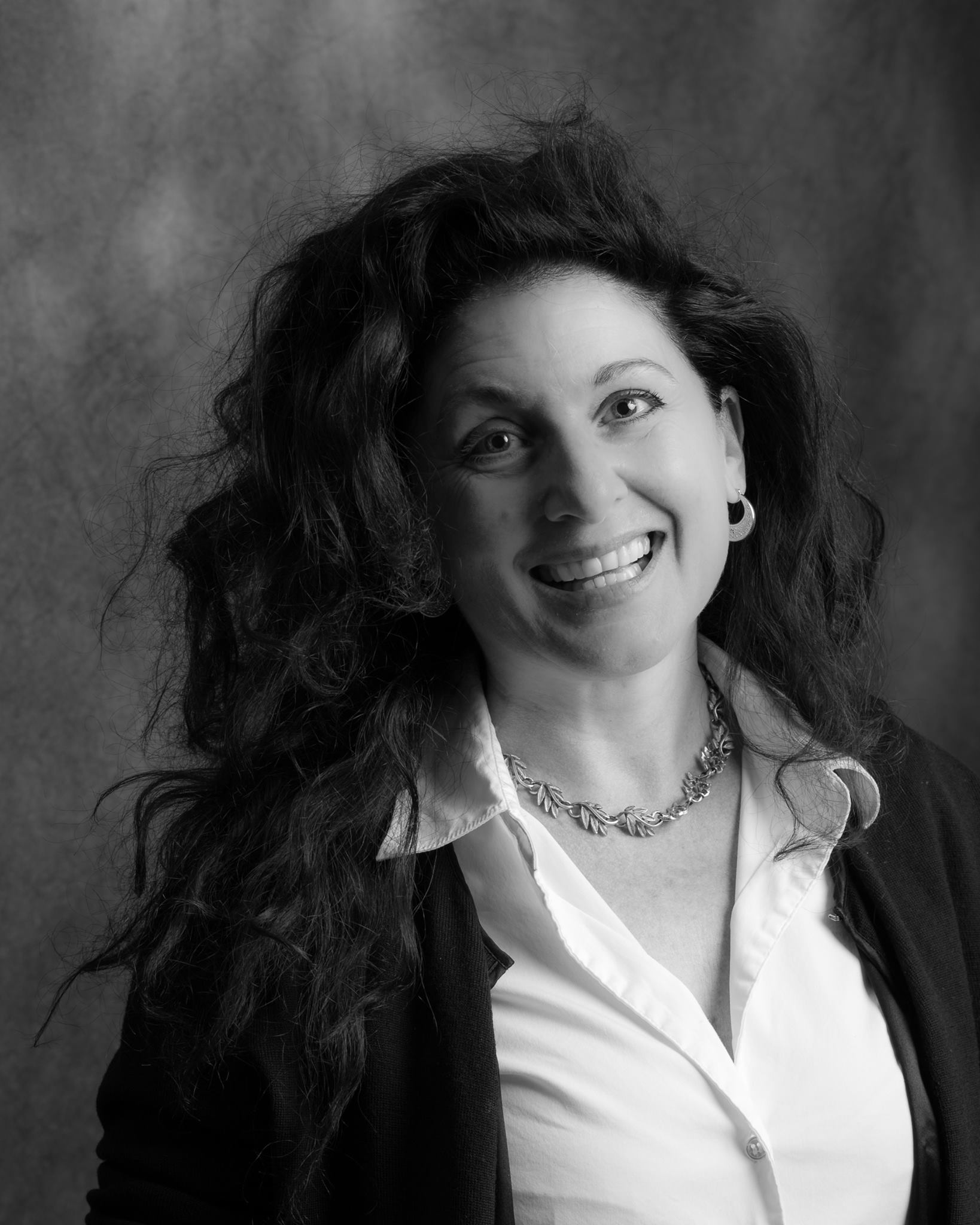
Dr. Paula Bruno, Ph.D., L.Ac., is a licensed acupuncturist and herbalist, an AOBTA-CP traditional Chinese bodywork therapist, a health coach, and an author. She maintains an active and growing practice at her Austin, TX office. Dr. Bruno is also available for distance appointments for wellness consultation or coaching.
In her first career, she was a Spanish professor.
Dr. Bruno’s specialties as a Chinese medicine practitioner include: • Musculoskeletal health (acute or chronic pain relief; Ehlers Danlos syndrome & hypermobility support) • Digestive support, gut health, and weight loss • Aesthetic treatment, including scar revision • Men’s health • General preventive care and wellness support for all persons.
She is the author of Chinese Medicine and the Management of Hypermobile Ehlers Danlos Syndrome: A Practitioner’s Guide. Dr. Bruno also maintains a second website, holistichealthandheds.com, with resources and information curated specifically for people with hEDS and HSD.
When you are ready to discover what traditional medicine plus a vibrant and engaged approach to holistic health can do for you, either contact Dr. Bruno or book an appointment online.
*****
*****
Two Hearts Wellness does not accept paid advertising on this website & only uses strictly necessary cookies.
Note: Material on this web site site is not intended to diagnose, prevent, treat, or cure any disease, illness, or ailment. A Chinese medicine practitioner in Texas identifies syndrome patterns but does not diagnose illness. Material on this web site does not purport to identify syndrome patterns.
*****
- Yes, there is a blog post for that: “Health coaching, Edu-coaching, Consultation: The Which and Why and When for People with Ehlers-Danlos Syndrome.” ↩︎
- Unless the person is a graduate student it is usually a parent who reaches out to me to start their student on a health coaching program. Yes, I have blog post for that, starting with one directed towards mom and dad: “Sending Your Daughter or Son Off to College: Some Healthy Advice For You And For Them.” There’s also “Health Coach For College Students? Yes! (Here’s Why),” and the EDS-dedicated “Health Coach For College Students? Yes! (Ehlers Danlos Syndrome Edition).” Students are not my primary clientele for health coaching–I’m more of a gut health, weight loss, lifestyle overhaul, and/or complex chronic illness health coach–but I do love my student clients. That is a fun age and stage to work with, I think. And that’s another point to consider as you look for a health coach: what is your age and life stage? Does the health coach have enough age and life stage of their own so that they can offer you both the challenges and the understanding that you deserve? ↩︎
 Two Hearts Wellness