It’s been quite a while since I’ve shared a book review and even more time has passed since I’ve written a scholarly critique of a narrative text. Reading Chemically Imbalanced: The Making and Unmaking of the Serotonin Myth (Flint, 2025) inspired me. This is a book that deserves any and all attention it gets and I hope, when all is said and done, that it opens up discussion not only of antidepressant medication and Big Pharma but also of depression and anxiety and how these emotions pertain to a bigger picture of collective trauma.
In my first career (I was a Spanish professor), my specialty area was national trauma and how it filters through literature and art. By “national trauma,” I mean: civil war, dictatorship, genocide, and torture. I spent a good twenty-plus years of my life studying this topic so it’s one, even now after my career change, that remains close to me. Collective trauma and the narratives it produces is a topic that invites a lifetime of inquiry. Even though I am now a practitioner of Chinese medicine, I assume that I will continue to study this subject for the rest of my life.
Becoming expert in this area also gave me a skill set similar to that of a medical historian. When I read texts like this one, I read them with a professional eye and a critical brain. Here, in this context, I am writing a reader-friendly review rather than a theoretical dissection of it. However, I do hold that Chemically Imbalanced is an excellent and informative book that merits both non-professional and scholarly attention and response.
One of the main arguments of Chemically Imbalanced is that Pharma’s story about serotonin is not only based on shady science but that it also misses the point about depression and anxiety. Are we really depressed and anxious because there’s a li’l imbalance in our brains, she asks, one that can be resolved by Pharma’s drug regimens? Or are we depressed and anxious because life is getting harder and harder, and it’s getting tougher and tougher to bounce back?
*****
*****
I wrote a blog post on this very topic, in fact. My argument in “Grief and Mourning (Some Thoughts)” is that we (and by this I mean not just North Americans, but pretty much everyone) have not necessarily come to terms with the shift that the COVID pandemic wrought. I think that as a global community, we skipped the opportunity to grieve together, to work together, and to heal together. I think that in the United States, especially, we have been too quick to move on (or at least pretend we’ve moved on) and we have not addressed the bigger picture of how traumatizing it was to learn how helpless we were (and remain) against pandemics of this nature.
(Do not get me rolling on the topic of current events…)
The author of Chemically Imbalanced is a professor, a researcher, and a practicing psychiatrist. She’s not some influencer who “did her research” and is now gabbling fanciful “theories” about how duplicitous Big Pharma is and how we must all drink raw milk and forgo vaccines and bathing if we want to remain healthy. No, she’s a substantive critic of the industry. I’m not going to reiterate the entire book (please read it–it’s worth your time and effort to do so!), so to keep it brief I am going to share only seven quotes directly from the book and then share my reply after each.
One thing to keep in mind before continuing, though? This is important: I do not want to shame or guilt trip anyone who is taking, has taken, or who is thinking about taking antidepressant medication. If it’s working for you, then it’s working for you. And everyone’s situation is different and only you and your doctor get to decide whether or not you benefit from taking them. What I do want to inspire with this review/response post is critical thought about how we are socialized to take medication and how much responsibility Big Pharma and their advertisements shape how we view the relentless stream of drugs they’d love for us all to be taking.
I highly recommend reading the entire tome yourself, but the highlights are as follows:
Dr. Moncrieff says:
“Many areas of science are not settled, and the story I am going to tell illustrates what can happen when people are misled into believing that they are” (p. 11).
*****
*****
My reply:
This gives me two flashbacks, one to my first microbiology and pathology class and the second to my evidence-based medicine course.
Acupuncturists in the United States take about the same amount of biomedicine coursework as a dentist does.1 We also have board exam that tests us on our biomedical knowledge. My first microbiology course used Robbins Basic Pathology as the textbook and I read it with great dedication. Years later, I still remember how taken aback I was by how many times the authors wrote “We don’t know why that is” and “We don’t really know how this works” and other similar. I was truly shocked at the time. I had never, ever gotten the sense from any doctor I’d ever dealt with that biomedicine has so many knowledge gaps. It’s genuinely astonishing to me, even now, how Western biomedicine has successfully perpetuated a narrative of being all-knowing. It is most certainly not that.
One of my super-specialty areas (to the extent that I wrote a book on the topic and have a website entirely dedicated to it) is Ehlers-Danlos syndrome and its accompanying common comorbid conditions, including MCAS and dysautonomia. In this role I have extension experience working with people who struggle with medical PTSD. Refer to “Medical PTSD and Chronic Illness: Root Causes and Strategies for Survival” for insights into this subject. Please note that that the initial anecdote it shares, a story about a specialist of rare disease who died in the hospital due to being gaslit about this same illness, is only unusual because the guy who died was the authority on his own condition, TL/DR: No, your doctor does not know everything and absolutely no, biomedicine does not hold all the answers.
This also really hit the memory buttons for my evidence-based medicine class. I finally gave up and just coasted through the term by being silent, but initially? I really got into with the instructor on the topic of evidence based medicine and bias.
BTW: Yes, I “believe in” science. Yes, I respect the value of research that is based on actual data and not feelings. Absolutely yes, I hold that research is crucial.
However. Facty-fact time: research is the creation of human beings and human beings are intersectional and human beings also need to fund their labs or not piss off the one cutting the paycheck and so forth. Also: political winds of change can upend what scientists can do and say, as is becoming more and more clear as of late. Neither researchers nor Dr. AI Chatbot are entirely bias or influence-free. So…just because the nice scientists at the Pharma lab say it’s safe or needed or evidence-based? That doesn’t make it true in all cases. And saying so made the instructor really upset. (I’ve noticed that this is a posture that gets scientists really pissed off on social media, too.)
But the author of this book is a research scholar and practicing psychiatrist, so take it from her and not me if it’s more palatable coming from someone with an MD rather than a PhD (which is the terminal degree that I hold).
*****
*****
Dr. Moncrieff says:
“We have this idea that there is ordinary low mood or sadness, and then there is this different thing called ‘clinical depression’ or ‘major depression.’ We have been told there is a difference between these two situations, but, in fact, there is no dividing line. There is no test that can tell us who has the ‘ordinary’ version and who has the ‘real’ medical condition” (p. 17).
My reply:
The author of this book makes two central points. One: the narrative about depression being a medical condition (a chemical imbalance of the brain) is a market-driven fable, and she proves it via her professional review of the research literature. And two: There is more to emotions than what can be tested in a laboratory.
For the first assertion, she relies on a valid assessment of the scientific literature to date to prove her point. The second argument might rely a bit more on philosophy of practice than on statistics but she’s certainly not wrong. Both my Spanish professor and practitioner of Chinese medicine selves laugh at the idea that everyone’s experience of emotion and how they express can follow a data-driven, monolingual-privileging Q&A model. That’s not how life works. That’s not how language works and it’s not how culture works.
(But if this reality gets in the way of Big Pharma’s marketing plans…? Pshaw! As this book shows, there is a useful narrative that is created and data is found to support it. This narrative then falls on fertile soil and is nurtured with every prescription written.)
*****
*****
Dr. Moncrieff says:
“We will see that the disease-centred [sic] model was embraced not because there was good scientific evidence to suggest it was correct, but because it fulfilled the ambitions of the psychiatric profession to be like other doctors and offer treatments that look like treatments in the rest of medicine” (p. 61).
My reply:
This happened in Spanish too. I’m of the generation that was told to go into academia because “everyone would be retiring by the time you get your degree and there will be lots of great jobs.” This is not how things went. I graduated the year of 9/11. The job market crashed, nobody retired when they might have generations ago, tenure has been pretty much phased out for all but a very few, and language departments decided that leaning heavily into second language acquisition (SLA) and linguistics would make us all sexy, up-to-date, and scientifical. (I know, it’s “scientific.” I’m being sarcastic though.)
Unlike literature (which, to be fair, was also trying to be as science-y as possible), linguistics relies on data. You have to have numbers. And so, as time went by, linguistics became predominate and literature shrank. I did not leave the profession immediately. I did hold two tenure-track positions (neither of which were good fits for me and my goals) and I was fortunate enough to be well-treated, well-compensated visiting faculty at excellent institutions, including Colorado College and Bucknell University (both of which I loved). But eventually I did need to make a choice and I chose to switch careers and practice Chinese medicine. And I remember once, during my first or second year of acupuncture school, looking on the job listings for Spanish. I wasn’t interested in returning to the profession and I wasn’t looking for a job for myself. I just wanted to see how things were going with the job market. It was the earlier stages of the academic job search time frame, so late September/early October.
What I saw made me hyperventilate until I broke down and wept. There were no literature jobs. It was all linguistics and/or SLA. The scholarly career I had spent my entire adult life preparing for was gone. There were no literature jobs posted. Not one. But the linguistics folks had a decent selection of jobs available and the market still seemed pretty good for them. But my field? Nothing. And it broke my heart.
Anyway… I can easily see psychiatry chomping at the bit to be accepted as Real Live Scientifical Folks Who Know How To Crunch Data. We sure as sh*t did that in the humanities, especially in Spanish and other languages.
And to such success, too! (/s)
*****
*****
Dr. Moncrieff says:
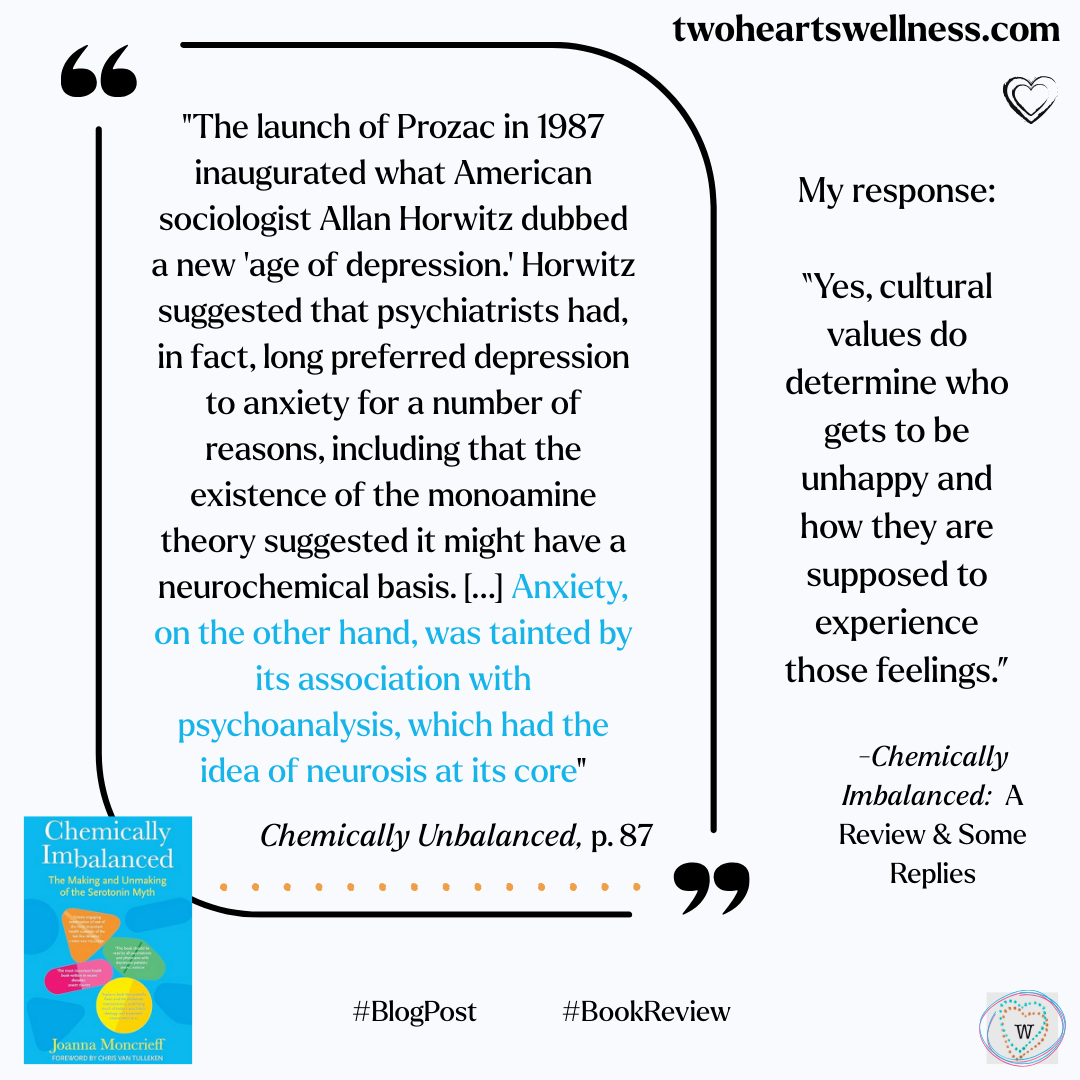
“The launch of Prozac in 1987 inaugurated what American sociologist Allan Horwitz dubbed a new ‘age of depression.’ Horwitz suggested that psychiatrists had, in fact, long preferred depression to anxiety for a number of reasons, including that the existence of the monoamine theory suggested it might have a neurochemical basis. […] Anxiety, on the other hand, was tainted by its association with psychoanalysis, which had the idea of neurosis at its core” (p. 87).
My reply:
Whoop, I can confirm this one too!
One question that could easily appear on one’s MA exam or–depending on one’s doctoral committee–one’s qualifying exams could relate to the word abulia and how it relates to a famous school of authors whose heyday was during the period of the loss of Spain’s imperial power. This would be the generación del ’98 (The Generation of 1898) and the country’s lingering abulia–or malaise, lack of willpower, and/or the incapacity to decide and act–was a major focus. This is a big deal. You could find yourself with an entire exam question asking you to demonstrate the cultural value of this word, how this attitude showed up in the literary tradition, and what it meant both in the specific literary detail and in the big, historical picture.
Wusses who lose their colonies get abulia. Germany, on the other hand, had cool options, like Friedrich Nietzsche’s Übermensch (Overman). I mean…who wants to be paralyzed by glitching executive function when you can be post-human and not fussed or fazed by anything?
I am being a smart ass AND generalizing so no, those are not the only seeds that have borne fruit currently, but it’s a mentality (emotional states as markers of one’s entire being) that resonates even unto today. It’s not a big step to look at the broad picture of attitudes towards what it means to be unhappy and emotionally unwell if you start with abulia vs. übermensch-dom. If you’re a woman, maybe it’s your womb or your hormones, but either way, you’re hysterical. Men are supposed to be über-dudes or else. If that’s not how things are rolling, then why not “fix” your brain chemistry and get better as soon as possible? So much better than being neurotic, amirite?!
Yes, cultural values do determine who gets to be unhappy and how they are supposed to experience those feelings. Human being are intersectional and emotional distress is not equal for one and all. True fact.
*****
*****
Dr. Moncrieff says:
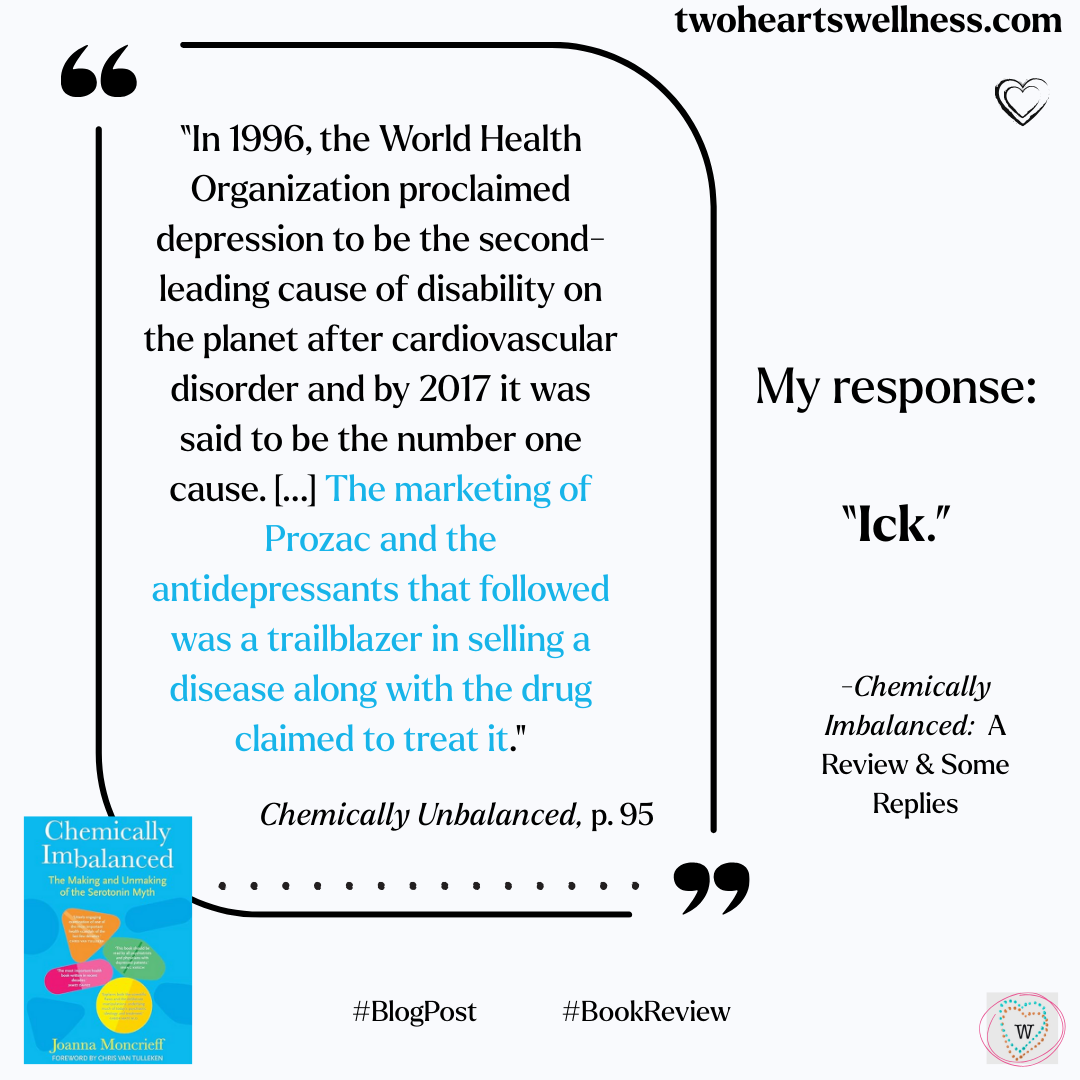
“In 1996, the World Health Organization proclaimed depression to be the second-leading cause of disability on the planet after cardiovascular disorder and by 2017 it was said to be the number one cause. […] The marketing of Prozac and the antidepressants that followed was a trailblazer in selling a disease along with the drug claimed to treat it” (p. 95).
She didn’t explain why, precisely, depression became this issue du jour for the WHO but the implication is that marketing forces and cultural approval of them created a monster of depression (rather than anxiety). Again, though, this development is a political, cultural, and economic issue first and foremost. And it was one that made it very, very easy for the good folks at the Pharma factory to start pumping out marketing stories to support it.
My reply:
Ick.
What I see as important here is the reminder that advertising does affect drug sales and consumption, which in turn affects how disease and dysfunction are diagnosed and treated. Disappointing, but true.
*****
*****
Dr. Moncrieff says:
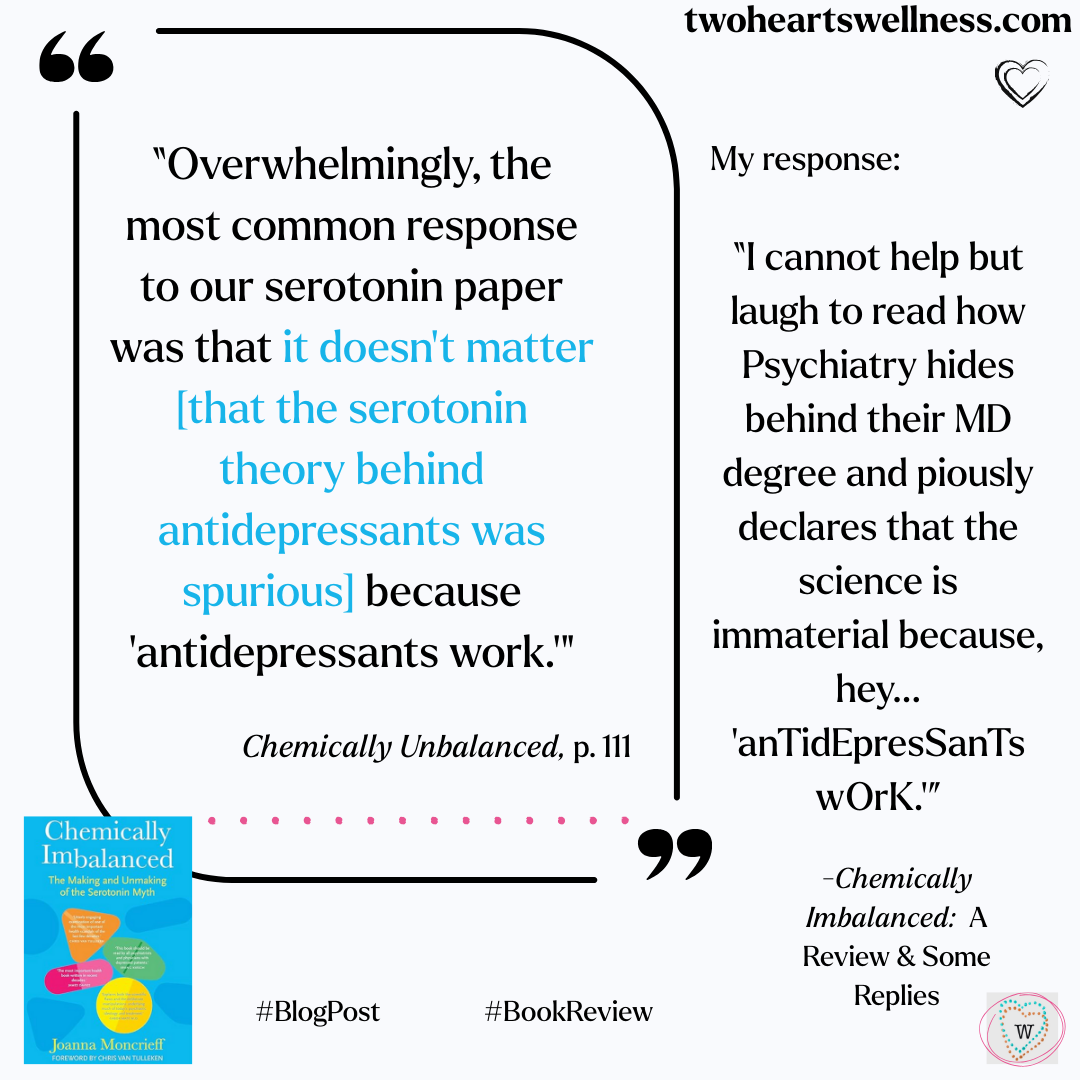
“Overwhelmingly, the most common response to our serotonin paper was that it doesn’t matter [that the serotonin theory behind antidepressants was spurious] because ‘antidepressants work'” (p. 111).
My reply:
This makes me cackle.
As an acupuncturist, the steaming horse apples that get tossed my way (and towards the profession) regarding whether acupuncture is pseudo-science, a placebo, utter quackery, etc. are deeply insulting. It becomes even worse when biomedical practitioners finally decide that acupuncture is fine, as long as it’s dry needling and performed by a physical therapist. Or Chinese medicine is woo-woo, but never fear! There are Western biomedical doctors who offer real medicine in the form of “medical acupuncture” (which, if you ponder it, implies that what an acupuncturist does is anything other than medical).
The biggest put-down, one that is supposed to be leaving us all hanging our heads in shame is the charge that any success via acupuncture and indeed Chinese medicine is all placebo. And if any of us say, “Well, so what? It works” then clearly we are un-scientific woo-woo energy healers and not real medical care providers. Or, as the kids say, rEaL mEdiCal ProVideRs.
I cannot help but laugh to read how psychiatry hides behind their MD degree and piously declares that the science is immaterial because, hey…”anTidEpresSanTs wOrK.” And they’re getting away with it! Holy cow, I wish we had it so easy over here in Chinese medicine! (/s)
*****
*****
Dr. Moncrieff says:
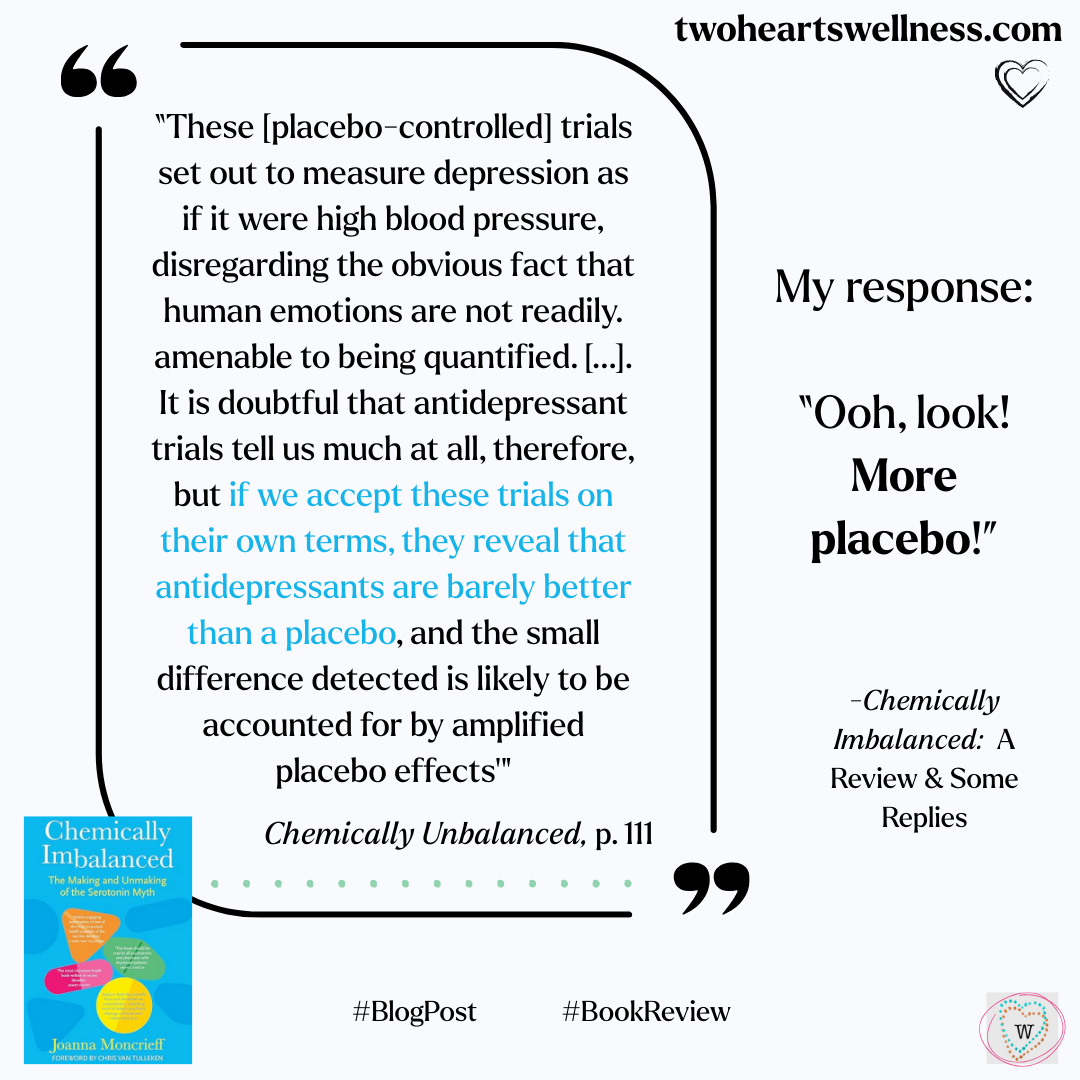
Re: placebo-controlled trials: “These [placebo-controlled] trials set out to measure depression as if it were high blood pressure, disregarding the obvious fact that human emotions are not readily amenable to being quantified. […]. It is doubtful that antidepressant trials tell us much at all, therefore, but if we accept these trials on their own terms, they reveal that antidepressants are barely better than a placebo, and the small difference detected is likely to be accounted for by amplified placebo effects” (123).
My reply:
Ooh, look! More placebo!
Seriously, the indignities that Chinese medicine suffers due to the charge of being a placebo are not trivial. And it really does indeed get to me when Western medicine does this and gets away with it. This isn’t the only instance of biomedical practitioners flat-out calling what they do a placebo. Written by Ian Harris, a practicing orthopedic surgeon, research scientist and professor of orthopedic, Surgery, The Ultimate Placebo: A Surgeon Cuts through the Evidence (U of South Wales P, 2016), is another writer who questions his own profession and addresses the placebo effect of surgery. He also has words to share about shaky scientific studies and the ethical obligation to not make surgery the first resort for healing strategies. (I’ve treated patients who have had one surgery after the next and yes, I definitely had thoughts after reading this book).
And if you’re not convinced by Dr. Moncrieff, you can always read The Truth About the Drug Companies: How They Deceive Us and What to Do About It ( Random House Trade Paperbacks, 2005). Its author, Marcia Angell, was on the editorial team of The New England Journal of Medicine for over two decades and is currently on the faculty at Harvard. Another critique, Bad Pharma: How Drug Companies Mislead Doctors and Harm Patients (Farrar, Straus and Giroux, 2014), was written by an UK physician who is on the faculty at Oxford. Both of these books paved the way for Dr. Moncrieff’s assertions regarding Big Pharma and massaged data.
But remember, dear reader: when Western biomedicine does this, it’s the fault of evil insurance companies and/or Big Pharma, but this should never undercut the authority of your trusted family physician or the authority of Science-with-a-capital-S. (Unlike Chinese medicine, which is a placebo and pseudo-science and not to be trusted, amirite?!) (/s).
Actually, I do think that we should be able to expect better from Science-with-a-capital-S and no, one’s “trusted family physician” (if indeed such a thing exists) is not exempt from scorn and/or lack of trust that results from when they blindly follow the stories Big Pharma tells them at their CEU seminar weekends. (Oh, and no, Chinese medicine is not one big old placebo and definitely it’s not pseudo-science).
Anyhoodles…the whole book really is quite something and I highly recommend it. There’s some there there and Dr. Moncrieff certainly skewers it.
*****
*****
In conclusion:
Being anxious or depressed is no kind of fun. Especially if a person is suffering enough that they are considering hurting themselves, this is indisputably serious. People should be able to speak with their doctor and come up with a plan for their mental health. If a depressed person and their doctor decides that antidepressants are what they think will help? That person is the boss of their own health and they have every right to do what they and their doctor feel is best.
And yet…it may be worth it to read Chemically Imbalanced. That way, there is a better opportunity to choose from a position of knowledge. Knowledge is power, and this book will certainly give readers food for thought.
And yet…I also cannot close this blog post without a plug for Chinese medicine. No, it’s not a placebo or quackery. Instead, what we offer is basically what the book argues for and that would be the way we look at the whole person and their environment and habits. (Yes, yes, I realize that this is similar to the biopsychosocial model that allopathic folk have been so proud of ever since it was proposed as a health template in 1977. However… let us do remember: Chinese medicine’s viewpoint of the whole patient, an entity that functions within an environment, is the OG version of this approach and reflects a philosophy that has been around for thousands of years).
So how, then, would an acupuncturist treat your depression or anxiety? Different practitioners hold different philosophies; a CCM (Classical Chinese medicine) specialist might be more inclined to talk lifestyle and give you herbal medicine. A TCM (traditional Chinese medicine, which is the more modern iteration of the practice that was developed in the 1950s) practitioner might have a point formula that they follow and they’d probably deliver lifestyle support that is less philosophical and more pragmatic.
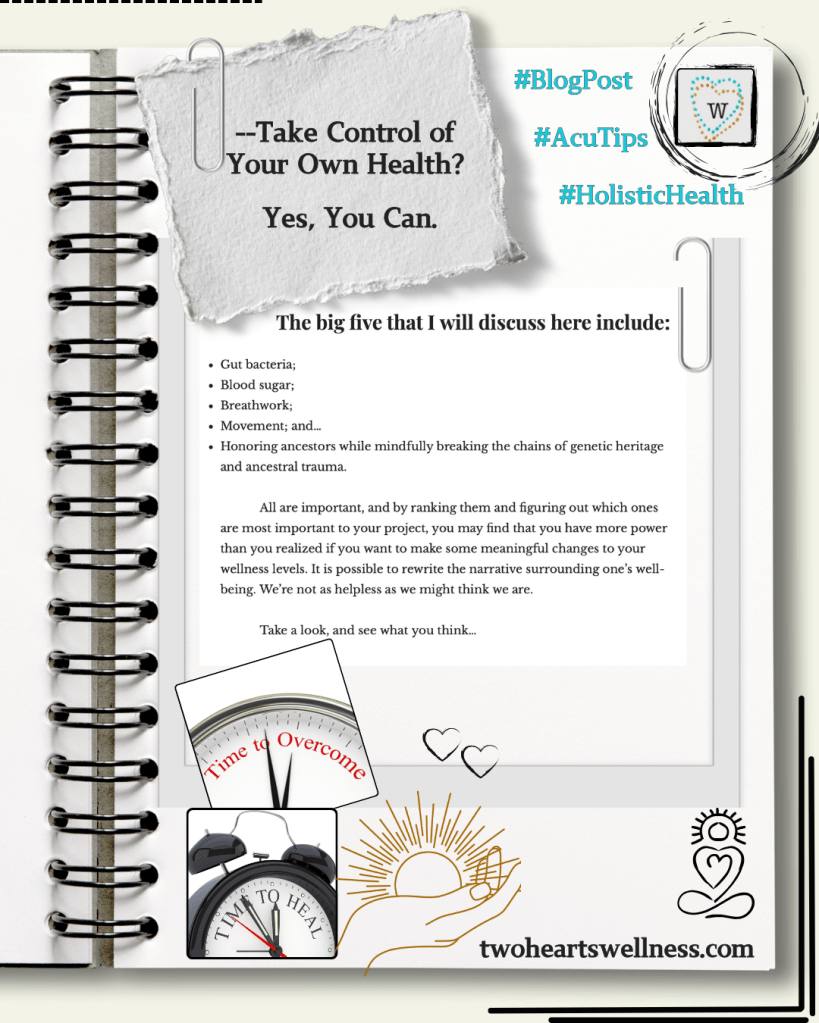
At the most basic, I draw from both CCM and TCM principles. Everyone’s treatment is individualized but–speaking in generalities–I more likely than not would address depression/anxiety with one or more of the five items I discuss in my blog post, “Take Control of Your Health? Yes, You Can!” These include paying attention to: gut health, blood sugar, sleep, breath, and resolving ancestral trauma. Sometimes the patient’s improved mental state is because what we do might focus on what Western medicine would view as reducing histamine overload (this can cause extreme feelings of anxiety) or improving autonomic nervous system function (another potential cause of distress). On a more prosaic level, a person’s mood can shift for the better just by improving sleep.
In essence, I foster patient wellbeing according to the Chinese precepts of balance (this is like achieving homeostasis but with a philosophical tone) through acupuncture, herbal medicine, nutritional education, breath work, health coaching, and/or bodywork therapy. These are all great options and, especially if the patient also goes for psychotherapy concurrently, it certainly is possible to actually effect meaningful changes in mood and psychological health.
And no, it’s not a placebo.
Prozac, on the other hand? Well. You read the book yourself and see what you think.
*****
*****
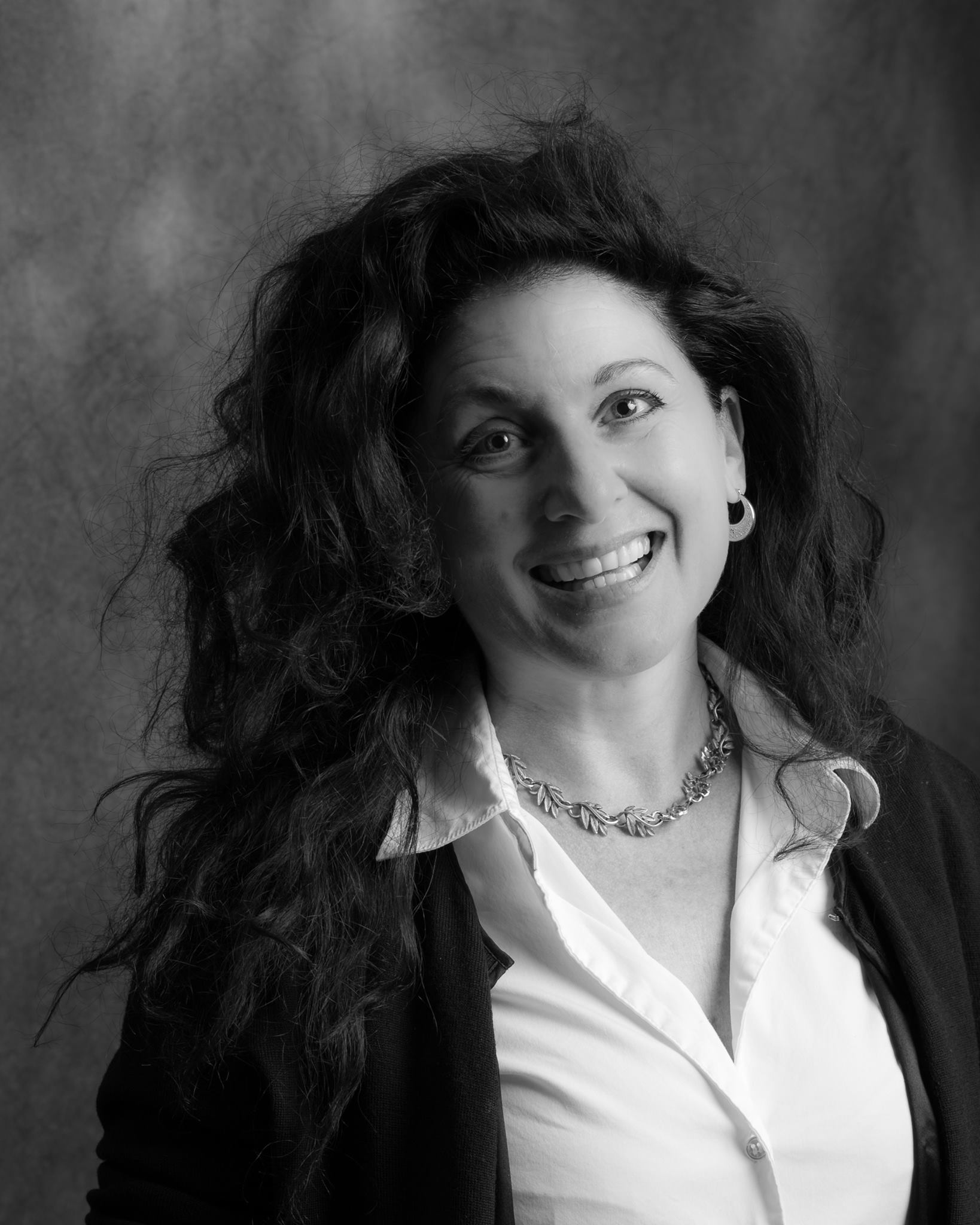
Dr. Paula Bruno, Ph.D., L.Ac., is a licensed acupuncturist and herbalist, an AOBTA-CP traditional Chinese bodywork therapist, a health coach, and an author. She maintains an active and growing practice at her Austin, TX office. Dr. Bruno is also available for distance appointments for wellness consultation or coaching.
In her first career, she was a Spanish professor.
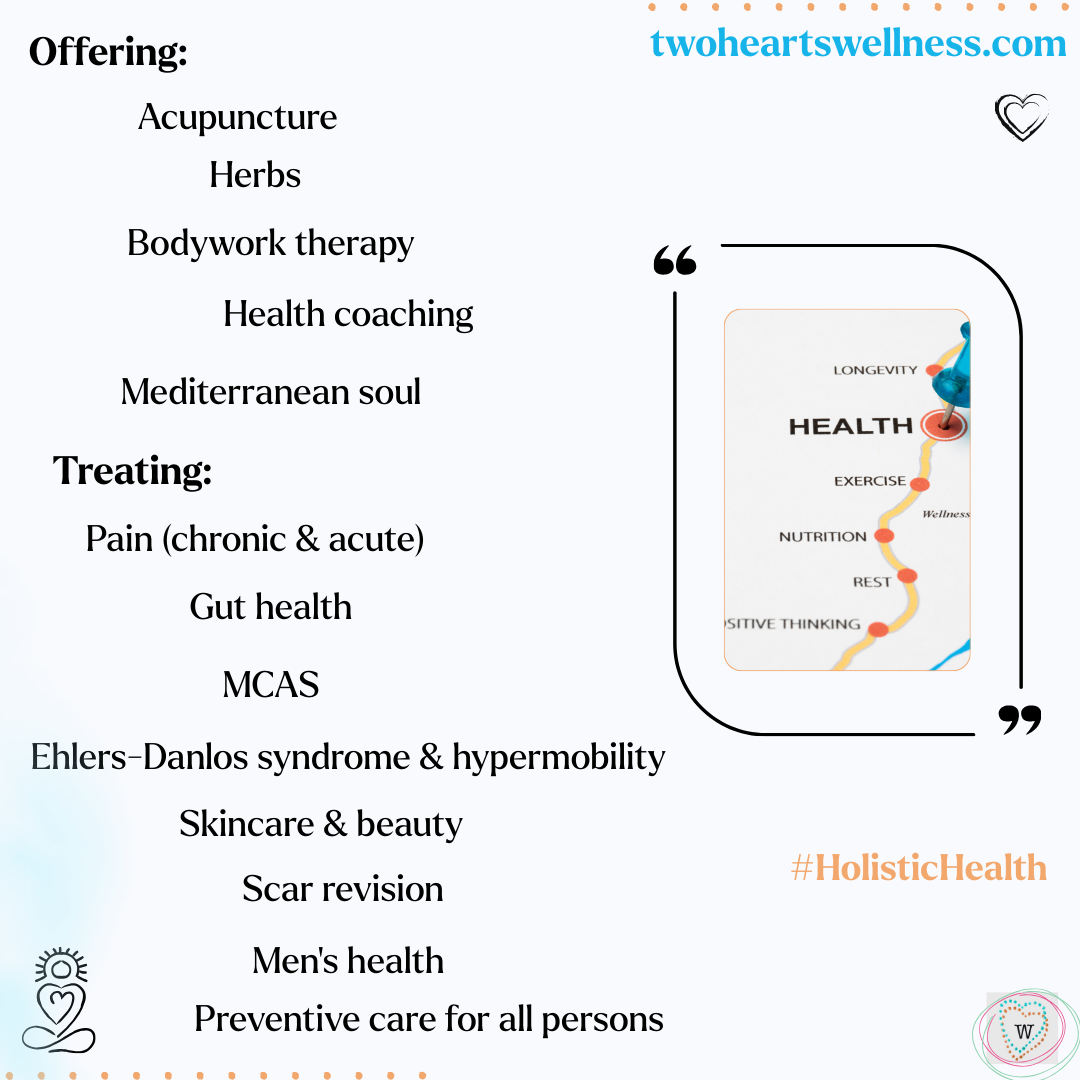
Dr. Bruno’s specialties as a Chinese medicine practitioner include: • Musculoskeletal health (acute or chronic pain relief; Ehlers Danlos syndrome & hypermobility support) • Digestive support, gut health, and weight loss • Aesthetic treatment, including scar revision • Men’s health • General preventive care and wellness support for all persons.
She is the author of Chinese Medicine and the Management of Hypermobile Ehlers Danlos Syndrome: A Practitioner’s Guide. Dr. Bruno also maintains a second website, holistichealthandheds.com, with resources and information curated specifically for people with hEDS and HSD.
When you are ready to discover what traditional medicine plus a vibrant and engaged approach to holistic health can do for you, either contact Dr. Bruno or book an appointment online.
*****
Two Hearts Wellness does not accept paid advertising on this website
Note: Material on this web site site is not intended to diagnose, prevent, treat, or cure any disease, illness, or ailment. A Chinese medicine practitioner in Texas identifies syndrome patterns but does not diagnose illness. Material on this web site does not purport to identify syndrome patterns.
*****
*****
- Of course there is a blog post for this topic. In fact, there are two. The first, “Acupuncturist Credentials: I Just Passed my Biomedicine Board Exam and Why it Matters for You” focuses only on my first board exam, and that would be the biomedical one. The second, “Acupuncturist Credentials: I Just Passed my Last Board Exam and Why it Matters for You,” discusses my experiences with the other three exams (Foundations of Chinese Medicine, Acupuncture and Point Location, and Herbal Medicine, respectively. ↩︎
 Two Hearts Wellness