Are you stuck, either metaphorically or on a more tangible plane? Getting stuck (by acupuncture needles) is a great way to get yourself un-stuck. By now, I think that just about everyone has heard about acupuncture or even tried it but I am not sure that folks realize just how many ways that Chinese medicine (and this is all of it, not just the acupuncture) can help you to get moving when you’re in a rut.
I’m going to stick with (see what I did there?) six conditions that acupuncture can potentially resolve:
- Plum pit qi;
- Constipation;
- Stiff joints, fixed facial expressions, and scars;
- Chronic trauma response (fight, flight, freeze, or fawn);
- Sleep disorder, including nightmares; and
- Metaphoric stuckness.
Are you ready to get moving? If so, keep reading.
Plum pit qi (aka when you feel like something is stuck in your craw):
Western medicine has a term for this: globus pharyngeus. Personally, I like the Chinese medical designation better. We call it plum pit qi. Whatever phrase resonates for you is fine, but either way…it is not fun to have the sense that something is stuck in your throat. Plum pit qi isn’t caused by anything physical. Instead, it’s a stress response in most cases. When you suffer from plum pit qi it is fairly common to also struggle with acid reflux along with it, which adds to the discomfort.
And though Western culture sees the same thing, more or less, as Chinese does (hence the colloquialism that something “sticks in a person’s craw”), biomedicine isn’t as sure what to do about it.1 Western medicine doesn’t have much to offer in this realm, not really. Chinese medicine’s narrative views it as a sign of Liver qi stagnation. This usually means that the patient is cranky or short-tempered, feels stuck in a rut, and maybe feels distention in the upper chest, abdomen, and/or throat. Liver qi stagnation is common when people experience chronic stress combined with a sedentary lifestyle. If you go for acupuncture to resolve your plum pit qi, we might also might get a little metaphysical on you and ask you about whether or not your voice is stifled.
If stress and anxiety are sticking in your craw and you want to learn more about what acupuncture can do for you, take a look at “Chronic Stress: Ways to Protect Your Mind, Body, and Spirit for the Long Haul.” See also “Stress Relief That Gets Right to the Point: Acupuncture Treatments Designed Just for You.”
Constipation, or when your bowels are stuck:
In one side and (not) out the other…maybe it’s not your throat that’s stuck. Maybe it’s the other end. Are you constipated? There are a lot of reasons why a person might suffer from this scourge, from the basic (not enough fiber in the diet, not enough exercise, and/or dehydration) to the more complex (diabetes, depression, nerve issues, pelvic floor problems, and more…). Simply holding your nose and drinking a cup of water and Metamucil before bed won’t cut it in many cases.
Chronic constipation is no joke, though. Aside from feeling bloated and miserable, chronic constipation can result in everything from hemorrhoids to prolapse. You really do not want to ignore things if you are chronically constipated.
But not to worry, dear reader, because…oh, does Chinese medicine have answers for you! Trust me when I say that your acupuncturist will take your gut and digestive health seriously. And you can pretty much always expect to be asked about your poop during your appointment.
Getting unstuck via acupuncture, herbs, nutrition, and/or bodywork therapy (cupping, gua sha, or tui na, which is akin to massage and like getting acupressure treatment) are all ways to get things moving.
Chinese medicine is an exceptional resource for anyone with gut health or digestive issues. Got questions? See “Gut & Digestive Health: Three Reasons Why It Matters & How Chinese Medicine Can Improve Yours.” For the blog post referenced in the graphic, refer to “How’s Your Digestion? Two Hearts Wellness Gives You The Straight Poop on … Well, You Know.”
Stiff joints, fixed facial expressions, and scars: your physical body on a tangible level
Do you wake up in the morning with stiff joints? Or maybe you have tight, painful shoulders or a clenched lumbar spine. You don’t even need to be a Gen X or older person to be impeded by old injuries or scars. When your body has its tight, painful areas…they hurt, whether you’re fifteen or fifty, give or take a decade. Right? And that admonition that you heard about not making that face or it will stick that way?
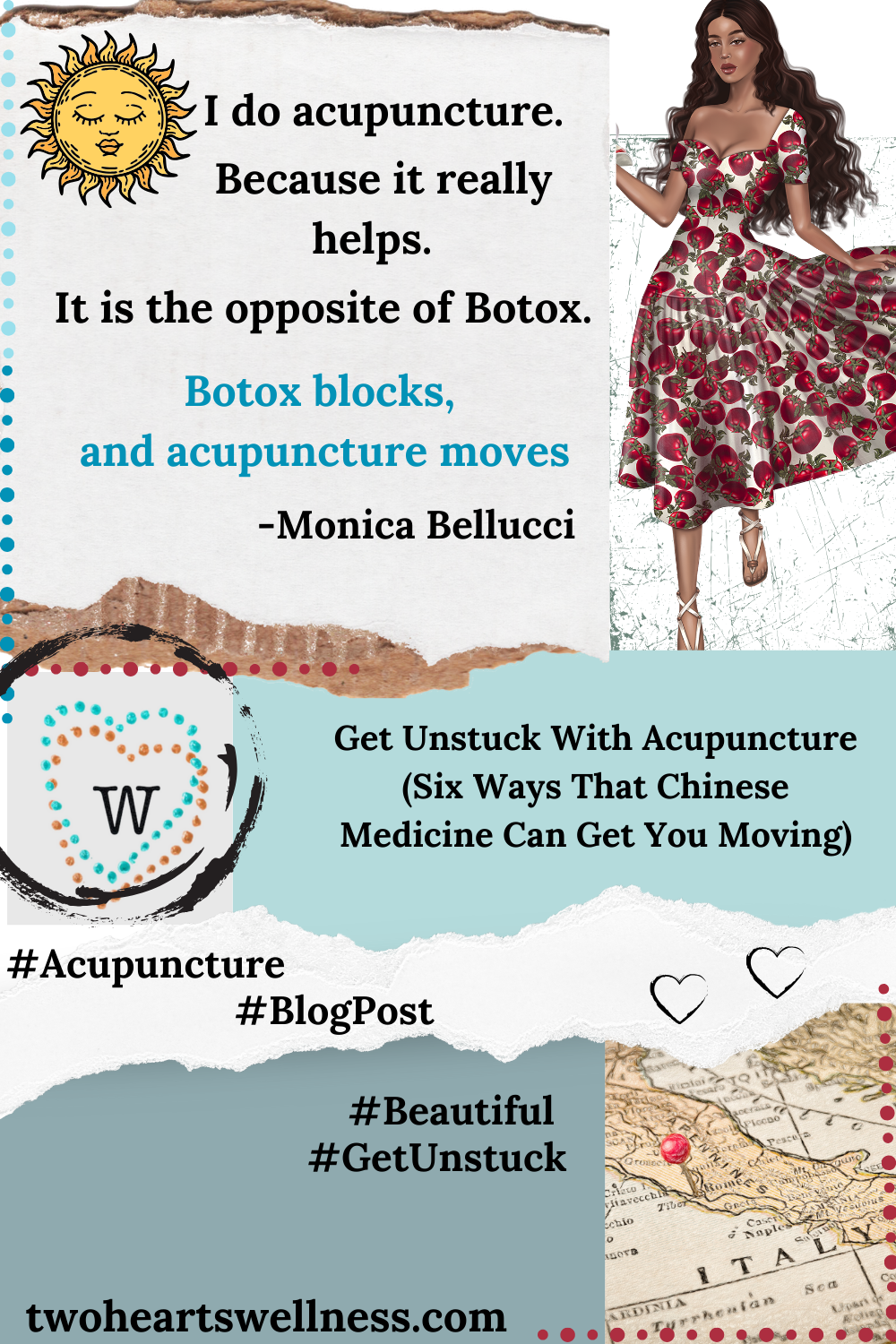
Look no further than my generation’s answer to Sophia Loren. Monica Bellucci carries on the tradition of beautiful Italian women who age gracefully and realistically. I love her comment about acupuncture, too (“Botox blocks and acupuncture moves”), and definitely agree with it.2
If you want to do something about facial muscles that fall into an all-too-familiar pattern, take a look at “Aesthetic Treatment for Beauty and Calm, or How to Achieve a Serene Face and a Peaceful Heart.” Wondering about cosmetic treatment? Look no further than “Microneedling and More: Holistic Treatments That You Will LOVE” for answers. Truly, the #NoTox movement is on to something, so do not miss out…
Being stiff and in pain, as I think that we all know already, is uncomfortable on both physical and mental planes. It can lead to more immobilization, further atrophy of muscle, tightening and weakening of tendons and ligaments, depression, anxiety, and feelings of being trapped within your own body. Among other things. And don’t get me rolling here on the topic of scars or this essay will turn into a novel! Scars can definitely keep you stuck in a position that recalls the original injury.
If you’re stuck, physically, then maybe it’s time to consider Chinese medicine.
There’s a lot to say about stiffness, physical pain, and Chinese medicine. If you are looking for injury relief, see “Acupuncture and Chinese Medicine For Pain Relief and Healing, Part I: Sprains, Strains, and Broken Bones.” Got scars? Here are some answers: “Every Scar Tells a Story (Physical Scars and What to Consider About Yours).”
Fight, flight, or freeze:
It goes without saying, but…being stuck in a never-ending loop of trauma response can be exhausting, miserable, and genuinely detrimental to your health. It’s not so easy as taking a deep breath and telling yourself to calm down, either. Fight, flight, or freeze (with the later add-on, fawn) are survival instincts driven by the sympathetic nervous system (SNS) and designed for acute danger.3 These instincts run deep, and they don’t necessarily respond to logic. When the SNS is activated and stays that way long term, as in the case of chronic stress or feeling of threat due to unresolved trauma, it’s easy to become stuck in a holding pattern.
A short list of what can indicate a stuck SNS include but are not limited to: high blood pressure and/or fast heartbeat; elevated cortisol; muscle tension; headaches; brain fog; sleep disorder; digestive concerns; constant sense of being on the alert; and/or feelings of overwhelm. This could also present as hyper-reaction to triggers that wouldn’t generally be viewed as threatening under the normal scheme of perception. When a person experiences these symptoms, they might find that the root cause is their sympathetic nervous system. Acupuncture is an amazing resource in such cases. Have you ever heard of the term “acu-nap?”
Being stuck in a seemingly endless state of trauma response to the point of a PTSD diagnosis usually requires psychotherapy. As a complementary approach to your work with a therapist, acupuncture and other modalities of Chinese medicine can help you to move forward. If you’re dealing with the results of chronic hyperarousal, in any case, Chinese medicine can be an excellent resource, as “Got Stress? (It Doesn’t Do a Body Good But There are Ways To Resolve It)” demonstrates. For thoughts on the marks left by trauma, see also “Emotional Scars Tell a Story (But You Can Change the Narrative).”
Nightmares and sleep disorders:
When you don’t deal with your issues when you’re awake, do you find that they come back to haunt you when you sleep? That’s assuming you do sleep. Other manifestations of dis-ease include lying awake in your bed with a monkey mind that jumps all over the place and won’t let you calm down enough to fall asleep. Either way, being trapped in a repetitive cycle of insomnia and/or vivid dreams is draining, tiresome, and discouraging.
Nightmares can leave a person depressed, anxious, and/or sleep deprived. Not getting enough sleep, either because the nightmares are so bad or because you have insomnia for other reasons, can lead to daytime sleepiness, brain fog, mood disorders, heart disease, and/or weight gain. Sleep problems of this sort really are a horrible way to be stuck in a rut and the effects of them permeate one’s entire life.
Yes, there is a blog post for this, too. “Sleep: Why You Need It and How To Get It” gives you the full outline of how Chinese medicine can make a difference for your slumber. Take a look!

Metaphoric stuck-ness: are you ready to make a decision to try new things…and then actually follow through with it?
Are you stuck in a rut? Going around in circles? Feeling like you’re not getting anywhere (or even worse: going backwards)? Being stuck on a metaphoric level is something that everyone has experienced at some point or another in their lives. Sometimes it can be because you are stopped in a plateau state for longer than you want to stay. The in-between and the not-knowing is draining your energy and optimism. Other times, it may be that you’re genuinely at a halt and not sure how you got where you are and baffled as to what to do next.
Being stuck in a rut is demoralizing, exhausting, and frustrating…at least while you’re in it. You may, once you’ve broken through the barriers that bind you, find that your stuck state was an opportunity to gather yourself before launching. But while you’re there, you may have health issues, like anxiety, depression, insomnia, constipation, a sense of panic and the worry that life is passing you by and that things will never change.
A good place to start is by assessing your health and wellbeing. When your digestion is moving along smoothly, you get decent sleep, and your emotions are on a reasonably even keel, it is much, much easier to start planning and to take that first, proverbial step in the journey of a thousand miles that is your life. Chinese medicine is a valuable and meaningful option, especially if you’re not inclined to rely on Pharma drugs. When you work with an acupuncturist, it really is possible to pull yourself out of your rut and to change your direction.
Are you ready to get moving?
*****
*****

Dr. Paula Bruno, Ph.D., L.Ac., is a licensed acupuncturist and herbalist, an AOBTA-CP traditional Chinese bodywork therapist, a health coach, and an author. She maintains an active and growing practice at her Austin, TX office. Dr. Bruno is also available for distance appointments for wellness consultation or coaching.
In her first career, she was a Spanish professor.
Dr. Bruno’s specialties as a Chinese medicine practitioner include: • Musculoskeletal health (acute or chronic pain relief; Ehlers Danlos syndrome & hypermobility support) • Digestive support, gut health, and weight loss • Aesthetic treatment, including scar revision • Men’s health • General preventative care and wellness support for all persons.
She is the author of Chinese Medicine and the Management of Hypermobile Ehlers Danlos Syndrome: A Practitioner’s Guide. Dr. Bruno also maintains a second website, holistichealthandheds.com, with resources and information curated specifically for people with hEDS and HSD.
When you are ready to discover what traditional medicine plus a vibrant and engaged approach to holistic health can do for you, either contact Dr. Bruno or book an appointment online.
*****


*****
Two Hearts Wellness does not accept paid advertising on this website
Note: Material on this web site site is not intended to diagnose, prevent, treat, or cure any disease, illness, or ailment. A Chinese medicine practitioner in Texas identifies syndrome patterns but does not diagnose illness. Material on this web site does not purport to identify syndrome patterns.
*****
- “ESOPHAGEAL HEALTH:Globus Pharyngeus” offers a brief, useful explanation of this condition and, interestingly, has an Asian woman in its stock photo of a sufferer. Either it’s a coincidence (doubt it) or they already know that there is a cultural connection. But it’s not only Asian persons who experience plum pit qi. This conversation, “Meaning and usage of ‘stuck in the craw’” dissects this colloquial term and makes it clear that feeling something intangible but real lodged in your throat is universal. A more in-depth look at the sense of this kind of blockage, “Globus pharyngeus: A review of its etiology, diagnosis and treatment,” is also worth reading. Western medicine, as you can see by reading it, is baffled by this condition. Chinese medicine, for its part, takes plum pit qi seriously and is an effective option for treating it as a result. ↩︎
- The full quote, found at “Monica Bellucci finds ageing sexy,” is “‘I’ve nothing against using something to help your beauty – but do it in a good way, with intelligence. I do acupuncture. Because it really helps. It is the opposite of Botox. Botox blocks and acupuncture moves. Botox for some people is really good. For others they have different reactions. I am for freedom.'” And it’s true…Botox does work well for some people (although I question it for long term use). Meantime, the question “Are We Entering a ‘Notox’ Era?” is gaining steam as I write. ↩︎
- Refer to “Acute Stress Response: Fight, Flight, Freeze, and Fawn” to read more about what Western medicine says about acute stress response. A useful post, “Trauma: it’s more than ‘fight or flight’” includes a fifth option (“flop”) and is also worth reading. ↩︎
 Two Hearts Wellness