What do you think about your liver? Do you know how hard-working and interesting this organ is? Well. If you do not, you will by the time you finish reading this blog post. From both the Western and the Eastern perspectives, this is an organ with a story.
The Western viewpoint is not quite as elaborate or interesting as the Eastern so I will address that theme first. But keep reading for the good stuff at about the halfway mark. Yes, a biomedical liver is a fascinating thing. But I’m partial to Chinese medicine and besides, the narratives that are given to internal organs are fascinating and interconnected with all-the-things. You’ll see. Keep reading.
Your Western Liver
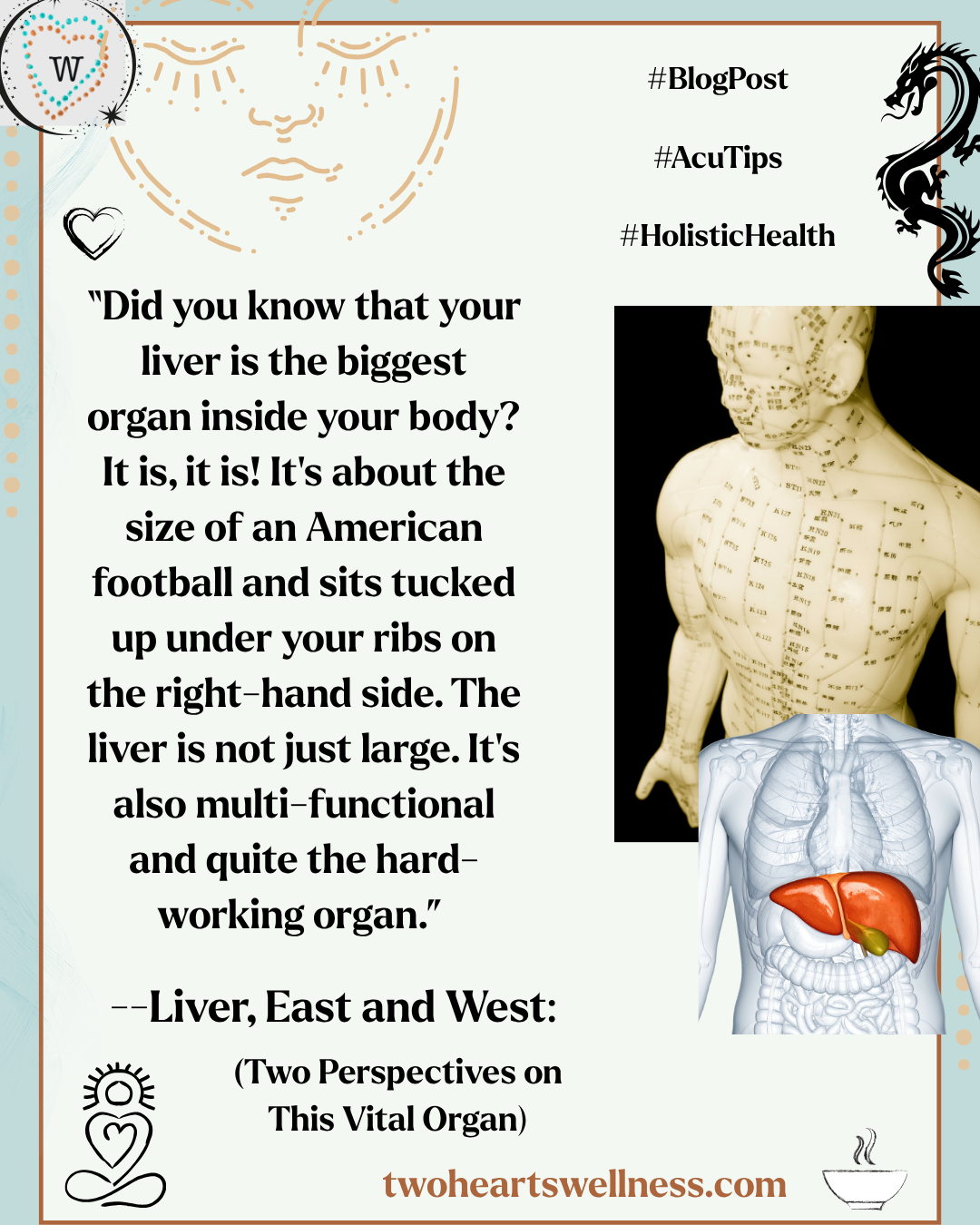
Did you know that your liver is the biggest organ inside your body? It is, it is! It’s about the size of an American football and sits tucked up under your ribs on the right-hand side. The liver is not just large. It’s also multi-functional and quite the hard-working organ.
*****
*****
Your liver is your filtration system, and it cleanses about 250 gallons of your blood daily via the hepatic artery (for oxygenated blood) and the hepatic portal vein (this is nutrient-rich blood from your intestines). Of the many things your liver does, its efforts to keep you healthy via detoxification of the blood is one of its more important jobs. Your liver also processes your macros and converts any excess glucose into glycogen for storage, releasing it as needed to keep your blood sugar stable. It produces blood plasma proteins to help you with blood clotting and helps with clean-up too. Yes, your good liver breaks down old red blood cells and removes bacteria from your blood.
Your liver also produces some pretty useful things, like bile. You need this yellowish-green acidic liquid to emulsify fats if you expect your small intestine to absorb them properly. It also regulates amino acid levels in the body, which is another important function related to protein synthesis, gluconeogenesis, and urea cycle detoxification (this prevents nitrogen accumulation, which is not a good thing). Your liver also plays a part in hormone regulation, by metabolizing and clearing excess estrogen.
If the liver is sluggish or otherwise not clearing waste and managing your blood the way it should, the outcome can be hormone imbalance. Western medicine might point to fatigue, mood issues, and weight fluctuations as evidence of liver problems. Other signs can be bloating or ascites, jaundice, itchiness, brain fog, and/or spider veins (angiomas) on the skin of the ribcage. When your liver is not happy the rest of you will likely follow along.
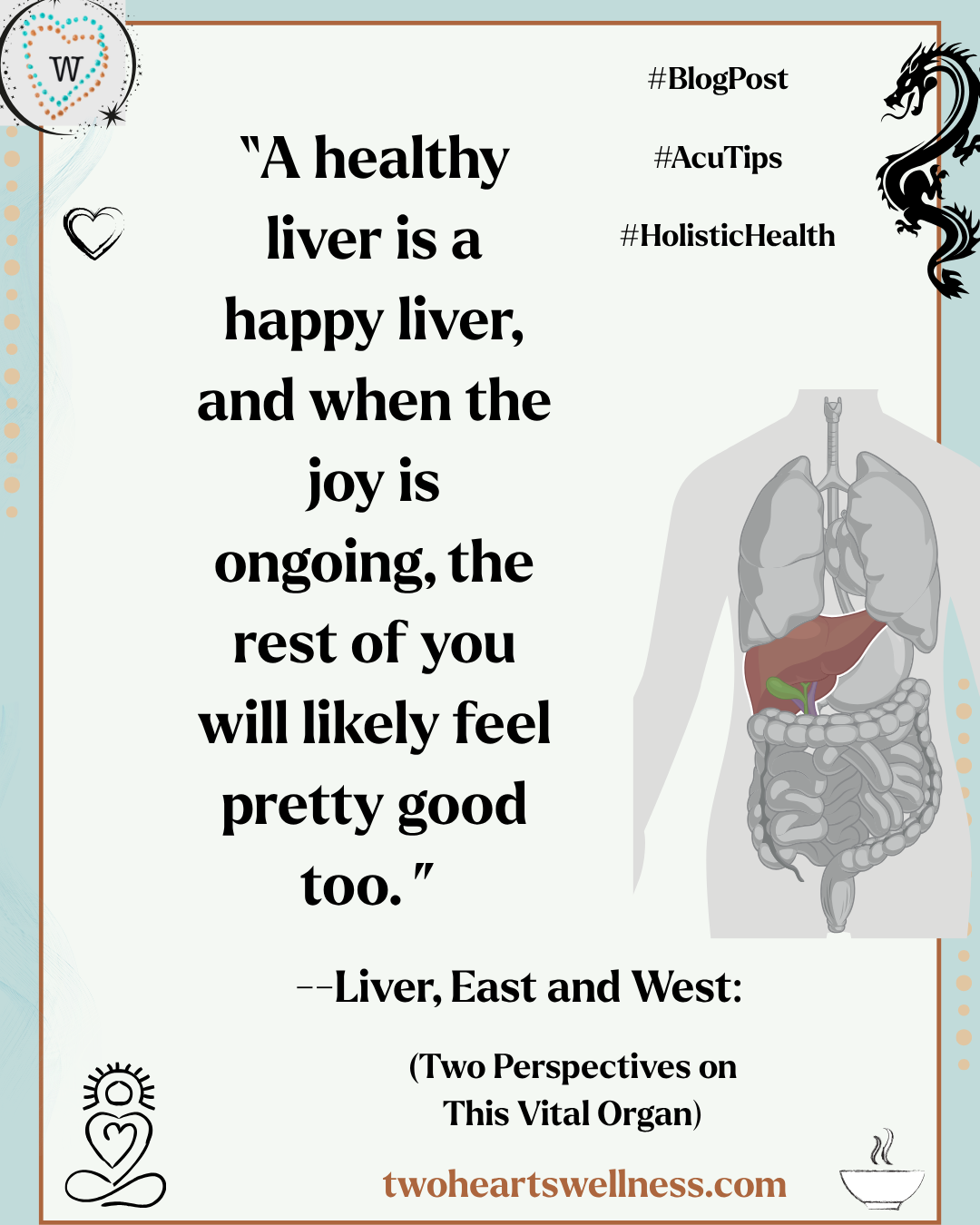
A healthy liver is a happy liver, and when the joy is ongoing, the rest of you will likely feel pretty good too.
*****
*****
Your Chinese Liver
I’m of Mediterranean heritage but I have a Chinese Liver and, if you want one too, feel free. You can have a Chinese Liver too. All you need to do is start viewing your Liver as a capital-L entity with lots of possibilities and meanings.
One of the first things you will want to understand is that we often capitalize the word to distinguish it from your Western biomedical organ. We do this for a couple reasons, one of them being that references to the organs in Chinese medicine can be one or all of three things: (1). An actual organ (liver, heart, kidney, etc.); (2). It can indicate the channel, which is the geographical space associated with the organ; and (3). It can be used as an umbrella term that encompasses not only the organ but also the associations that go with it. There is usually a context to go along with the use of the term which will make things clear.
The Liver as an organ is important on its own and it is key to the overall interconnection of the internal organs as a team. A practitioner of Chinese medicine learns from the Nei Jing, or Inner Classic (an ancient tome that functions as our medical bible, basically), that the Liver is the General. It is responsible for decision-making and strategy (and its pair organ, the Gallbladder, is linked to courage or the lack of same). The Liver is responsible for the smooth flow of qi throughout the body, it stores Blood (again, capitalized to indicate Chinese medicine’s version), and it nourishes tendons and ligaments.
One thing I love about Chinese medicine (there are many, many things I love about Chinese medicine) is that each organ has a soul, or energy, linked to it. For the Liver, that would be the Hun, or ethereal soul, that is the spirit of the organ which has its own responsibilities. For the Liver, this would be sleep, dreams, and the ability to strategize and envision. The Liver also has its emotion, and that would be anger. And though it may seem quirky, we also associate the Liver with Wind, springtime, and the color green.
*****
*****
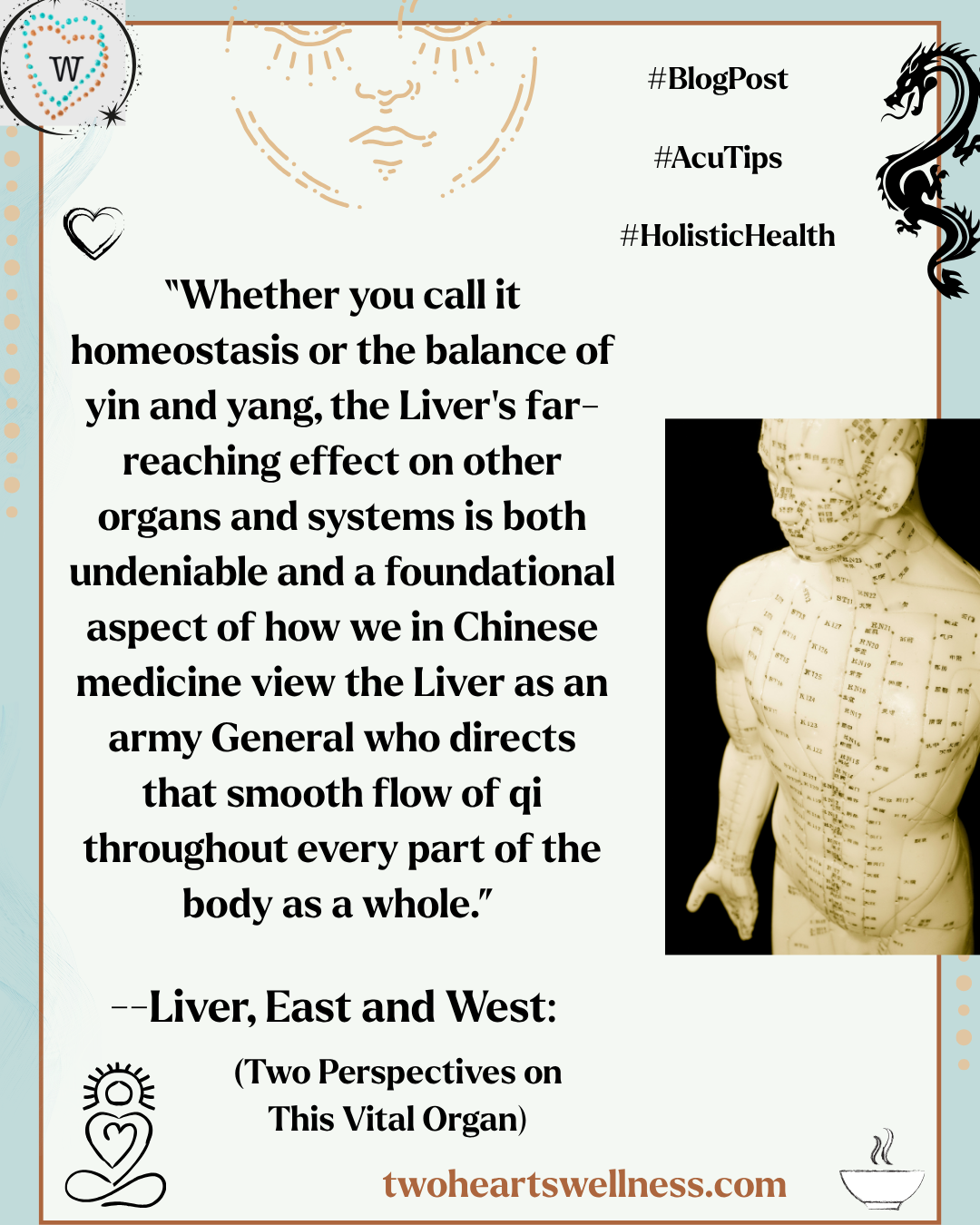
Chinese medicine privileges interconnection, so we will look at the health of this organ in its relationship with other organs. Circulation, neural signals, cardio-metabolic processes and more all involve the liver (or Liver) and its bidirectional relationship with its fellow organs. Whether you call it homeostasis or the balance of yin and yang, the Liver’s far-reaching effect on other organs and systems is both undeniable and a foundational aspect of how we in Chinese medicine view the Liver as an army General who directs that smooth flow of qi throughout every part of the body as a whole.
“If the Liver qi is stuck, we may be angry, or we sigh a lot, or maybe we have dry eyes or floaters in our vision. If the Gallbladder qi is stuck, we may have gallstones; if it is weak or deficient, we are fearful. A healthy Liver makes for a calmer temperament, stronger tendons, and clear vision. A thriving and healthy Gallbladder makes for bravery.” — Living With The Seasons According To Chinese Medicine: Spring Tips For Health And Happiness
I’m not entirely certain if your allopathic physician focuses quite as strongly on liver health if you don’t go for an appointment specifically for issues related to hepatic wellbeing. If you get a yearly blood screen, they will look at your enzymes and other markers of health. You will certainly hear about your liver if you have diabetes or metabolic syndrome or a fatty liver, no matter the cause. Other than that, your liver may take a backseat to other health issues.
In contrast, your Chinese medicine practitioner will almost always have something to say about your Liver. We do treat diabetes and other metabolic concerns and we certainly are able to address issues like fatty liver. We also treat a lot of Liver qi stagnation, which is when a person is cranky or has PMS or they sigh a lot and feel sluggish. We may, if there are allergies or hives or rashes, treat Wind and Damp and maybe also Heat. If your digestion is weak, you may be told that your Liver is overacting on your Spleen (or, as my favorite teacher has said: Liver beats up Spleen, then Spleen doesn’t work so good afterward).
Many, many common syndromes and patterns involve the Liver and we can offer you acupuncture, herbal medicine, and lifestyle counseling to support hepatic health. Eating green, leafy vegetables and moderating emotion, plus a reasonable effort to move your body (however that manifests for you) are ways you can support your Liver. We have excellent herbal formulas that have been relied on for centuries…because they work. We also address the Liver and its relation to other organs or the health of the Blood. It’s all inter-related, so just because we start with the Liver it doesn’t mean we stay there.
*****
*****
You are a reflection of your environment and your environment is a reflection of you. If your Liver qi is not smooth? More likely than not, there’s frustration and blockage in your life. Whether it’s the environment first or the Liver makes you cranky so you face the world with spikes facing outward, pacifying the Liver and redirecting your energies can truly make your environment that much more conducive to a calmer, steadier existence. If you have ungodly PMS or you’re itchy and puffy and prone to hives, there will always be the environmental factors that are part of the manifestation of Liver dis-ease. Everything is connected.
By working with a practitioner of Chinese medicine you can resolve many of these issues without Pharma drugs or extreme dietary change. Sometimes, there needs to be a fairly substantive lifestyle change, such as when a person drinks more alcohol than is beneficial or has an addiction to ultra-processed food products. But most of the time, your acupuncturist will place the needles in ways to pacify the Liver or unblock the stagnation and you won’t even know that your Liver was the focus. You just feel a lot better and, more likely than not, more even-keeled emotionally. (No, the needles do not hurt, and yes, acupuncture is usually incredibly relaxing).1
Your Chinese Liver, like your Western liver, is a crucial organ if you want to live a healthy life. I’ve only just skated over the surface here, and there is more to come… there’s lots to say about your internal organs, and trust me–there will be blog posts forthcoming.
Meantime, what are you going to do on behalf of your General?
*****
*****

Dr. Paula Bruno, Ph.D., L.Ac., is a licensed acupuncturist and herbalist, an AOBTA-CP traditional Chinese bodywork therapist, a health coach, and an author. She maintains an active and growing practice at her Austin, TX office. Dr. Bruno is also available for distance appointments for wellness consultation or coaching.
In her first career, she was a Spanish professor.
Dr. Bruno’s specialties as a Chinese medicine practitioner include: • Musculoskeletal health (acute or chronic pain relief; Ehlers Danlos syndrome & hypermobility support) • Digestive support, gut health, and weight loss • Aesthetic treatment, including scar revision • Men’s health • General preventive care and wellness support for all persons.
She is the author of Chinese Medicine and the Management of Hypermobile Ehlers Danlos Syndrome: A Practitioner’s Guide. Dr. Bruno also maintains a second website, holistichealthandheds.com, with resources and information curated specifically for people with hEDS and HSD.
When you are ready to discover what traditional medicine plus a vibrant and engaged approach to holistic health can do for you, either contact Dr. Bruno or book an appointment online.
*****


*****
Two Hearts Wellness does not accept paid advertising on this website & only uses strictly necessary cookies.
Note: Material on this web site site is not intended to diagnose, prevent, treat, or cure any disease, illness, or ailment. A Chinese medicine practitioner in Texas identifies syndrome patterns but does not diagnose illness. Material on this web site does not purport to identify syndrome patterns.
*****
- Yes, yes, there is a blog post for that: “Acupuncture And More (Where to Start With Traditional Chinese Medicine if Needles Make You Nervous).” TL/DR: You can experience the marvel of Chinese medicine without the needles. We have options for you, including herbal medicine, manual therapy (tui na, pronounced “twee nah” is divine), nutritional guidance, and breath and movement in the form of tai chi and qigong. So no, the acupuncture needles don’t hurt but even if you’re not convinced, that’s fine. You have options. ↩︎
 Two Hearts Wellness