Have you pondered your sacrum lately? It’s such an important part of your body and (unless you’re into yoga or have tailbone pain) you might not think much of it. It’s kind of hidden, too, due to the way it is set beneath your lumbar spine and nestled between the two wings of your pelvic bones. But whether you approach this bone from a strictly biomedical perspective or you’re steeped in metaphysical spirituality, we can all agree on one thing here. To wit: your sacrum is an important center of power and balance.
I think it’s good to look at these things from all angles. Medical ideas gain currency when brought to life by metaphysical considerations. Bones are magical and deserve such an approach. They’re also biological entities and the languages of medicine speak for them just as eloquently.
The easiest place to begin is with the where, the tangible, the seemingly prosaic. From there? Well, keep reading and see what resonates.
Location, location, location
Anatomy:
When you were a baby your sacrum was made up of five bones. As you grew they fused together to make the upside down triangle that shapes your sacrum. By the time you were in your mid-teens, the bones were set in place and, as an adult of about aged thirty, you have what you have, for better or for worse. Your sacrum is below the lumbar vertebrae and between the two hip bones of your pelvis, thus forming the posterior aspect of the pelvic girdle. The upper part is broad and called the base because it’s the foundation of your spine above it. The pointy bottom end leads to your coccyx, or tailbone.
*****
*****
Nerves and nerve conduction:
Running from top to bottom there are four sets of foramen, or holes, one row on each side, and these provide space for the sacral nerve plexus (S-1 through S-4) and for blood vessels. These nerves give motor and sensory information all the way down to your toes. Major ones that you might recognize include those innervating the lower limbs via the sciatic nerve (legs and feet), the rear end via gluteal nerves (buttocks), and the pelvic floor and external genitalia via the pudendal nerve. If there’s something wrong with the nerves related to your sacrum you will know it, both near and far.
Daoism:
I’ll return to the sacrum according to Chinese medical tradition at the end of this post, but I think that the Daoist perspective fits nicely alongside the anatomical narrative. Even if the language of nerves and bones speaks more clearly to you, it’s always good to remember that this–like all of your body–has its metaphoric and metaphysical value too.
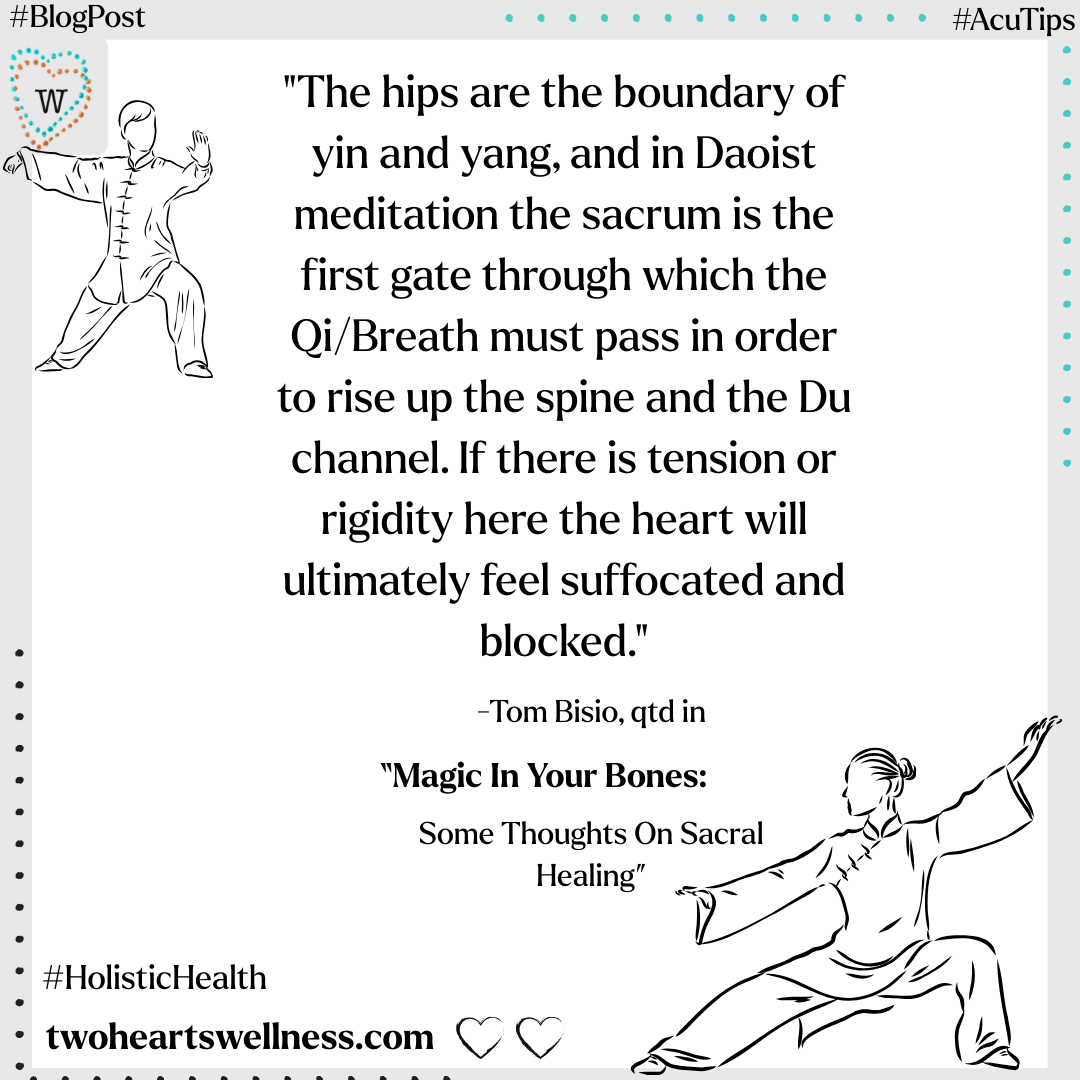
Tom Bisio says it better than I, so please allow me to quote him: “The hips are the boundary of yin and yang, and in Daoist meditation the sacrum is the first gate through which the Qi/Breath must pass in order to rise up the spine and the Du channel. If there is tension or rigidity here the heart will ultimately feel suffocated and blocked.”1
The point? Your hips are an important part of you and awareness of them, and of what they contain, is a key element of wellbeing.
*****

*****
What about your shoulders?
The things they carry:
Speaking of what is contained brings to mind a short story collection, The Things They Carried. Written by Tim O’Brien and published in 1990, the collection meanders through both the physical items (flak jacket, weapons) and metaphorical burdens (memories, traumas, grief) taken along by soldiers in the Viet Nam War. In this context, the focus is more aligned with the shoulders and the mind than the sacrum and its inner cave, the hollowed out section between base and tailbone that protects your pelvic floor. Even so, it’s the same idea: we carry things both tangible and metaphysical with our bodies and within them.
The psoas and fear response:
When we are frightened or under stress our psoas muscle responds accordingly. These deep hip flexor muscles connect the lumbar spine (T12-L5) to the femur by way of the groin and next to the sacrum. When we are triggered to fight, flight, or freeze our psoas directly responds and, if there’s no option to do the first or second, then this muscle can tighten the body into a fetal position and harden, helping to protect the internal organs. When the psoas is weak or tight, the body gets a chronic low-grade message that says danger, danger, danger. As you can imagine, this is not a good thing for the long run. Given the proximity of the psoas to the sacrum, it’s no surprise to find out that a tight flexor can affect everything from your tailbone to the lumbosacral juncture.
“Acupuncture is great for your psoas. You can also get cupping on your low back or on your legs to enhance blood flow and muscle relaxation. Some practitioners offer the Chinese-style manual therapy called tui na (pronounced “twee nah”). I do, and I offer a tui na foot protocol, similar to reflexology, that is especially valuable for anything anxiety-related.” –“Acupuncture for Anxiety: Where to Start When You Need to Find Your Peace“
And when your hips ache and your low back is tight it is never a surprise to find that your shoulders ache or you have trouble taking a deep breath. Not everyone is enthusiastic about pelvic floor physical therapy, but if you can access your psoas and sacrum in a meaningful way (keep reading for discussion of how you can do this without PT) you will often find that pain from neck to hips to even the soles of your feet suddenly disappears. In part, such bliss requires the ability to relax into the sacrum.
*****

*****
Sacred
What’s in a name?
Yes, the sacrum is magical bone. It was designated as such by the Romans (os sacrum, or “sacred bone”) in alignment with the Greek hieron osteon (“strong bone” or “holy bone”). For the Egyptians, this bone was seen as sacred to Osiris, the god of agriculture and of resurrection. In yoga, the sacrum is the space for the second chakra, or Svadhisthana. This chakra relates to pleasure, emotions, and flow; when it’s unbalanced, the outcome can include either physical problems, especially related to the lower body, and/or psycho-spiritual disorders like fear of change, poor emotional boundaries, lack of motivation, hypersensitivity, and/or emotional numbness.
What does it mean to you?
What is your relationship with your sacrum? A person with tight hips or a history of IBS will say one thing; someone who has a history of coccyx pain will say something else. The person who cries during pigeon pose (Eka Pada Rajakapotasana) in yoga class will have another answer. Trust me when I say that my patients will Ehlers Danlos syndrome definitely have their thoughts about the sacrum.
I hope, though, that this blog post will invite you to consider (and maybe reconsider) what you think of this bone.
*****
*****
Chinese medicine
Philosophy of practice:
The sacrum in Chinese medicine is associated with the lower dantian, or energy center (xia dantian). This is our center of gravity and the root of our power. We access this power by way of mindfulness and intentional relaxation of the low back and pelvic floor. As per the Bisio quote that came earlier in this blog post, breath is a key component to sacral health. We may also turn to acupuncture, manual therapy, and/or movement practices in order to nurture this area as well.
There are a few ways we might approach our sacrum from the perspective of Chinese medicine, in fact.
Breath:
If you sit with your breath you may be able to feel the effect of your breath from your pelvic floor and sacrum and track its path along your spine and the channel that runs along it, the Du. When you relax your pelvic floor and allow your breath to wander along the channel, you may also feel your heart relax as well. If you wish to experience this sensation and cannot on your own, a tui na (Chinese medical massage) treatment might make it available to you.
Movement:
If you’ve ever watched anyone practicing tai chi or qigong, you might notice that they flow at the same time that they are rooted. The practitioner’s legs and hips are softened and fluid but strong. This allows the upper body to do its work without clutching or overworking. The body is balanced, as are the mind and spirit. All of this emanates from the core, hips, and sacrum.2
*****
*****
Needles:
If you go to an acupuncturist and want help with gut health and bowel issues (constipation, painful bladder, IBS, menstrual cramps), your chances are high that the practitioner will needle the Bladder points located on your sacrum. We may also needle Gallbladder points on the hips or IT bands. If you struggle with pelvic floor issues, we will probably needle the lower abdomen, the hips, and the medial thigh just above the knees. All of these points can affect the flow of qi to and through the sacrum.
And more:
Anyone who follows my blog knows that I love acupuncture, both getting it and giving it. That said, not everyone wants acupuncture and, as a dedicated tui na (pronounced “twee nah,” it is akin to massage) practitioner, I always want to remind people that they have options.3 Of course, I am biased in favor of tui na, but cupping is a lovely option too. In my practice, I will give a guided meditation as an option, inviting the patient to focus on the journey of their in-breath as it travels down the spine, all the way to the pelvis, grounding and peaceful. On the exhale, the patient will be asked to feel their breath traveling back up through the spine and meandering all the way to the top of their head.
Tui na for feet plus guided meditation can be heavenly for a tight pelvic floor and an aching tail bone.4 It’s heavenly for just about anything related to the sacrum, actually. What matters is that you are intentional in your healing process and that you commit to breath and release and restoration. Healing sacral dysfunction, either functional or metaphysical requires your presence and participation too.
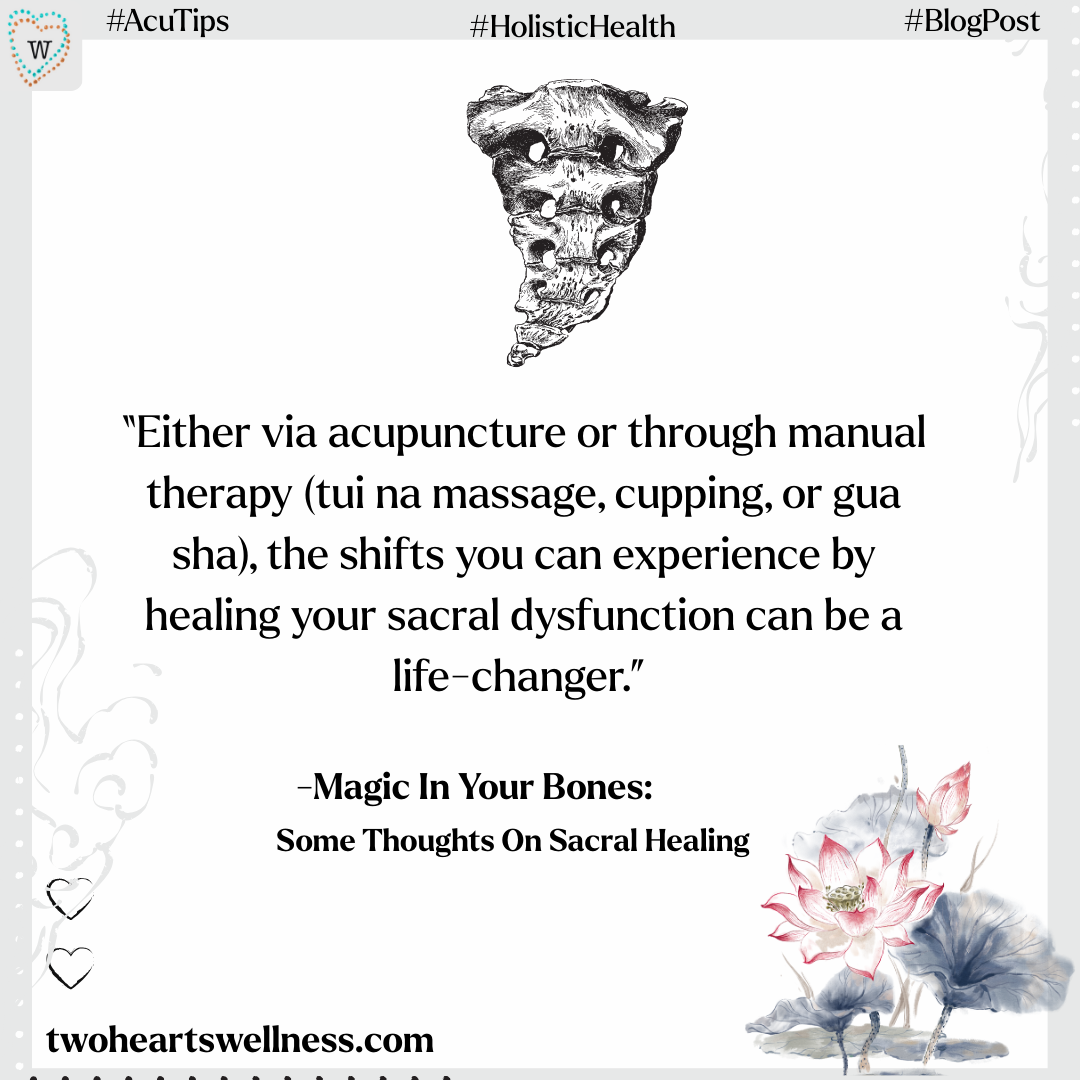
Do you want to do something meaningful for your nervous system, if not your spirit? Well, then. Either via acupuncture or through manual therapy (tui na massage, cupping, or gua sha), the shifts you can experience by healing your sacral dysfunction can be a life-changer.
Are you ready to begin?
*****
*****
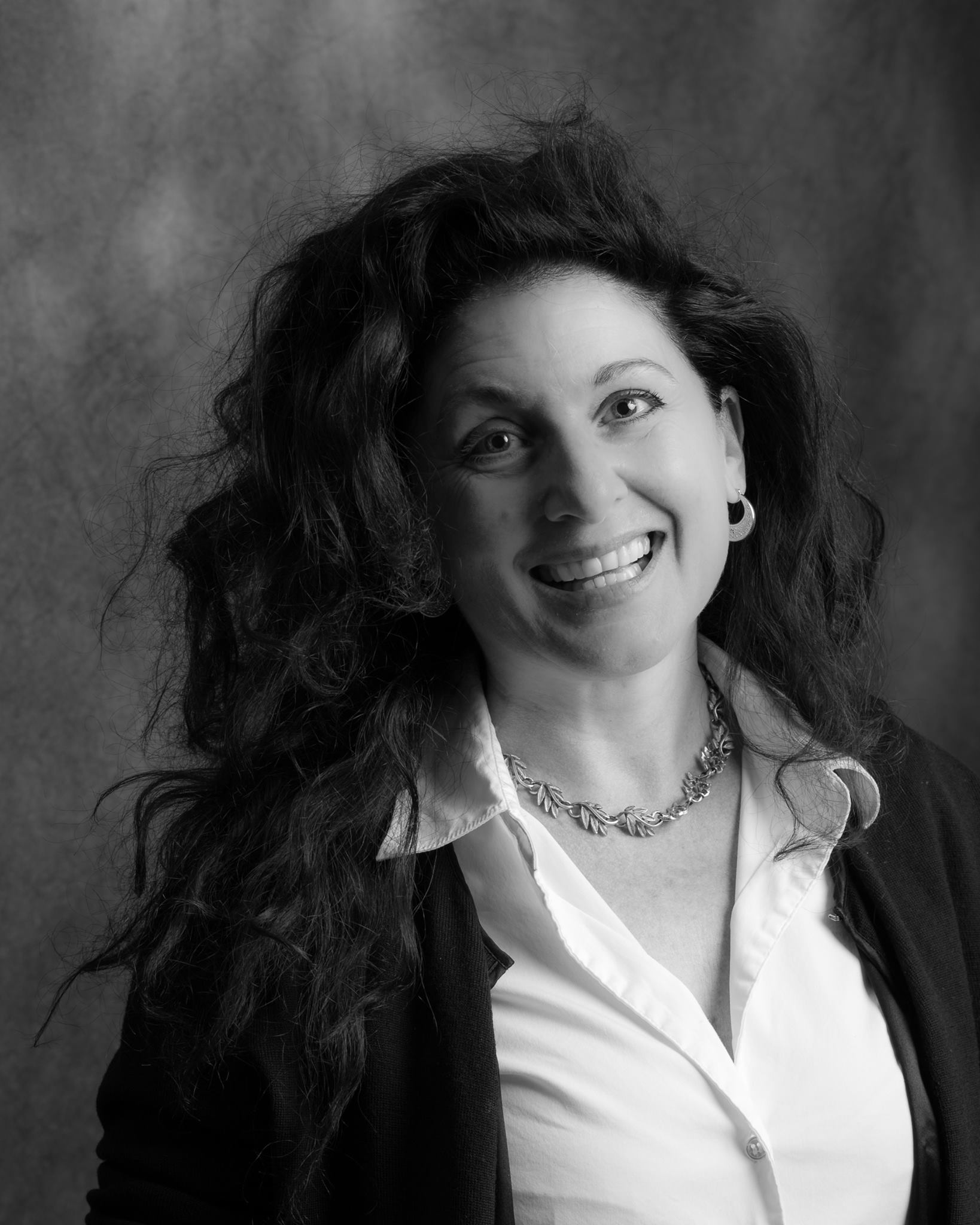
Dr. Paula Bruno, Ph.D., L.Ac., is a licensed acupuncturist and herbalist, an AOBTA-CP traditional Chinese bodywork therapist, a health coach, and an author. She maintains an active and growing practice at her Austin, TX office. Dr. Bruno is also available for distance appointments for wellness consultation or coaching.
In her first career, she was a Spanish professor.
Dr. Bruno’s specialties as a Chinese medicine practitioner include: • Musculoskeletal health (acute or chronic pain relief; Ehlers Danlos syndrome & hypermobility support) • Digestive support, gut health, and weight loss • Aesthetic treatment, including scar revision • Men’s health • General preventive care and wellness support for all persons.
She is the author of Chinese Medicine and the Management of Hypermobile Ehlers Danlos Syndrome: A Practitioner’s Guide. Dr. Bruno also maintains a second website, holistichealthandheds.com, with resources and information curated specifically for people with hEDS and HSD.
When you are ready to discover what traditional medicine plus a vibrant and engaged approach to holistic health can do for you, either contact Dr. Bruno or book an appointment online.
*****
Two Hearts Wellness does not accept paid advertising on this website
Note: Material on this web site site is not intended to diagnose, prevent, treat, or cure any disease, illness, or ailment. A Chinese medicine practitioner in Texas identifies syndrome patterns but does not diagnose illness. Material on this web site does not purport to identify syndrome patterns.
*****
*****
- Refer to “Monks, Meditation, and Mountains: The Body as a Sacred Landscape in Daoism: Part 3” for this quote. ↩︎
- Tai chi and qigong are excellent for both physical wellbeing and for inner peace. To learn more about these practices from a colleague who lives with Ehlers Danlos syndrome, refer to “Traveling With Hope: An Interview With Nicola of Earth Balance Tai Chi.” ↩︎
- Tui na for the abdomen can be wonderful for the sacrum too. Refer to “Chinese-Style Abdominal Massage Can Change Your Life (Seriously, It’s Amazing)” for discussion of mid-section bliss. ↩︎
- Refer to “Pelvic Floor Pain & Men (And How Chinese Medicine Can Help You)” for consideration of how foot treatment can help to resolve pelvic floor pain in men (the principles work for anyone, not just guys). ↩︎
 Two Hearts Wellness