What about winter? Do you enjoy the season, either for the weather or for the holidays or for some other reason, or does the cold bother you, the consumerism annoy you, and the constant stream of “New Year, New You” as we roll towards January bug you unto your last nerve? Either way, it’s hard to deny that winter has its beauties and gifts. What can make it better if you don’t love the season (and healthier if you love all those holiday treats just a little too much) is a bit of strategizing according to the belief system of Chinese medicine.
I’ve written this before and I’ll write it again, but… the longer I practice Chinese medicine, the more deeply it becomes ingrained in me to make its precepts a part of my daily life. Even five years ago, a patient could have asked me about planning for the season and I would have trotted out all the usual advice about seasonal living (without necessarily following it myself). Now, though? I strategize according to the wisdom of our venerable medical ancestors and cannot imagine doing otherwise.
And so… this essay invites you to consider how you navigate your wellbeing during during winter and it shares ways to nurture your wellbeing in so doing. Also, and in accordance with my other essays on the subject, I base this discussion on the four primary factors related to the seasons and health according to the philosophy of Chinese medicine.1 These are: environment, organs, food, and mood.
*****
*****
Environment:
Look around you. Feel the chair under your rear, the ground under your feet, the way your chest expands when you breathe. What color is the sky, or–if you’re indoors–the light that illuminates your space? What about smells and sounds? You put forth your own smells and sounds and you interact with the ones created by others. And all the energy you are feeling now? You are part of a big picture that is interconnected. So it goes with energy, too.
We are never separate from our environment.
Chinese thought absolutely loves to consider inter-relations and the space in between this and that. We do hope that the one and the other interact in a harmonious and well-balanced fashion. There is the substantive, cooler and relatively dormant yin element and its pair, the moveable, energetic yang, but what popular culture and Western understanding of Chinese philosophy often misses is that in-between space, which is called the shao yang, or pivot. Things are always shifting, changing, growing, diminishing. beginning, and ending. The space in between is an important element of that symphony too.
Heaven is yang and Earth is yin; we, as human beings stand in between the two. We are of our environment and our environment is of us. Seasons have their yin and yang too. Summer is the most yang, fall is the transitional stage, and winter is as deep as it gets, yin-wise, before yang begins to assert itself once again via the stirrings of spring.
Winter’s essential element is water, and its organ association is the Kidney and its pair, the Urinary Bladder. This season and its organs relate to the emotion of fear, the ears, the bones and teeth and hair, salty flavors, and the color black. As we go inward and rest, gathering our strength and preparing for spring and a new cycle, we reflect on the virtues associated with the season. These are: strength, wisdom, and courage.
Winter is a special period for growth, but we achieve this via dormancy. And though it may seem odd, it actually is extremely reflective of Chinese thought. There is always practical wisdom combined with the more esoteric, and together, the one and the other make for a better and healthier way of life.
*****
*****
You may notice that I capitalize certain words that we wouldn’t normally in English. If it’s an organ, that is when I’m referring to Chinese medicine’s version of same. If they’re not capitalized, that indicates the organs as per biomedicine. You’ll notice the same in my use of Earth vs. earth, heaven/Heaven, and other similar.
Organs:
The Kidney and its pair, the Urinary Bladder (UB), are tasked with regulating fluid distribution. In effect, the UB discharges waste while the Kidney plays an important role in maintaining normal water metabolism in the body. In Chinese medicine, our view of what these two organs do is not that different from biomedicine’s story. How we frame it is different in our word choice and descriptions. There is also a philosophical perspective that belongs to Chinese medicine and not Western thought. But at heart, both traditions recognize the important role of these organs and it is definitely worth viewing them from multiple angles.
Kidney in Chinese medicine is the seat of balance for yin and yang, it regulates our body fluid, and it functions as the storehouse of our essence or jing. This energy comes from our parents (Western biomedicine would speak about genetic inheritance in this context) and it slowly diminishes as we age. When we are children, our kidney essence is abundant. This makes it possible for our bones, teeth, and hair to grow. Kidney essence also factors into brain health, and when our jing is vibrant we have good memory, focus, and thinking skills.
The Kidney also opens onto the ears, and when our Kidney is healthy, our ears will follow.2 If we keep in mind that everything is connected herein, we will also be interested to learn that breathing requires a working relationship between this organ and the Lung, which is the organ associated with fall season. When you take a deep breath, see if you can notice how it feels all the way down towards your pelvic floor. That sensation of connection with your lower reaches? We in Chinese medicine would call that Kidney grasping the qi.
Gradual decrease of one’s essence is one thing, and normal. However, life circumstances like trauma, injury, illness, and fear can accelerate the depletion of jing in a way that is not healthy or natural. Ongoing trauma can lead (as we all know) to chronic anxiety or fear, even PTSD and/or adrenal fatigue. Other signs that the Kidney is not its healthy best include ongoing or frequent dizziness, tinnitus, soreness or lower back and/or knees, insomnia, poor memory, dry mouth, and night sweats.
Fortunately, when we are strategic about our health, we can do something to bolster our stores of natural wellbeing in this realm.
*****
*****
Food:
Chinese medicine values food therapy and venerates the Stomach and Spleen as the center of post-natal qi. In fact, one of the super stars of Chinese medicine, one Li Dong-Yuan (1180-1251), is credited with the founding of the Earth School (also known as the Tonifying Earth School). This is the ultimate approach to gut health and its argument is that we begin here and heal the patient’s digestion in order to strengthen the whole system. The outcome of our choices affects different organs for different reasons and Chinese medicine is pretty clear about what’s what for the Kidney.
What your practitioner will want you to avoid is pretty logical. We don’t want to you drink to excess, be it coffee or alcoholic beverages. It’s best to minimize greasy foods, highly processed items, and sugary treats. Salt is good for the Kidney but overdoing is not in your best interests.
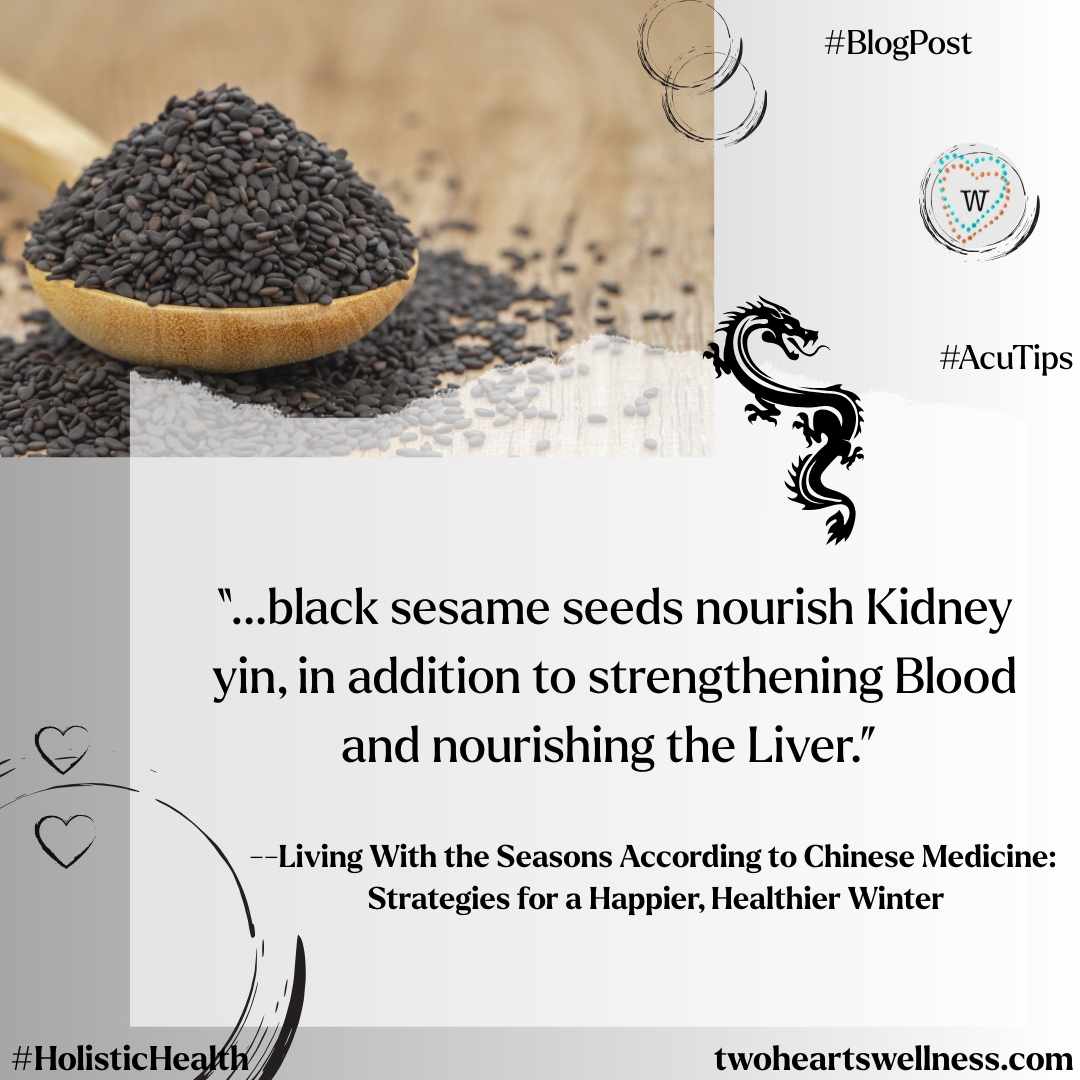
Remember that I mentioned the color black being associated with the Kidney? Well, it stands to reason, then, that black-colored food is linked to Kidney health. Black sesame seeds are noted in Western nutrition for helping to balance hormones by boosting progesterone; for us, in Chinese medicine, we will say that black sesame seeds nourish Kidney yin, in addition to strengthening Blood and nourishing the Liver. Other black foods that your acupuncturist might suggest include black beans, silkie chicken, or mulberries.
Earlier, I mentioned Kidney’s connection to the brain and to intelligence, memory, and concentration. You might already know of lion’s mane mushroom, but did you know that it’s been used for thousands of years in Chinese medicine? Current scientific research is looking at lion’s mane for brain vitality and even, potentially, as a resource for dementia and Alzheimer’s patients.
During the winter season, especially, we want to focus on seasonal food and things that warm and nourish. Bone broth can be a good option, as can stews (either with meat or made of root vegetables) spiced with ginger, garlic, and/or black pepper. We also view walnuts, cashews, and chestnuts as a good and Kidney-friendly choice.
*****
*****
Mood:
The adrenal glands sit atop the kidneys and, when the body experiences stress, these glands respond by releasing adrenaline into the bloodstream. This sets off a fight-or-flight cascade of increased heart rate, higher blood pressure, and quicker breathing. That’s the biomedical story. For us, we will say that shock shatters the qi and then fright and prolonged fear damages the Kidney.
Keep in mind that this doesn’t always need to be an acute situation. Chronic fear can lead to adrenal fatigue (per Western thought) or diminishedjing (our version). Either way, you end up with fatigue, loss of willpower, and/or anxiety. It can also lead to lowered libido. When essence is used unwisely the aging process seems to accelerate. Cultivating our jing, or essence, is key to a healthy path towards maturity and aging.
This is important year-round but that much more so in the winter. During this period, we nurture our bodies with good food and our spirits with rest, calming activities like meditation or qigong, and we certainly want to go for our acupuncture appointments. Our practitioners can offer nutrition education along with the treatment and, if they are also a health coach (I am also a health coach) it is possible to work on lifestyle revision with dedicated support based on Chinese medicine’s principles.
In conclusion:
As I do in all my blog posts, I have to conclude with a question or some questions. So… how do you go with the flow of the seasons? Do you put some energy towards planning and then shifting your lifestyle to accommodate change? More and more, people are becoming aware of weather patterns and the need to live in a way that supports the climate and the environment. What about you, and how you are adjusting and engaging with the world that surrounds you right now?
And are you ready to make some change today?
*****
*****

Dr. Paula Bruno, Ph.D., L.Ac., is a licensed acupuncturist and herbalist, an AOBTA-CP traditional Chinese bodywork therapist, a health coach, and an author. She maintains an active and growing practice at her Austin, TX office. Dr. Bruno is also available for distance appointments for wellness consultation or coaching.
In her first career, she was a Spanish professor.
Dr. Bruno’s specialties as a Chinese medicine practitioner include: • Musculoskeletal health (acute or chronic pain relief; Ehlers Danlos syndrome & hypermobility support) • Digestive support, gut health, and weight loss • Aesthetic treatment, including scar revision • Men’s health • General preventive care and wellness support for all persons.
She is the author of Chinese Medicine and the Management of Hypermobile Ehlers Danlos Syndrome: A Practitioner’s Guide. Dr. Bruno also maintains a second website, holistichealthandheds.com, with resources and information curated specifically for people with hEDS and HSD.
When you are ready to discover what traditional medicine plus a vibrant and engaged approach to holistic health can do for you, either contact Dr. Bruno or book an appointment online.
*****
Two Hearts Wellness does not accept paid advertising on this website
Note: Material on this web site site is not intended to diagnose, prevent, treat, or cure any disease, illness, or ailment. A Chinese medicine practitioner in Texas identifies syndrome patterns but does not diagnose illness. Material on this web site does not purport to identify syndrome patterns.
*****
- If you are interested in this topic, I do have blog posts for every season. “Are You Ready For Fall? (Living With the Seasons According to Chinese Medicine)” has links to the summer and spring essays and is a fine place to start if you wish to read the whole series. ↩︎
- Western science started getting on board with this only about twenty years ago, noting that “Despite their difference in embryonic origin, the ear and kidney share some developmental pathways and, in adults, they share physiological processes required for normal function. These similarities likely explain the association between ear and kidney disease” (“Shared features in ear and kidney development – implications for oto-renal syndromes“). ↩︎
 Two Hearts Wellness