Imagine yourself in a metaphorical garden, months from now. You are harvesting the fruit of the seeds you planted. I’m talking about the equivalent of peppers (three to five months from seed to fruit) and asparagus (you’ve waited two to three years). In other words, you’re looking at things that take a relatively long time from the day you put those seeds down to the moment when everything matures and now you can harvest your crop. And off to the side, you have flowers that involved a shorter-term wait. Marigolds, for instance, need about two months to go from seed to flower. As you look at the outcome of your work, what do you see? Are you happy about your bounty or do you wish–there in the future–that you had done something different today, while you still had the option of choice?
It is not always easy to plan ahead. So much that pulls attention one way and then the other is going on right this minute. Without intending it, we become reactive and distracted. As anyone who reads my blog posts know, I’ve really been on a mission to advocate for presence, the ability to maintain healthy boundaries, and the decision not react to every bump in the road or squirrel in the path. I, myself, am dedicating energy towards planning ahead and being proactive and I think that it’s a message to share and reiterate.
One way to practice is by thinking about your life as though it were a garden. What, then, will you plant? What do you hope for in the future, and which habits do you need to change? You can’t just drop the seeds in the earth and forget them. Cultivating the garden is important too and your habits are the equivalent of watering and mulching and weeding.
*****

*****
Developing a habit takes more than the popular notion of 21 or 90 days. If it’s something fun and you want to be doing it, then developing a habit can be pretty quick. Does it take a lot of effort to become habituated to flopping down on the couch and eating a piece of cake after dinner every night? Probably not. Will it require self-discipline and consistency to break a habit of eating dessert every night in order to lose some weight and reverse a pre-diabetes diagnosis? Yes, and it can be tough, especially if eating that big old piece of chocolate deliciousness is a bandage for emotional wounds that are overwhelming.
You don’t even need the cake part to make checking out of life a problem. It doesn’t take much to become habituated to sitting on the couch every night and zoning out in front of the computer or the tv. In contrast, it does demand intention and effort to drive to the gym and have a meaningful workout and then go home, throw the gym clothes into the wash, have a shower, and maybe do a little bit of extra stretching so that the delayed onset muscle soreness is averted or ameliorated.
So no, I’m not all about the peppy slogans regarding habit change. But I do love the metaphors and the creativity of viewing life as a garden to be cultivated.1 If it’s a garden, where are your flowers (the bright, the beautiful, the encouraging)? What about the vegetables that will nourish you? Is there anything for the animals that meander on by, or are you putting up a fence and protecting your bounty?
Creating change and cultivating the benefits of it is an evergreen topic. It can be tough to do something new and near-impossible to uproot deeply-held patterns. Reviewing the concept through the lens of metaphor and whimsy opens new vistas for change and creativity, don’t you agree?
Some things do not take long to go from seed to fruit. Other things take a bit more time. Still others are a real work of commitment to self and will probably entail falling off the wagon, getting back on, getting sidetracked, and trying yet again. In my estimation, it helps to be aware of some common sticking points and things will go even more smoothly if there is a strategy in place to get around them.
*****

*****
What about those goals?
Set realistic goals: Past performance predicts future success and if you have tried and failed and tried and failed then you might need some extra planning before you try once again. Setting realistic goals is the first step to changing this dynamic. One type of goal is like asparagus (something that takes a long time to bear fruit) and the other is your flowers (these are quicker to bloom). Starting small and picking a few things that will blossom quickly can be part of the program but for the long-term, it helps to strategize according to your specific history, and this means including both successes and failures.
Flower: Commit to eating three different colors of vegetables each day. One serving of zucchini, a tomato, and some yellow bell pepper makes three. Broccoli rabe, butternut squash, and daikon radish makes three. Collard greens, red bell pepper, and purple potato makes three. All you need is some good olive oil, a little sea salt, some garlic, and–if you want spice–some dried red pepper flakes and any one of the aforementioned groups is going to be lovely. Is this something you could start right now and then later, future you can see how good you feel after eight weeks of healthier eating?
Asparagus: Losing some pounds and reversing a pre-diabetes diagnosis is a project that will take time. Start working with a health coach or a trainer now and see what happens over the course of six months or even a year or two. Yes, it’s an investment but–especially if you approach the endeavor with good faith and determination–it’s an investment that will pay off big-time later. Your future self will thank you for this decision.
Start somewhere
Specific: Broad and general ideas can be harder to implement. Narrowing things down and chipping away at an issue can lead to big-picture change though. What if you want to shift your world-view just a bit so that you can practice compassion to self and other in a non-attached way? Maybe you want to learn better self-care skills and heal old emotional scars. There are lots of ways to interpret a big goal like cultivating inner healing and compassion, so if you choose that, then definitely start with a few specific options to get you rolling in the right direction.
Flower: Commit to one act of self-kindness or care every day. This could be as easy as ending the day, each and every day, by identifying three things that you did right today. It could be a little more involved, like deciding that once a week you will turn this kindness and care outward, so you go volunteer or otherwise support your community. Maybe you want to create a mantra and repeat it to yourself whenever you feel anxious. Little things add up, and a month or two into it, you may realize that you’re a little kinder to yourself, a little more tuned in to others, and possibly, you are even seeing the first bloom of inner peace to go along with a newfound ability to move forward in a healthy way.
Asparagus: Working with a psychotherapist to heal old scars and develop inner peace. This requires patience, dedication, and commitment over time. It can definitely be worth it, but yes, the immediate gratification factor probably isn’t going to be there. So? You will be glad later if you start today.
*****

*****
Perfectionism vs. getting it done
Try for something other than perfection: What are you already good at, or good about doing? What brings you joy now, without any habit change or seed-planting? It might be possible to start from your strengths and build upon them, and when this is an option, healthy change can be that much easier. Where are your weaknesses? Can you approach working on your weaknesses as healing lessons? There’s “I’m so bad at [fill in the blank]” and being immobilized by self-doubt and there’s “I’m so bad at [fill in the blank]” and deciding that you can learn about your own process by simply trying, by experimenting, and by cutting yourself some slack as you go about acquiring a new skill. All or nothing leads to quitting, so it seems to me that the second option is the better choice. What do you think?
Asparagus and flowers: This is more of a health coach thing than an acupuncturist’s service, but what I do with my clients is support their wellness journey by finding just the right mixture of things that they’re already good at and spicing it up with some appropriate-level challenges and mindful support. Each step builds on the last and the parts you are already good at give way to new knowledge that can stand on its own. In academia, when I was a professor, this was called scaffolded learning. Now, as a health coach and practitioner of Chinese medicine I call this taking one step at a time and creating personalized strategies that work. For some situations, it’s a long-term endeavor and for others, it’s a short-term project.
In conclusion (for now)
Each one of us has our own personality, our life experiences, and our goals. Collectively, we’re all kind of going through it though, aren’t we? Between the reverberations of the COVID pandemic (that is certainly not over for a good swath of the population) plus world events, from the cultural to the climatological, stuff is happening. We all need to be aware of the bigger picture at the same time that we remain dedicated to cultivating our own gardens.
With creativity and patience and the wisdom to plant now for a thriving and vibrant tomorrow, healthy change can be easier than you think. Why not start now…and where do you want to begin?
*****
*****

Dr. Paula Bruno, Ph.D., L.Ac., is a licensed acupuncturist and herbalist, an AOBTA-CP traditional Chinese bodywork therapist, a health coach, and an author. She maintains an active and growing practice at her Austin, TX office. Dr. Bruno is also available for distance appointments for wellness consultation or coaching.
In her first career, she was a Spanish professor.
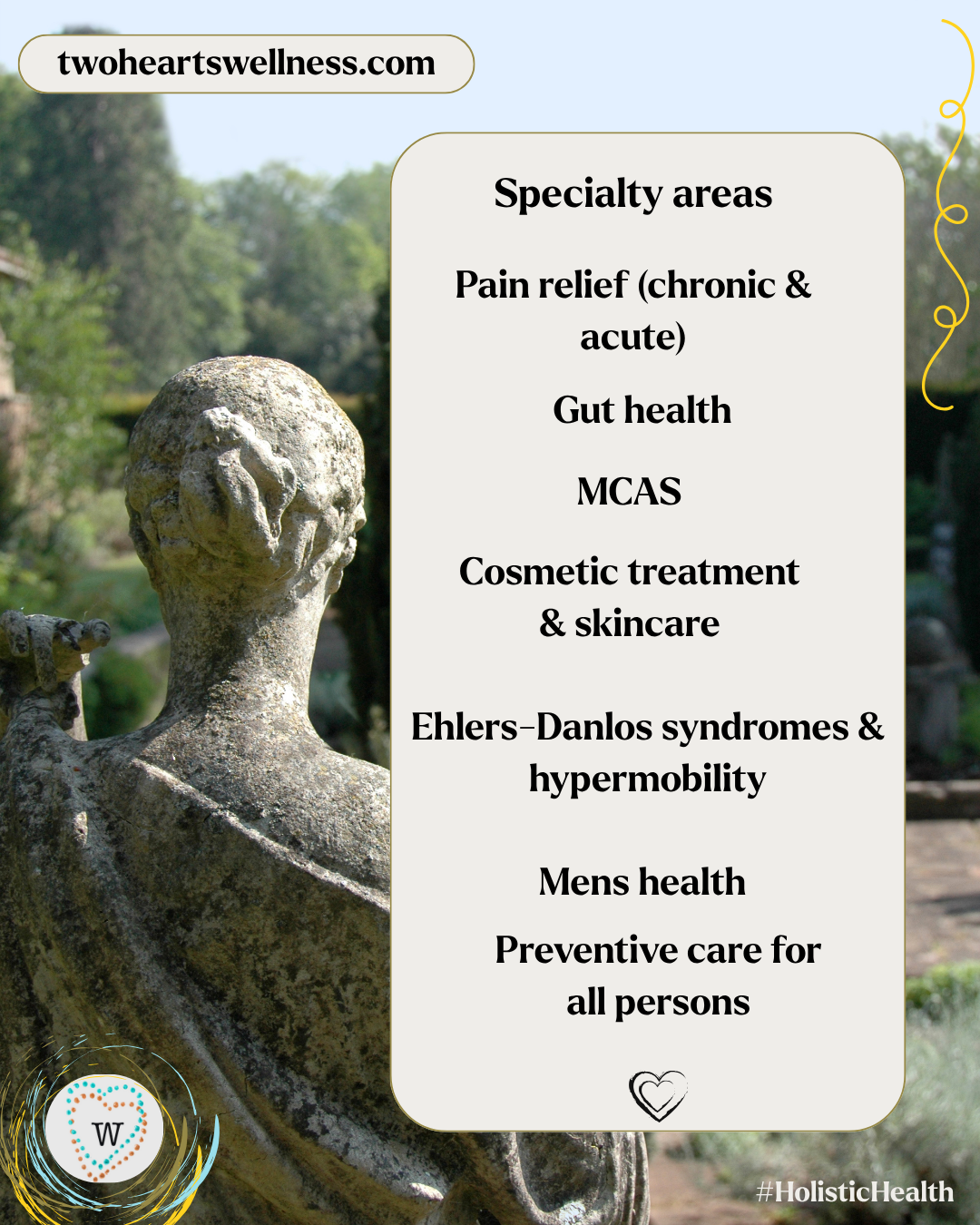
Dr. Bruno’s specialties as a Chinese medicine practitioner include: • Musculoskeletal health (acute or chronic pain relief; Ehlers Danlos syndrome & hypermobility support) • Digestive support, gut health, and weight loss • Aesthetic treatment, including scar revision • Men’s health • General preventive care and wellness support for all persons.
She is the author of Chinese Medicine and the Management of Hypermobile Ehlers Danlos Syndrome: A Practitioner’s Guide. Dr. Bruno also maintains a second website, holistichealthandheds.com, with resources and information curated specifically for people with hEDS and HSD.
When you are ready to discover what traditional medicine plus a vibrant and engaged approach to holistic health can do for you, either contact Dr. Bruno or book an appointment online.
*****
Two Hearts Wellness does not accept paid advertising on this website
Note: Material on this web site site is not intended to diagnose, prevent, treat, or cure any disease, illness, or ailment. A Chinese medicine practitioner in Texas identifies syndrome patterns but does not diagnose illness. Material on this web site does not purport to identify syndrome patterns.
*****


*****
- I’m not necessarily being inventive here. Cicero’s Cato Maior de Senectute (“Cato the Elder on Old Age,” 44 BC) references his noted love of gardening in part to create the metaphor of a cultivated life. Probably more well-known is Voltaire’s Candide (1759) that centers around the idea. Gardens are fertile spaces for not just produce and flowers but also metaphor, what else can I say? ↩︎
 Two Hearts Wellness