What do you think about your own hands? Are they functional, pain-free, and altogether unremarkable? Or do they cause you pain and worry? If you have thought about your hands, maybe you have paid attention to how well they implement your objectives and are capable of fine, delicate movement. Maybe you only notice them when they do not do what you want in an easy and flowing way.
As a health coach and practitioner of Chinese medicine, I see hands in a very special way. There is a difference between the needs of a healthy string instrument player and someone with a broken finger. A person with arthritis does not experience their hands the way someone with a scar across their palm does. And so forth. Hands are magical, I think, and each pair has a story.
Hands are so beautiful, each and every one, and everyone has a unique fingerprint. If you’ve ever wanted to think creatively about your own hands or you are looking to discover what Chinese medicine can do for you from wrist to fingertip, then keep reading. This blog post is for you!
*****
Hands like a history book:
If your hands could talk, what stories would they tell? Hands do have a language, you know. It may be scars or calluses or smooth, perfect skin over fine and dainty bones. It could be knuckles like elephant knees. Everyone’s hands are reflective of their life’s journey.
Do you move your hands when you are speaking? I’m of Mediterranean heritage and I sometimes gesture even just in response to thinking. What about you? Notice, throughout the day, what your hands do if you feel angry or sad, or when you are happy or reaching towards something that you want to hold or touch.
There is a lifetime of history in your hands and each day you will add to it. If you’ve never considered your hands, or maybe you have a health concern that involves them, then this essay will give you some food for thought.
*****
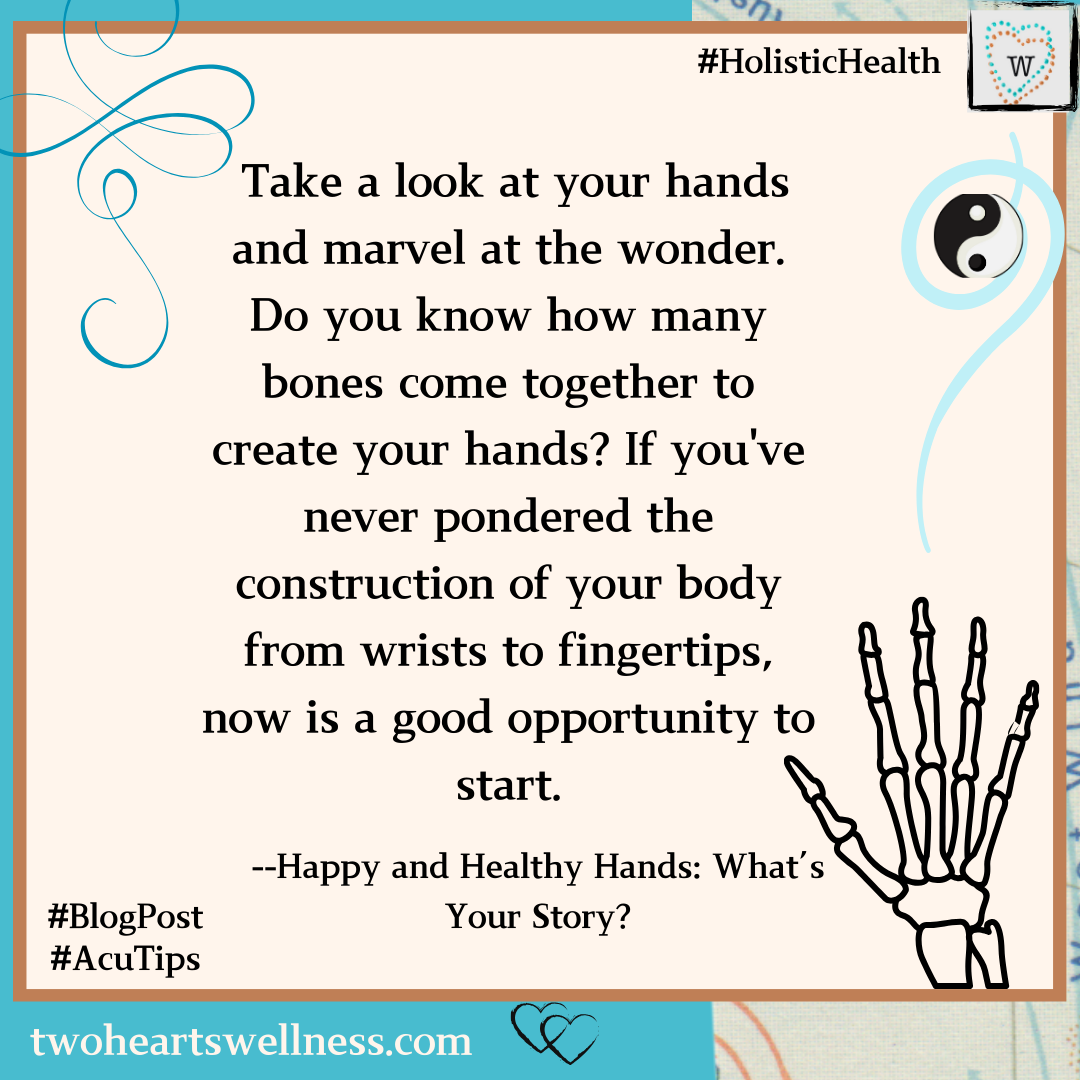
Structure of the hand:
Take a look at your hands and marvel at the wonder. If you’ve never pondered the construction of your body from wrists to fingertips, now is a good opportunity to start.
Do you know how many bones come together to create your hands? Each hand is made up of 27 bones: 8 carpal bones (in the base of the hand at the wrist), 5 metacarpal bones (in the middle part of the hand) and 14 phalanges (finger bones). The hand can be divided up into three different areas based on the joints (wrist, hand, and fingers). The human body has 206 bones, and between your feet (26 bones per) and your hands, that’s over half your skeleton.
Your hands are innervated by three important conductors: the median, ulnar, and radial nerves. All three of these nerves function in both a sensory and a motor capacity, delivering environmental information from your hands to your brain (sensory aspect) and directions for movement (motor function).
Your hands may seem small compared to the rest of you but they certainly play a big role in your life and your wellbeing.
*****
Metaphors related to hands:
On a cultural level our hands have captured our hearts in many ways. Think about how many metaphors included mention of these treasures. On the one hand (you see what I’ve done here), there are the basic ones we all know. If you want to get something done, you take matters into your own hands. A good friend? You know them like the back of your hand. Familiarity with a topic? You experience it first-hand.
On the other hand …what about being guilty of something dreadful? That’s when a person has blood on their hands. In English, we say that we wash our hands of something when we’re unwilling to continue engaging with it. I like the Spanish version much better: lavarse las manos como Poncio Pilato means to wash your hands like Pontius Pilate. At least the way I learned it when I lived in Madrid, you also want to raise your hands to about chest height and show your palms when you say it.
Do any hand metaphors resonate particularly strongly for you?
*****
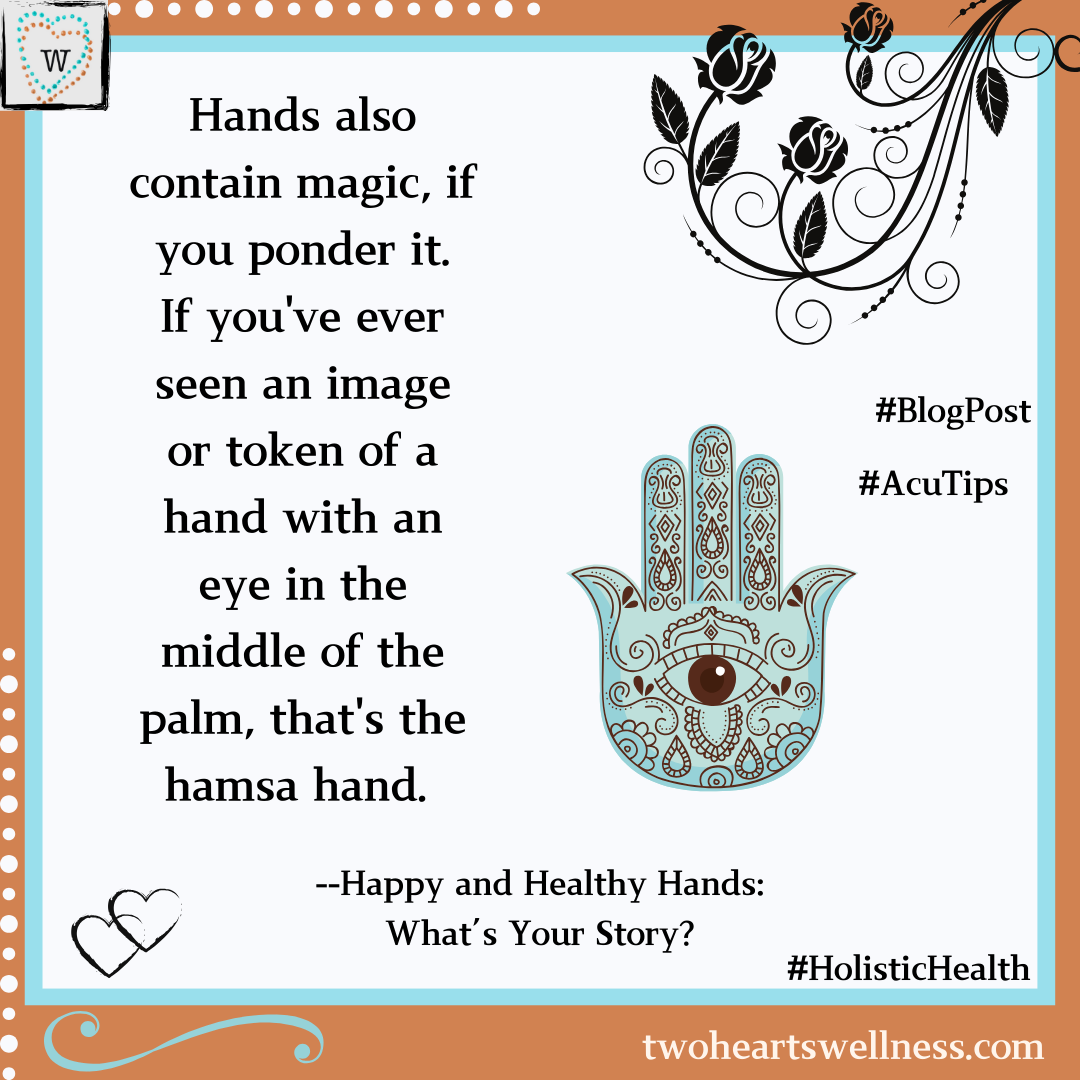
Hamsa hand:
Hands also contain magic, if you ponder it. My own hands are extremely sensitive, leaving me well aware of their power. When I palpate the relevant areas of a patient, my fingers read and listen. It’s not just feeling. I can close my eyes and my fingers see on my behalf, and they hear. And maybe I’m a little more aware of the marvel of hands because I work on them so much in my practice, but popular culture from the roots of human history acknowledges the magic of this body part. What do you think about the notion of magic in your hands?
And what about the power of the hand over the course of history? If you’ve ever seen an image or token of a hand with an eye in the middle of the palm, that’s the hamsa hand and it serves a protective function. Its most ancient origins are rooted Mesopotamia, and then in Islamic and Jewish cultures. Today, this symbol flows through just about every religion. If you are from a culture that believes in the evil eye then you know about the hamsa hand and what this means.1
So, take a look at your hands one more time. Your hands are a treasure, aren’t they? They’re story-tellers and seers, gatherers and warning systems, and vessels for joy.
What, then, if your hands are injured or ill?
*****
Injuries/issues:
Hand problems are no kind of fun. You really can’t ignore it if your fingers can’t grip or you are in pain for one reason or another.
Some of the more common issues I see in my office include:
- arthritis;
- wrist pain;
- carpal tunnel syndrome;
- trigger finger;
- overuse injuries (texting thumb, anyone?); and
- dysfunction related to Ehlers Danlos syndrome, a connective tissue disorder, and HSD (hypermobility spectrum disorder, which is similar to the hypermobile version of the aforementioned EDS).
My practice has a few niche specialties, including acute injury treatment, so I also treat people with sprains, strains, and/or broken bones. I also treat kitchen accidents. I love treating scars, too. One of my favorite patient populations includes my professional musicians. Working on the fingers of violists and other performing artists who use their hands to create their artistry is absolutely magical.
*****
What Chinese medicine can do for your hands:
Not all practitioners are specialists in hand health (I am, obviously!) but if you look at the practitioner’s website, usually there will be indications regarding which conditions they treat. Someone who works with chronic pain is generally a good bet, and if they mention things like treating musicians, for instance, then you definitely know they’re a hand person.
Did you know that Chinese medicine can work wonders for your hands?
Options include acupuncture, of course, but you might also want to try tui na (Chinese manual therapy, akin to massage), gua sha (a scraping technique that many know from TikTok and YouTube clips about cosmetic treatments) or cupping (same). We can also apply topical herbs and write you a prescription for herbal formulas. In some instances, breath and movement via qigong or tai chi might be helpful for you. Acupuncture is marvelous but if you’re not keen on the idea, we do have options for you.
Your magic is in your hands, dear reader…so what are you going to do for them?
*****
*****

Dr. Paula Bruno, Ph.D., L.Ac., is a licensed acupuncturist and herbalist, an AOBTA-CP traditional Chinese bodywork therapist, a health coach, and an author. She maintains an active and growing practice at her Austin, TX office. Dr. Bruno is also available for distance appointments for wellness consultation or coaching.
In her first career, she was a Spanish professor.
Dr. Bruno’s specialties as a Chinese medicine practitioner include: • Musculoskeletal health (acute or chronic pain relief; Ehlers Danlos syndrome & hypermobility support) • Digestive support, gut health, and weight loss • Aesthetic treatment, including scar revision • Men’s health • General preventative care and wellness support for all persons.
She is the author of Chinese Medicine and the Management of Hypermobile Ehlers Danlos Syndrome: A Practitioner’s Guide. Dr. Bruno also maintains a second website, holistichealthandheds.com, with resources and information curated specifically for people with hEDS and HSD.
When you are ready to discover what traditional medicine plus a vibrant and engaged approach to holistic health can do for you, either contact Dr. Bruno or book an appointment online.
*****

*****
Two Hearts Wellness does not accept paid advertising on this website
Note: Material on this web site site is not intended to diagnose, prevent, treat, or cure any disease, illness, or ailment. A Chinese medicine practitioner in Texas identifies syndrome patterns but does not diagnose illness. Material on this web site does not purport to identify syndrome patterns.
*****
- For more information, take a look at “”The Hamsa Appears in Multiple Cultures, but Why?” and “The strange power of the ‘evil eye.’” ↩︎
 Two Hearts Wellness