Generation X health and wellbeing is a topic, isn’t it? Gen Y and millennial too, but we get overlooked so much that I’m going to stick with my own folks here and focus on those of us born during that fabulous fifteen-year period from 1965 to 1980. The question of the day here relates to what Chinese medicine can do for those of us in our still vibrant yet vintage life stages. Why should you, if you’re Team Gen X, consider making it a part of your long-term wellness strategy?
A detour down memory lane is in order here (of course).
Back in the day, the student recreation program at Indiana University Bloomington was the place to get a part-time job if you were a kinesiology major or in any way planning to have a fitness-related career. In order to get hired as weight room attendant, you had to enroll in a semester-long course during your first term as an employee. As part of the requirement, you would also need to sit for a personal trainer exam and become certified if you weren’t already. Being a weight room attendant was an extremely cool job, so when they said “jump,” the answer was “how high?”
At the time, I was in my initial graduate program (this was for the first two MA degrees and the PhD for career number one as a Spanish professor) and all I did was study and go to the gym. Eventually, I managed to get myself hired as a weight room attendant. I completed the semester course as an auditor but they made an exception for me on the PT certification since I had master’s exams to study for, plus teaching, plus the grind of my own coursework.1 Still, I took that class as seriously as I took my literature courses. I loved working in the IUB weight room!
I remember the first day of class even now (and it’s been a while, just saying). One of the icebreakers was to think of a personal wellness mantra and share it with your peers. I was in my later twenties at the time and everyone else was nineteen or twenty so I counted as old back then (…yeah, whatever). Anyway, I thought about it and–when my turn to speak arrived–I smiled wickedly and said, “Good genes and a bad attitude will take you far.” This cemented my reputation as a bit of rebel (I was a lot of a rebel, actually, but that’s another story…) and it got us all talking about nature versus nurture for a brief and glorious few minutes.
So what, you might be wondering, does this have to do with the subject of Gen X health and Chinese medicine?
Short answer: everything.
Longer answer…well, keep reading.
If you were born after 1965 and before the 90’s then you need to start thinking about what’s going to carry you for the next thirty to fifty or so years. Is it going to be your genes, mostly?2 Or your attitude? If you are now in your mid-forties to rounding up on sixty, the time to consider this and to do something about it is now. What do you want the rest of your life to be like? And what are you going to do to make it so? And while I’m at it…have you read the recent Guardian article about adults aging in bursts at the ages of 44 and 60? If you are around these milestone ages, it’s time to get real. You are at a crossroads and the path you choose will be a factor in how good things are for you twenty, thirty, and more years from now.
You might already be wondering what you can do about your changing body and shifting health considerations. You may have long since been questioning whether it is even possible for you to stave off the ravages of time.
You know what I’m going to say, right? Yes. Chinese medicine can help you. Yes, it can. And you are probably wondering, “But with what?” The short answer is: all the things.
The better answer is … I’ll focus on four specific areas for the purposes of brevity. These are:
- Scars;
- Gut health and metabolism;
- Sex; and
- Cosmetic treatments.
All things that matter to all people, but when you’re hitting your ripened and mature years, they matter that much more, and in different ways.
*****

Scars:
As we enter our vintage decades, our scars become like ghosts that cry out for attention. When we’re young, we can power through injuries at the gym and we can also keep busy and pretend that certain emotional wounds don’t exist. It’s not so easy as we get older. Being stuck by deep-set emotional scars and repeating the same old patterns brings to life the chestnut about errors being repeated until they are learned.3 At some point, it’s time to tread a different path…but how? And on the tangible level…a body that is becoming more sedentary and/or affected by anything from new injuries to chronic illness to normal aging is a body that experiences physical scar pain in a way that’s much tougher to shake off and ignore.
People who are aware of Chinese medicine tend to know that it is, indeed, mind-body medicine, and that yes, we do consider your spiritual and emotional factors when we assess your overall wellbeing. But did you know that your physical scars can also be addressed by your practitioner? Some of us specialize (I am a scar GODDESS) and others aren’t quite that enchanted by soft tissue problems. You want to check the practitioner’s website before going in for scar work…but if they do specialize, this is a boon for you.
An acupuncturist isn’t a psychotherapist but we can soothe a hyper-alert nervous system, we can help you to sleep better, and we can lower the volume on anxiety (among other things). And truly, if you have the remains of old physical injuries…do yourself a favor and see if you can find someone near you who is great with scars. Better range of motion, less pain, and maybe even (if it’s important to you) a cosmetic benefit? Yes, please!
Truly, I love scar work. If you are interested in seeing what Chinese medicine can do for your physical scars, refer to “Every Scar Tells a Story (Physical Scars and What to Consider About Yours).” For an essay on the psycho-spiritual side of things, take a look at “Emotional Scars Tell a Story (But You Can Change the Narrative).”

Gut health:
If you work with a practitioner who focuses on gut health (I sure do) then you are making an investment in yourself that you will appreciate for decades to come. Your microbiome, or the bacterial universe in your gut, regulates pretty much the rest of your body. Biomedical science has jumped on a bandwagon that Chinese medicine has known about for centuries and it doesn’t matter whose narrative, Eastern or Western, resonates with you. What matters is this: when your gut health is robust, so are you. When your digestion hums along the way it should, you will too.
And what your poop looks like says volumes about your overall wellbeing.
*****
Rates of autoimmune disease and allergies are rising and so is incidence of allergy and other hypersensitivity. A healthy gut microbiome can change the dynamic when you struggle with these conditions. If you’re one of the many adults who are living with diabetes, you can do something about that by doing something about your gut health.4
*****
Gut health is whole-self health, so if you want to do something truly meaningful for yourself, try focusing on your gut bacteria. As a practitioner of Chinese medicine, I help patients via acupuncture, herbal formulas, and lifestyle guidance. As a certified health coach, I do a lot of the same but swap out herbal formulas for commonly-used cooking herbs and the focus is more on lifestyle support and nutrition education. Either way, the goal is a healthy gut and robust digestion.
For valuable information on what Chinese medicine can do for your gut health, take a look at “Gut & Digestive Health: Three Reasons Why It Matters & How Chinese Medicine Can Improve Yours.”
Sex:
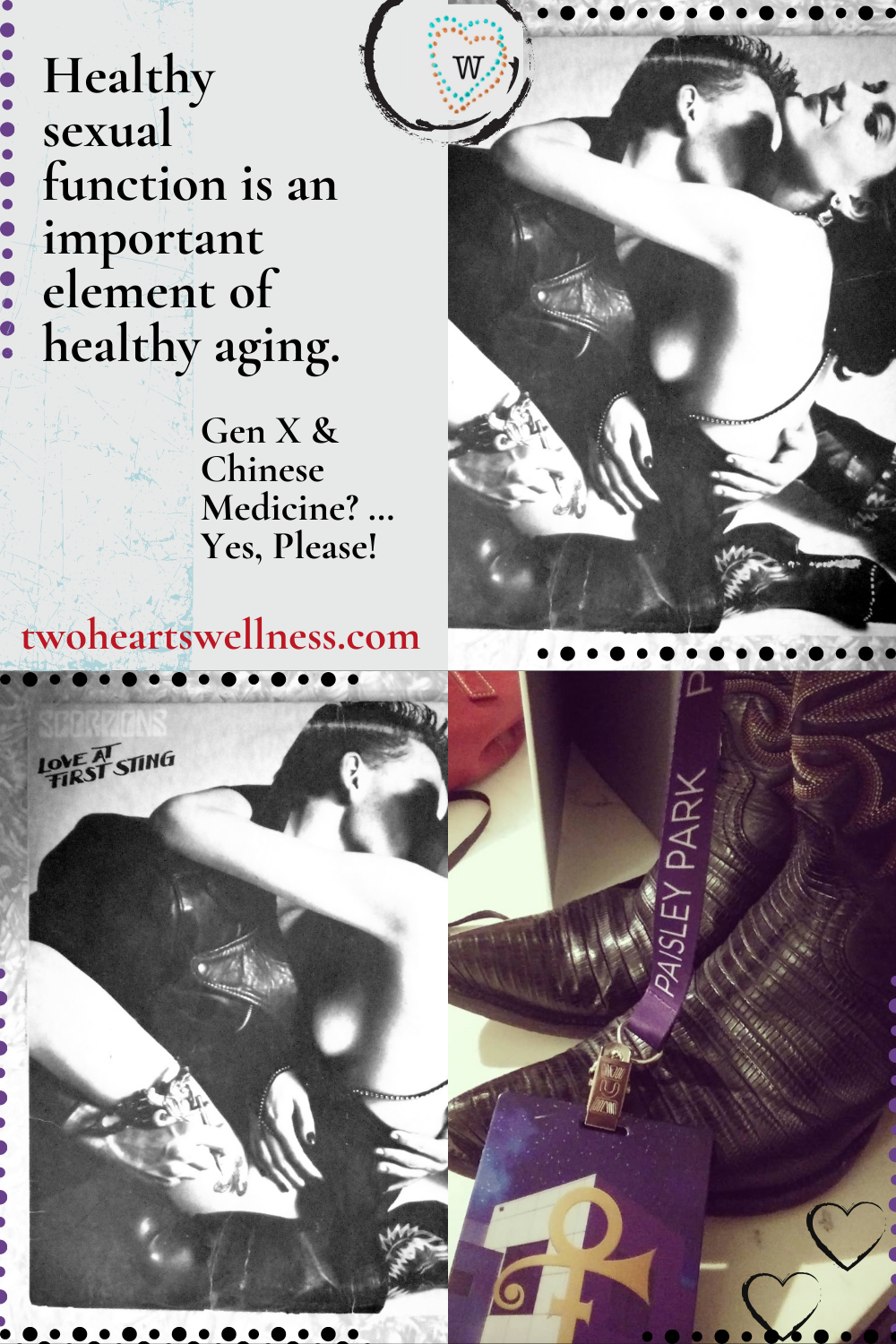
Healthy sexual function is an important element of healthy aging. This means different things to different people. Amount, type, monogamous, other…all of this is individual and not all of it are issues you would discuss in detail with your acupuncturist. What you can focus on, though, are things like erectile dysfunction, ways to maintain or boost libido, and/or strategies for transitioning gracefully into a healthy menopause.
Again, it helps to find an expert. In my practice, I have substantive experience in the realm of men’s health. Between my background in fitness/wellness, my career as a Spanish professor, and due to random life events (experiences in student clinic, volunteering at the Hill Country Ride for HIV/AIDS, etc.), things just sort of developed into a wonderful area specialty that means a lot to me. And though most of us can treat erectile dysfunction and low libido, it’s still good to get a specialist in men’s health if and when possible.
Myself, I do not specialize in women’s health per se. In other words: my practice is fairly well balanced between male patients and female patients. If and when a patient suffers from cramps or hot flashes during perimenopause or wants to become pregnant (in other words: common themes over the course of a woman’s life), I can work with that. But if a new patient specifically sets an appointment for, say, pregnancy preparation, I’d probably refer them to a specialist (unless this was a woman with Ehlers Danlos syndrome, in which case I’d start from the EDS and work on the fertility aspect in relation to the connective tissue disorder).
Do take a look at the linked blog post in the note attached to this section; in it, I have words to say about how we are taught about menopause and what I (remember: “good genes and bad attitude”) thought about it during my gynecology course in the second graduate program.5
There are a number of essays on men’s health on my blog. I shared how being a Spanish professor informs my practice today in “Men’s Health & Why It’s On My Radar (Thoughts From a Holistic Practitioner).” Another one from early on, “Men’s Health: What Student Clinic Taught Me About Erectile Dysfunction (And What Chinese Medicine Can Do About It),” delivers what its title promises. More recent articles include “Men’s Health: Self-Care Or Self-Sabotage? (Your Choice, Gentlemen),” “Gay Men’s Health & Why It’s On My Radar (Thoughts From a Holistic Practitioner, Part I),” and “Gay Men’s Health & What Should Be On Your Radar (Thoughts From a Holistic Practitioner, Part II).” Men (gay, straight, or anything in between) have an incredible resource in Chinese medicine, so do take a look!
Cosmetic treatment:
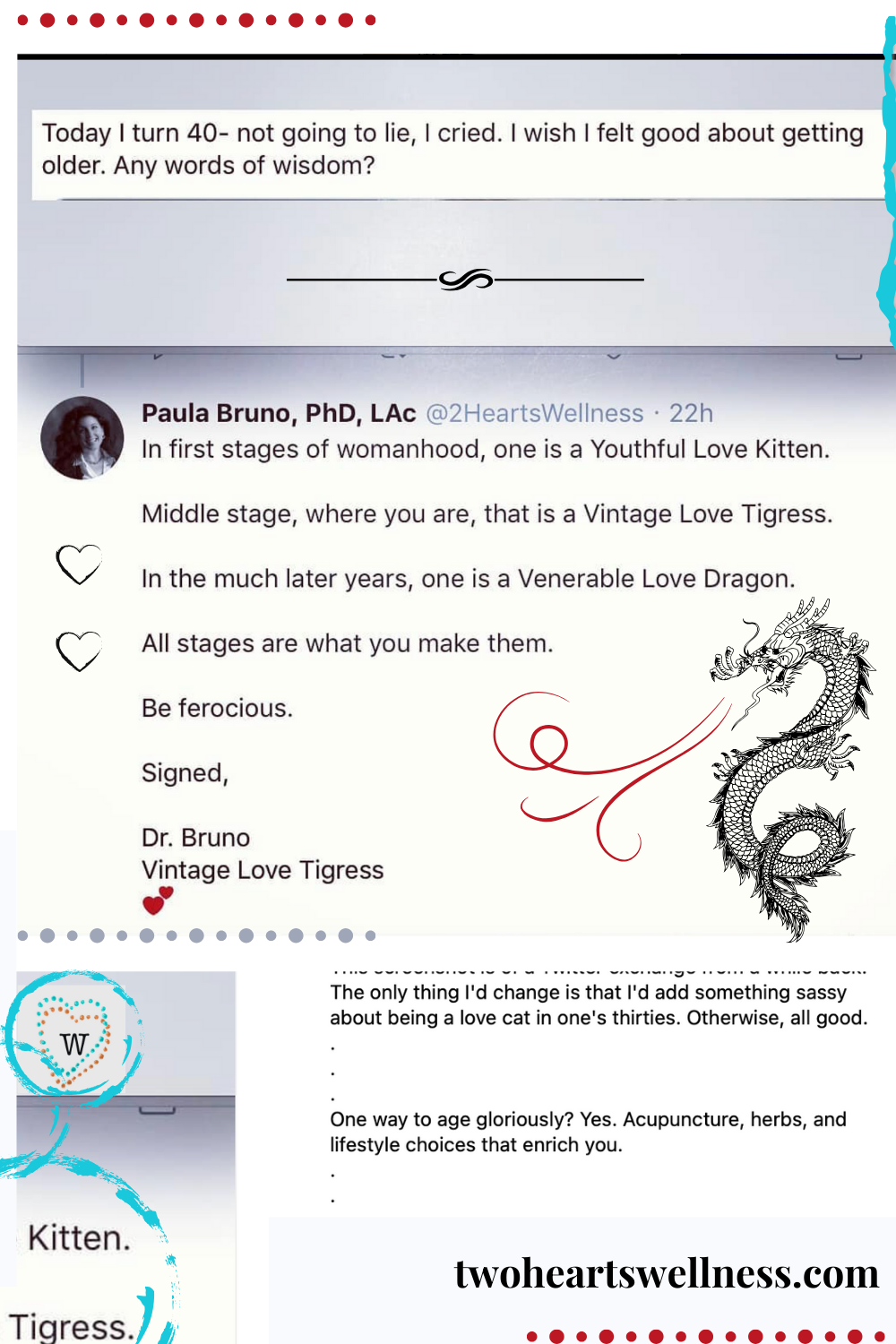
Here is where the bad attitude part has an opportunity to shine. Big time. As a Gen X person, you are now in your vintage love tiger decade(s). This is a prime moment to really feel your oats and create your own version of beauty and charisma…if you so choose. Bottom line? You do not need to subscribe to the idea that only young people are attractive, worthy, energetic, and/or intensely and marvelously ferocious.
As a dyed-in-the-wool smartass, I viewed one’s attraction potential as a matter of stages. When one is young, we’re youthful love kittens. Next, feisty love cats. After the age of forty and before seventy, one is a vintage love tiger. And anything after seventy? Venerable love dragon. (Scroll all the way down to the end of this essay for a snapshot of an exchange on Twitter–not X, not sorry–on this topic).
I cannot remember when I made these designations up, but it was sometime during the very late feisty stage and just preceding the vintage (where I am now) period. And I’m already planning for the next step. I think that when I am a venerable love dragon, I will start getting tattoos. I already have it planned that I am going to dye my hair an icy silver white at some point and I will most certainly keep it long and in its naturally curly state. When I’m old, I’ll be formidable. That doesn’t mean I’ll never get a facelift one day. I’m not planning one…but I’m not ruling it out, either. But whatever I do, it will be cool. It will make me happy with myself at that stage of life. I plan to be venerable, ferocious, and wise.
What about you?
Either way, cosmetic acupuncture is your friend. Myself, I have tried Botox but that was only because I had a friend who owns a med-spa and I got a deal. After the effects of my second round wore off, that was it for me and Botox. I’m not philosophically opposed to Botox, mind you. It’s ok, but my feeling on the matter was: what about muscle atrophy? And…after years of having a frozen face, what about bone loss? What about disruption of neuromuscular connections? I also think it does odd things to one’s capacity for emotion. Botox is nice (I guess) but definitely not smart for the long term. Cosmetic acupuncture leaves you looking like you, just refreshed and healthier-looking, and you can still move your face as part of the deal. Much better!

There are any number of ways to beautify your face via Chinese medicine. It’s a great place to start, and it’s a smart way to stave off ever feeling the need for a facelift or Botox. More recent essays include: “Microneedling and More: Holistic Treatments That You Will LOVE,” and “LED Light Therapy: What It Is, Why You’ll Love It.” If you are adamantly opposed to needles on your face, the solutions are here: “Facelift With no Downtime? (With Needles or Without, Traditional Chinese Medicine Can Make it Happen).” An essay that includes a link to research studies on how Botox interrupts facial expression and affects mood is here: “Aesthetic Treatment for Beauty and Calm, or How to Achieve a Serene Face and a Peaceful Heart.” If you don’t experience the marvel of Chinese medicine for cosmetic purposes you are missing out on one of life’s joys, trust me.
In conclusion (for now):
In some ways, I think that the Guardian article is just a little too perfect. Forty-four and sixty? That’s the beginning of the Gen X cohort and the end of it. It feels like a clever way to scoop us all up and make us all worried. And whether or not it’s entirely accurate or if it is, instead, just timely, the article still does present us with food for thought.
We in Gen X are at a crossroads. There is time to take a serious look at our wellbeing and to do something about it. But which way do you go? The way of poor gut health, worse metabolism, diminished libido, and a sense of feeling unattractive like stale cake left out on the counter? Or, instead, by figuring out which genetic inheritance is on your side and supporting your health on an individual level…plus having the attitude that yes, you are–according to your definition–sexy and strong?
I say go with option two. Chinese medicine is a resource, then. It gives you options, and it gives you a measure of control over your health.
Which will it be, and are you ready to try it?
******
*****
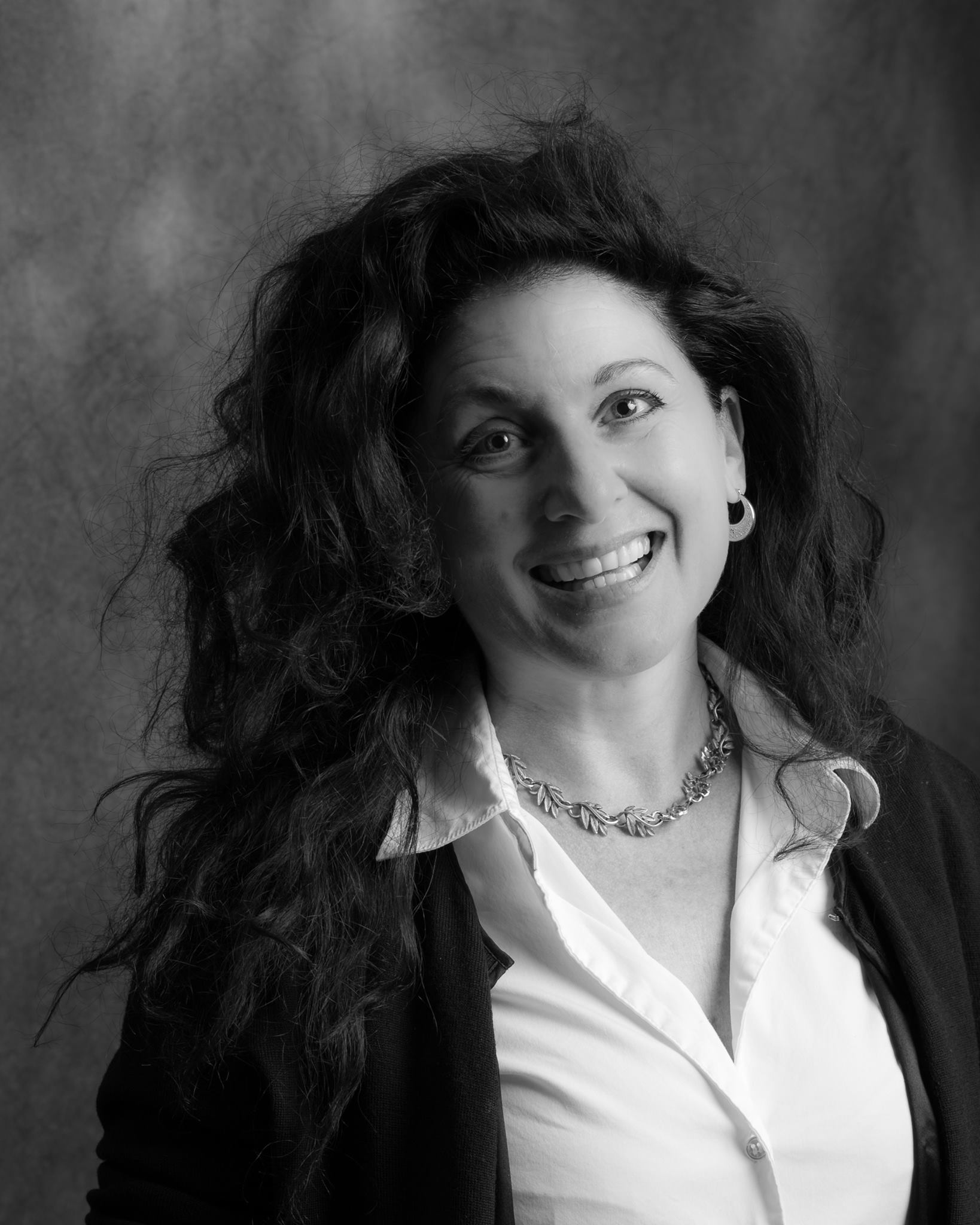
Dr. Paula Bruno, Ph.D., L.Ac., is a licensed acupuncturist and herbalist, an AOBTA-CP traditional Chinese bodywork therapist, a health coach, and an author. She maintains an active and growing practice at her Austin, TX office. Dr. Bruno is also available for distance appointments for wellness consultation or coaching.
In her first career, she was a Spanish professor.
Dr. Bruno’s specialties as a Chinese medicine practitioner include: • Musculoskeletal health (acute or chronic pain relief; Ehlers Danlos syndrome & hypermobility support) • Digestive support, gut health, and weight loss • Aesthetic treatment, including scar revision • Men’s health • General preventative care and wellness support for all persons.
She is the author of Chinese Medicine and the Management of Hypermobile Ehlers Danlos Syndrome: A Practitioner’s Guide. Dr. Bruno also maintains a second website, holistichealthandheds.com, with resources and information curated specifically for people with hEDS and HSD.
When you are ready to discover what traditional medicine plus a vibrant and engaged approach to holistic health can do for you, either contact Dr. Bruno or book an appointment online.
*****
The following is a Twitter (not X, sorry-not-sorry) exchange & a picture from an Elvis Costello concert:

*****
Two Hearts Wellness does not accept paid advertising on this website
Note: Material on this web site site is not intended to diagnose, prevent, treat, or cure any disease, illness, or ailment. A Chinese medicine practitioner in Texas identifies syndrome patterns but does not diagnose illness. Material on this web site does not purport to identify syndrome patterns.
*****
- Though I no longer offer personal training as one of my services I did get certified while in my second graduate program (for MA number three and the license to practice Chinese medicine) and I still provide fitness programming for health coaching clients and, sometimes, for patients. ↩︎
- As it turned out, my genes are a mixed bag. I do have excellent genes for longevity but when it comes to things like my history of extreme adverse events (we’re talking near-death) in response to basic Pharma drugs or the hypermobility issue, my genes are not necessarily an exemplar of flawless perfection. And a substantive percentage of my patient population got dealt a challenging hand as far as the genetics go (refer to my book, Chinese Medicine and the Management of Hypermobile Ehlers-Danlos Syndrome, for more on that) so let me just say for the record that yes, I know that the genetic part is a crapshoot. Even so, the bad attitude is still taking me far and I encourage all my patients to cultivate one of their own. ↩︎
- The famous Pema Chödrön quote, “nothing ever goes away until it teaches us what we need to know” is a somewhat pale expression of the larger commentary that the famous Buddhist nun intended. A good commentary on this issue is “The Problem with the Pema Chodron Quote: ‘Nothing ever goes away….’” ↩︎
- Useful, albeit alarming, is the March 2024 article, “A MAJOR HEALTH CRISIS: THE ALARMING RISE OF AUTOIMMUNE DISEASE.” See also “Facts and Statistics: Key information to help better understand food allergies and anaphylaxis.” The connection between gut bacteria and autoimmune disease has been a subject of investigation for some time now, as the 2018 article, “Gut microbe drives autoimmunity” attests. On the subject of diabetes and gut bacteria, refer to Harvard Medical School’s “Changes to Gut Microbiome May Increase Type 2 Diabetes Risk.” When you strengthen your gut bacteria you are bolstering your health for the long haul. ↩︎
- “Sexual Health, Vitality, and Life Stages” is an annotated bibliography of interesting books on the topic at hand. The section on women’s health, titled “Whores, Mothers, Vectors of Disease, and Crones: There is More to Being a Woman Than Diseased Wombs and Atrophied Vaginas” is a direct response to my reaction to the studied focus on women’s aging that was inflicted on the students in my program. Yes, I have a bad attitude…what else can I say? ↩︎
 Two Hearts Wellness